 Français
 English
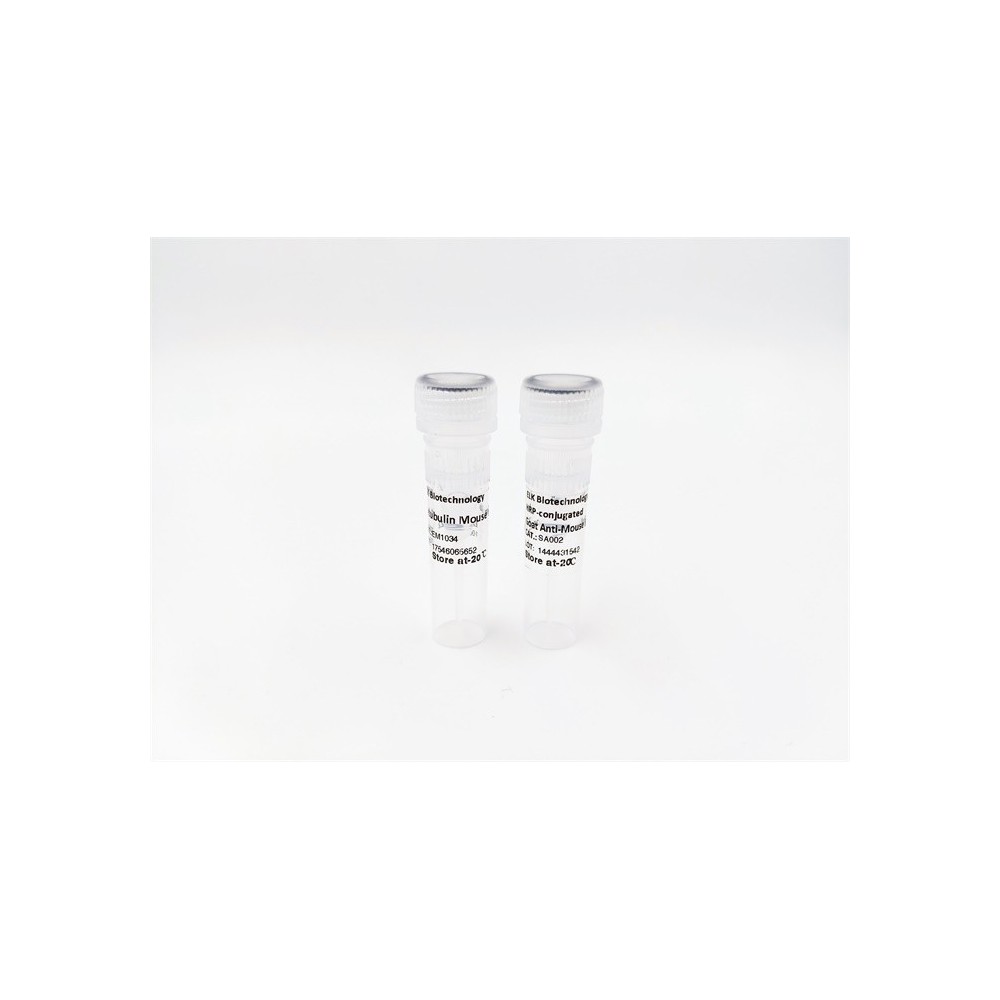

| ELK.No | ES2383 |
| Product name | G2A rabbit pAb |
| Reactivity | Human;Mouse;Monkey |
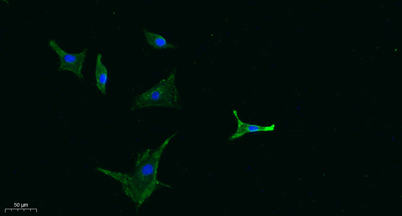
| Applications | WB;IF;ELISA |
| Other name | GPR132; G2A; Probable G-protein coupled receptor 132; G2 accumulation protein |
| Size | 50μL |
| Unit price ($) | 148 |
| Human gene ID | 29933 |
| Human Swiss-Prot | Q9UNW8 |
| Source | Rabbit |
| Isotype | IgG |
| Target | G2A |
| Fields | |
| Gene name | GPR132 |
| Protein name | Probable G-protein coupled receptor 132 |
| Human gene link | View Human Gene |
| Human Swiss link | View Human Swiss-Prot |
| Mouse gene ID | 56696 |
| Mouse gene link | View Mouse Gene |
| Mouse Swiss-Prot | Q9Z282 |
| Mouse Swiss link | View Mouse Swiss-Prot |
| Rat gene ID | |
| Rat gene link | |
| Rat Swiss-Prot | |
| Rat Swiss link | |
| Immunogen | The antiserum was produced against synthesized peptide derived from human GPR132. AA range:293-342 |
| Specificity | G2A Polyclonal Antibody detects endogenous levels of G2A protein. |
| Formulation | Liquid in PBS containing 50% glycerol, 0.5% BSA and 0.02% sodium azide. |
| Clonality | Polyclonal |
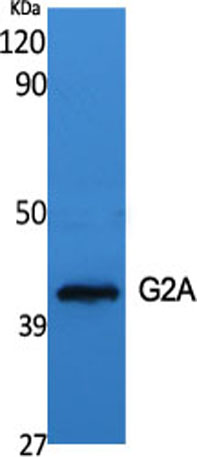
| Dilution | Western Blot: 1/500 - 1/2000. IHC-p: 1:100-300 ELISA: 1/20000. IF 1:100-300 Not yet tested in other applications. |
| Purification | The antibody was affinity-purified from rabbit antiserum by affinity-chromatography using epitope-specific immunogen. |
| Concentration | 1 mg/ml |
| Storage stability | -20°C/1 year |
| Molecular Weight (Da) | |
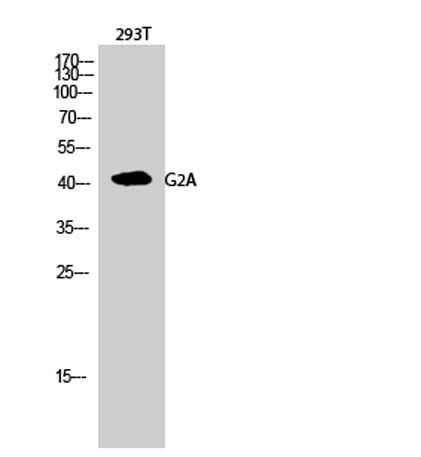
| Observed band (KD) | 42kD |
| Background | This gene encodes a member of the guanine nucleotide-binding protein (G protein)-coupled receptor (GPCR) superfamily. The receptors are seven-pass transmembrane proteins that respond to extracellular cues and activate intracellular signal transduction pathways. This protein was reported to be a receptor for lysophosphatidylcholine action, but PubMedID: 15653487 retracts this finding and instead suggests this protein to be an effector of lysophosphatidylcholine action. This protein may have proton-sensing activity and may be a receptor for oxidized free fatty acids. Alternative splicing results in multiple transcript variants. [provided by RefSeq, Jul 2013], |
| Function | caution:Was originally (PubMed:11474113) thought to be a receptor for lysophosphatidylcholine (LPC) and sphingosylphosphorylcholine (SPC), However, this work has been retracted.,function:Receptor for an unknown ligand. Activates a G alpha protein, most likely G alpha(q). May be involved in apoptosis. Functions at the G2/M checkpoint to delay mitosis. May serve as a mechanism for T- and B-cells, and other cell types, to slow their proliferation and repair damaged DNA to ensure proper replication.,induction:By stress and DNA-damaging agents.,similarity:Belongs to the G-protein coupled receptor 1 family.,subcellular location:Internalized and accumulated in endosomal compartments. LPC triggers the relocalization from the endosomal compartment to the cell surface.,tissue specificity:Highly expressed in macrophages and hematopoietic tissues rich in lymphocytes, like spleen and thymus. Weakly e |
| Subcellular location | Cell membrane ; Multi-pass membrane protein . Internalized and accumulated in endosomal compartments. LPC triggers the relocalization from the endosomal compartment to the cell surface (By similarity). . |
| Expression | Highly expressed in macrophages and hematopoietic tissues rich in lymphocytes, like spleen and thymus. Weakly expressed in heart and lung. In atherosclerotic plaques, expression is observed around the lipid core and at the shoulder region. |

Use collapsible tabs for more detailed information that will help customers make a purchasing decision.
Ex: Shipping and return policies, size guides, and other common questions.