 Français
 English

| ELK.No | ES2476 |
| Product name | GRK 1 rabbit pAb |
| Reactivity | Human;Mouse;Rat |
| Applications | WB;IHC;IF;ELISA |
| Other name | GRK1; RHOK; Rhodopsin kinase; RK; G protein-coupled receptor kinase 1 |
| Size | 100μL |
| Unit price ($) | 248 |
| Human gene ID | 6011 |
| Human Swiss-Prot | Q15835 |
| Source | Rabbit |
| Isotype | IgG |
| Target | GRK1 |
| Fields | >>Chemokine signaling pathway;>>Endocytosis;>>Phototransduction |
| Gene name | GRK1 |
| Protein name | Rhodopsin kinase |
| Human gene link | View Human Gene |
| Human Swiss link | View Human Swiss-Prot |
| Mouse gene ID | |
| Mouse gene link | |
| Mouse Swiss-Prot | Q9WVL4 |
| Mouse Swiss link | View Mouse Swiss-Prot |
| Rat gene ID | 81760 |
| Rat gene link | View Rat Gene |
| Rat Swiss-Prot | Q63651 |
| Rat Swiss link | View Rat Swiss-Prot |
| Immunogen | The antiserum was produced against synthesized peptide derived from human GRK1. AA range:6-55 |
| Specificity | GRK 1 Polyclonal Antibody detects endogenous levels of GRK 1 protein. |
| Formulation | Liquid in PBS containing 50% glycerol, 0.5% BSA and 0.02% sodium azide. |
| Clonality | Polyclonal |
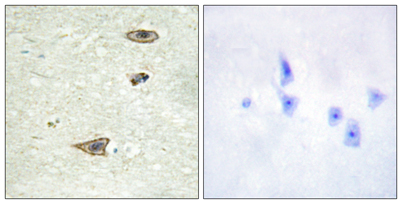
| Dilution | Western Blot: 1/500 - 1/2000. Immunohistochemistry: 1/100 - 1/300. ELISA: 1/40000. Not yet tested in other applications. |
| Purification | The antibody was affinity-purified from rabbit antiserum by affinity-chromatography using epitope-specific immunogen. |
| Concentration | 1 mg/ml |
| Storage stability | -20°C/1 year |
| Molecular Weight (Da) | |
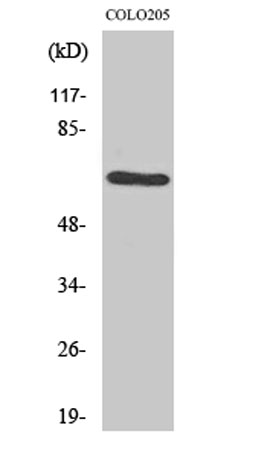
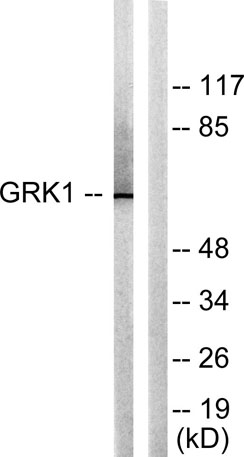
| Observed band (KD) | 63kD |
| Background | This gene encodes a member of the guanine nucleotide-binding protein (G protein)-coupled receptor kinase subfamily of the Ser/Thr protein kinase family. The protein phosphorylates rhodopsin and initiates its deactivation. Defects in GRK1 are known to cause Oguchi disease 2 (also known as stationary night blindness Oguchi type-2). [provided by RefSeq, Jul 2008], |
| Function | catalytic activity:ATP + [rhodopsin] = ADP + [rhodopsin] phosphate.,disease:Defects in GRK1 are a cause of congenital stationary night blindness Oguchi type (CSNBO) [MIM:258100]; also known as Oguchi disease. Congenital stationary night blindness is a non-progressive retinal disorder characterized by impaired night vision. CSNBO is an autosomal recessive form associated with fundus discoloration and abnormally slow dark adaptation.,function:Phosphorylates rhodopsin thereby initiating its deactivation.,online information:Retina International's Scientific Newsletter,PTM:Autophosphorylated.,PTM:Farnesylation is required for full activity.,similarity:Belongs to the protein kinase superfamily. AGC Ser/Thr protein kinase family. GPRK subfamily.,similarity:Contains 1 AGC-kinase C-terminal domain.,similarity:Contains 1 protein kinase domain.,similarity:Contains 1 RGS domain.,tissue specificity:R |
| Subcellular location | Membrane ; Lipid-anchor . Cell projection, cilium, photoreceptor outer segment . Subcellular location is not affected by light or dark conditions. . |
| Expression | Retinal-specific. Expressed in rods and cones cells. |

Use collapsible tabs for more detailed information that will help customers make a purchasing decision.
Ex: Shipping and return policies, size guides, and other common questions.