 Français
 English

| ELK.No | ES2492 |
| Product name | Gα t1 rabbit pAb |
| Reactivity | Human;Mouse;Rat |
| Applications | WB;ELISA |
| Other name | GNAT1; GNATR; Guanine nucleotide-binding protein G(t) subunit alpha-1; Transducin alpha-1 chain |
| Size | 50μL |
| Unit price ($) | 148 |
| Human gene ID | 2779 |
| Human Swiss-Prot | P11488 |
| Source | Rabbit |
| Isotype | IgG |
| Target | Gα t1 |
| Fields | >>Phototransduction |
| Gene name | GNAT1 |
| Protein name | Guanine nucleotide-binding protein G(t) subunit alpha-1 |
| Human gene link | View Human Gene |
| Human Swiss link | View Human Swiss-Prot |
| Mouse gene ID | 14685 |
| Mouse gene link | View Mouse Gene |
| Mouse Swiss-Prot | P20612 |
| Mouse Swiss link | View Mouse Swiss-Prot |
| Rat gene ID | |
| Rat gene link | |
| Rat Swiss-Prot | |
| Rat Swiss link | |
| Immunogen | The antiserum was produced against synthesized peptide derived from human GNAT1. AA range:71-120 |
| Specificity | Gα t1 Polyclonal Antibody detects endogenous levels of Gα t1 protein. |
| Formulation | Liquid in PBS containing 50% glycerol, 0.5% BSA and 0.02% sodium azide. |
| Clonality | Polyclonal |
| Dilution | Western Blot: 1/500 - 1/2000. ELISA: 1/40000. Not yet tested in other applications. |
| Purification | The antibody was affinity-purified from rabbit antiserum by affinity-chromatography using epitope-specific immunogen. |
| Concentration | 1 mg/ml |
| Storage stability | -20°C/1 year |
| Molecular Weight (Da) | |
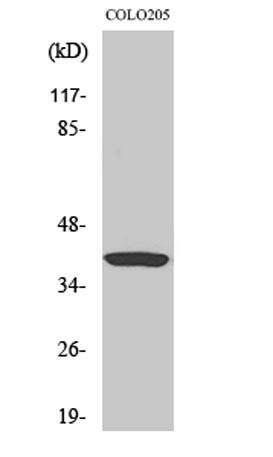
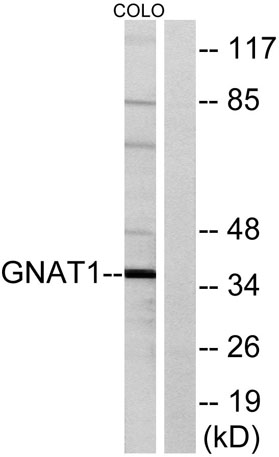
| Observed band (KD) | 36kD |
| Background | Transducin is a 3-subunit guanine nucleotide-binding protein (G protein) which stimulates the coupling of rhodopsin and cGMP-phoshodiesterase during visual impulses. The transducin alpha subunits in rods and cones are encoded by separate genes. This gene encodes the alpha subunit in rods. This gene is also expressed in other cells, and has been implicated in bitter taste transduction in rat taste cells. Mutations in this gene result in autosomal dominant congenital stationary night blindness. Multiple alternatively spliced variants, encoding the same protein, have been identified. [provided by RefSeq, Feb 2009], |
| Function | disease:Defects in GNAT1 are the cause of congenital stationary night blindness autosomal dominant type 3 (CSNBAD3) [MIM:610444]; also known as congenital stationary night blindness Nougaret type. Congenital stationary night blindness is a non-progressive retinal disorder characterized by impaired night vision.,function:Guanine nucleotide-binding proteins (G proteins) are involved as modulators or transducers in various transmembrane signaling systems. Transducin is an amplifier and one of the transducers of a visual impulse that performs the coupling between rhodopsin and cGMP-phosphodiesterase.,online information:Retina International's Scientific Newsletter,similarity:Belongs to the G-alpha family. G(i/o/t/z) subfamily.,subunit:G proteins are composed of 3 units; alpha, beta and gamma. The alpha chain contains the guanine nucleotide binding site.,tissue specificity:Rod., |
| Subcellular location | Cell projection, cilium, photoreceptor outer segment . Membrane ; Peripheral membrane protein . Photoreceptor inner segment . Localizes mainly in the outer segment in the dark-adapted state, whereas is translocated to the inner part of the photoreceptors in the light-adapted state. During dark-adapted conditions, in the presence of UNC119 mislocalizes from the outer segment to the inner part of rod photoreceptors which leads to decreased photoreceptor damage caused by light. . |
| Expression | Rod photoreceptor cells (PubMed:1614872). Predominantly expressed in the retina followed by the ciliary body, iris and retinal pigment epithelium (PubMed:22190596). |

Use collapsible tabs for more detailed information that will help customers make a purchasing decision.
Ex: Shipping and return policies, size guides, and other common questions.