 Français
 English

| ELK.No | ES2583 |
| Product name | HSP40 rabbit pAb |
| Reactivity | Human;Mouse;Rat |
| Applications | WB;IHC;IF;ELISA |
| Other name | DNAJB1; DNAJ1; HDJ1; HSPF1; DnaJ homolog subfamily B member 1; DnaJ protein homolog 1; Heat shock 40 kDa protein 1; HSP40; Heat shock protein 40; Human DnaJ protein 1; hDj-1 |
| Size | 50μL |
| Unit price ($) | 148 |
| Human gene ID | 3337 |
| Human Swiss-Prot | P25685 |
| Source | Rabbit |
| Isotype | IgG |
| Target | HSP40 |
| Fields | >>Protein processing in endoplasmic reticulum;>>Influenza A |
| Gene name | DNAJB1 |
| Protein name | DnaJ homolog subfamily B member 1 |
| Human gene link | View Human Gene |
| Human Swiss link | View Human Swiss-Prot |
| Mouse gene ID | 81489 |
| Mouse gene link | View Mouse Gene |
| Mouse Swiss-Prot | Q9QYJ3 |
| Mouse Swiss link | View Mouse Swiss-Prot |
| Rat gene ID | |
| Rat gene link | |
| Rat Swiss-Prot | |
| Rat Swiss link | |
| Immunogen | The antiserum was produced against synthesized peptide derived from human HSP40. AA range:271-320 |
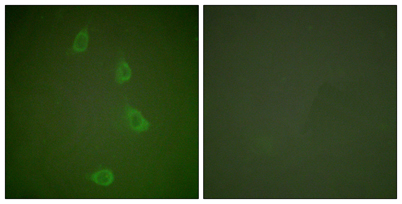
| Specificity | HSP40 Polyclonal Antibody detects endogenous levels of HSP40 protein. |
| Formulation | Liquid in PBS containing 50% glycerol, 0.5% BSA and 0.02% sodium azide. |
| Clonality | Polyclonal |
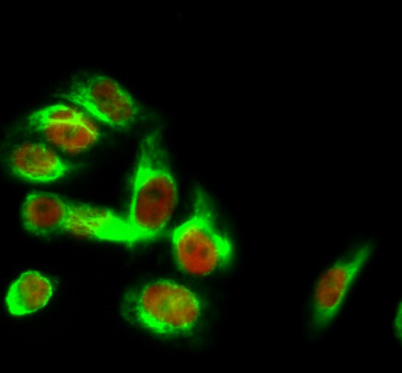
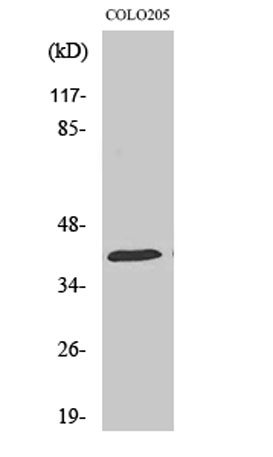
| Dilution | Western Blot: 1/500 - 1/2000. Immunohistochemistry: 1/100 - 1/300. Immunofluorescence: 1/200 - 1/1000. ELISA: 1/10000. Not yet tested in other applications. |
| Purification | The antibody was affinity-purified from rabbit antiserum by affinity-chromatography using epitope-specific immunogen. |
| Concentration | 1 mg/ml |
| Storage stability | -20°C/1 year |
| Molecular Weight (Da) | |
| Observed band (KD) | 45kD |
| Background | This gene encodes a member of the DnaJ or Hsp40 (heat shock protein 40 kD) family of proteins. DNAJ family members are characterized by a highly conserved amino acid stretch called the 'J-domain' and function as one of the two major classes of molecular chaperones involved in a wide range of cellular events, such as protein folding and oligomeric protein complex assembly. The encoded protein is a molecular chaperone that stimulates the ATPase activity of Hsp70 heat-shock proteins in order to promote protein folding and prevent misfolded protein aggregation. Alternative splicing results in multiple transcript variants. [provided by RefSeq, Sep 2015], |
| Function | function:Interacts with HSP70 and can stimulate its ATPase activity. Stimulates the association between HSC70 and HIP.,induction:By heat shock.,similarity:Contains 1 J domain.,subcellular location:Translocates rapidly from the cytoplasm to the nucleus, and especially to the nucleoli, upon heat shock.,subunit:Interacts with DNAJC3., |
| Subcellular location | Cytoplasm . Nucleus . Nucleus, nucleolus . Translocates rapidly from the cytoplasm to the nucleus, and especially to the nucleoli, upon heat shock. |
| Expression | Brain,Heart,Lung,Placenta, |

Use collapsible tabs for more detailed information that will help customers make a purchasing decision.
Ex: Shipping and return policies, size guides, and other common questions.