 Français
 English
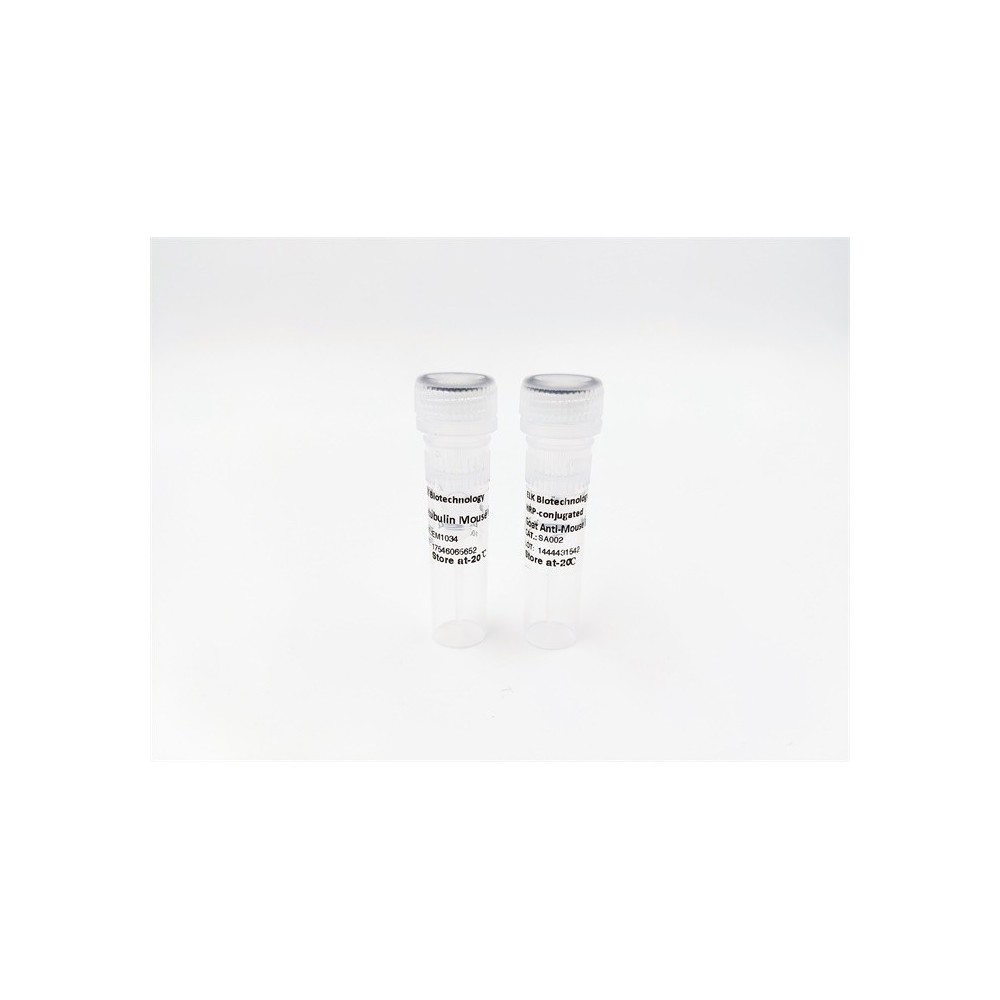

| ELK.No | ES2644 |
| Product name | IRF-4 rabbit pAb |
| Reactivity | Human;Mouse |
| Applications | WB;IHC;IF;ELISA |
| Other name | IRF4; MUM1; Interferon regulatory factor 4; IRF-4; Lymphocyte-specific interferon regulatory factor; LSIRF; Multiple myeloma oncogene 1; NF-EM5 |
| Size | 100μL |
| Unit price ($) | 248 |
| Human gene ID | 3662 |
| Human Swiss-Prot | Q15306 |
| Source | Rabbit |
| Isotype | IgG |
| Target | IRF-4 |
| Fields | >>Th17 cell differentiation |
| Gene name | IRF4 |
| Protein name | Interferon regulatory factor 4 |
| Human gene link | View Human Gene |
| Human Swiss link | View Human Swiss-Prot |
| Mouse gene ID | 16364 |
| Mouse gene link | View Mouse Gene |
| Mouse Swiss-Prot | Q64287 |
| Mouse Swiss link | View Mouse Swiss-Prot |
| Rat gene ID | |
| Rat gene link | |
| Rat Swiss-Prot | |
| Rat Swiss link | |
| Immunogen | The antiserum was produced against synthesized peptide derived from human IRF4. AA range:281-330 |
| Specificity | IRF-4 Polyclonal Antibody detects endogenous levels of IRF-4 protein. |
| Formulation | Liquid in PBS containing 50% glycerol, 0.5% BSA and 0.02% sodium azide. |
| Clonality | Polyclonal |
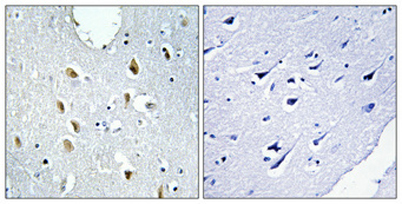
| Dilution | Western Blot: 1/500 - 1/2000. Immunohistochemistry: 1/100 - 1/300. Immunofluorescence: 1/200 - 1/1000. ELISA: 1/20000. Not yet tested in other applications. |
| Purification | The antibody was affinity-purified from rabbit antiserum by affinity-chromatography using epitope-specific immunogen. |
| Concentration | 1 mg/ml |
| Storage stability | -20°C/1 year |
| Molecular Weight (Da) | |
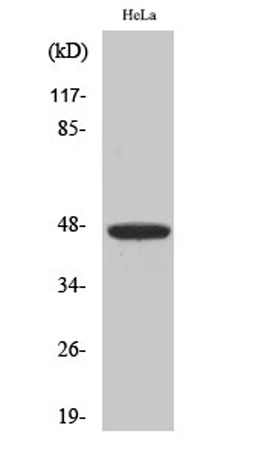
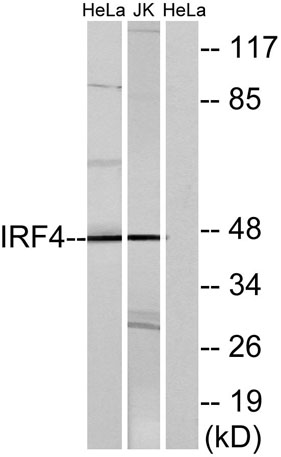
| Observed band (KD) | 45kD |
| Background | The protein encoded by this gene belongs to the IRF (interferon regulatory factor) family of transcription factors, characterized by an unique tryptophan pentad repeat DNA-binding domain. The IRFs are important in the regulation of interferons in response to infection by virus, and in the regulation of interferon-inducible genes. This family member is lymphocyte specific and negatively regulates Toll-like-receptor (TLR) signaling that is central to the activation of innate and adaptive immune systems. A chromosomal translocation involving this gene and the IgH locus, t(6;14)(p25;q32), may be a cause of multiple myeloma. Alternatively spliced transcript variants have been found for this gene. [provided by RefSeq, Aug 2010], |
| Function | disease:A chromosomal aberration involving IRF4 may be a cause of multiple myeloma [MIM:254500]. Translocation t(6;14)(p25;q32) with the IgH locus.,function:Transcriptional activator. Binds to the interferon-stimulated response element (ISRE) of the MHC class I promoter. Binds the immunoglobulin lambda light chain enhancer, together with PU.1. Probably plays a role in ISRE-targeted signal transduction mechanisms specific to lymphoid cells.,induction:Not induced by interferons.,similarity:Belongs to the IRF family.,similarity:Contains 1 tryptophan pentad repeat DNA-binding domain.,subunit:Interacts with SPIB and DEF6.,tissue specificity:Lymphoid cells., |
| Subcellular location | Nucleus. |
| Expression | Lymphoid cells. |

Use collapsible tabs for more detailed information that will help customers make a purchasing decision.
Ex: Shipping and return policies, size guides, and other common questions.