 Français
 English

| ELK.No | ES2661 |
| Product name | JMY rabbit pAb |
| Reactivity | Human;Mouse |
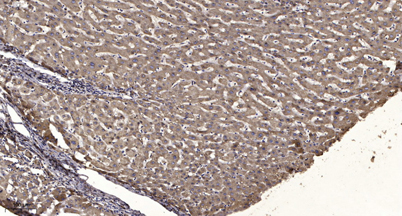
| Applications | WB;ELISA;IHC |
| Other name | JMY; Junction-mediating and -regulatory protein |
| Size | 50μL |
| Unit price ($) | 148 |
| Human gene ID | 133746 |
| Human Swiss-Prot | Q8N9B5 |
| Source | Rabbit |
| Isotype | IgG |
| Target | JMY |
| Fields | |
| Gene name | JMY |
| Protein name | Junction-mediating and -regulatory protein |
| Human gene link | View Human Gene |
| Human Swiss link | View Human Swiss-Prot |
| Mouse gene ID | 57748 |
| Mouse gene link | View Mouse Gene |
| Mouse Swiss-Prot | Q9QXM1 |
| Mouse Swiss link | View Mouse Swiss-Prot |
| Rat gene ID | |
| Rat gene link | |
| Rat Swiss-Prot | |
| Rat Swiss link | |
| Immunogen | The antiserum was produced against synthesized peptide derived from human JMY. AA range:931-980 |
| Specificity | JMY Polyclonal Antibody detects endogenous levels of JMY protein. |
| Formulation | Liquid in PBS containing 50% glycerol, 0.5% BSA and 0.02% sodium azide. |
| Clonality | Polyclonal |
| Dilution | WB 1:500-2000;IHC-p 1:50-300; ELISA 2000-20000 |
| Purification | The antibody was affinity-purified from rabbit antiserum by affinity-chromatography using epitope-specific immunogen. |
| Concentration | 1 mg/ml |
| Storage stability | -20°C/1 year |
| Molecular Weight (Da) | |
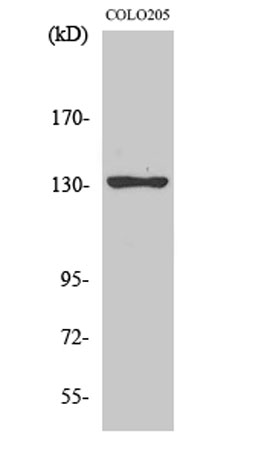
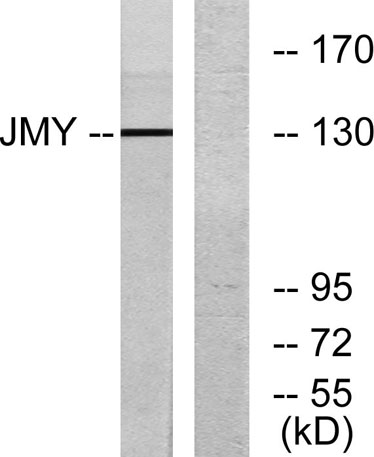
| Observed band (KD) | 130kD |
| Background | function:Cofactor that increases p53/TP53 response via its interaction with p300/EP300. Increases p53/TP53-dependent transcription and apoptosis, suggesting an important role in p53/TP53 stress response such as DNA damage.,induction:By E2F.,PTM:Ubiquitinated by MDM2, leading to its subsequent degradation by the proteasome. In case of DNA damage, the interaction with MDM2 is altered, preventing degradation and allowing interaction with p300/EP300 and its function in p53/TP53 stress response.,similarity:Contains 1 WH2 domain.,subunit:Interacts with p300/EP300, the complex being recruited to activated p53/TP53. Interacts with TTC5., |
| Function | function:Cofactor that increases p53/TP53 response via its interaction with p300/EP300. Increases p53/TP53-dependent transcription and apoptosis, suggesting an important role in p53/TP53 stress response such as DNA damage.,induction:By E2F.,PTM:Ubiquitinated by MDM2, leading to its subsequent degradation by the proteasome. In case of DNA damage, the interaction with MDM2 is altered, preventing degradation and allowing interaction with p300/EP300 and its function in p53/TP53 stress response.,similarity:Contains 1 WH2 domain.,subunit:Interacts with p300/EP300, the complex being recruited to activated p53/TP53. Interacts with TTC5., |
| Subcellular location | Nucleus . Cytoplasmic vesicle . Cytoplasm, cytoskeleton . Endomembrane system; Lipid-anchor. Cytoplasmic vesicle, autophagosome membrane . Localizes to the nucleus in most cell types. Accumulates in nucleus under DNA damage conditions, increasing p53/TP53 transcription response and reducing its influence on cell motility (By similarity). In primary neutrophils, it colocalizes with actin filaments at the leading edge and is excluded from the nucleus. Localization correlates with motility, because it moves from the nucleus to the cytoplasmic compartment when cells are differentiated from nonmotile cells into highly motile neutrophil-like cells. Localizes to cytoplasmic vesicles which associate with actin filament and autophagosomal membranes upon starvation-induced autophagy (PubMed:30420355 |
| Expression | Brain,Substantia nigra, |

Use collapsible tabs for more detailed information that will help customers make a purchasing decision.
Ex: Shipping and return policies, size guides, and other common questions.