 Français
 English

| ELK.No | ES2671 |
| Product name | KDEL Receptor 2 rabbit pAb |
| Reactivity | Human;Mouse;Rat |
| Applications | WB;IHC;IF;ELISA |
| Other name | KDELR2; ERD2.2; ER lumen protein retaining receptor 2; ERD2-like protein 1; ELP-1; KDEL endoplasmic reticulum protein retention receptor 2; KDEL receptor 2 |
| Size | 50μL |
| Unit price ($) | 148 |
| Human gene ID | 11014 |
| Human Swiss-Prot | P33947 |
| Source | Rabbit |
| Isotype | IgG |
| Target | KDEL Receptor 2 |
| Fields | >>Vibrio cholerae infection |
| Gene name | KDELR2 |
| Protein name | ER lumen protein retaining receptor 2 |
| Human gene link | View Human Gene |
| Human Swiss link | View Human Swiss-Prot |
| Mouse gene ID | 66913 |
| Mouse gene link | View Mouse Gene |
| Mouse Swiss-Prot | Q9CQM2 |
| Mouse Swiss link | View Mouse Swiss-Prot |
| Rat gene ID | 304290 |
| Rat gene link | View Rat Gene |
| Rat Swiss-Prot | Q5U305 |
| Rat Swiss link | View Rat Swiss-Prot |
| Immunogen | The antiserum was produced against synthesized peptide derived from human ERD22. AA range:81-130 |
| Specificity | KDEL Receptor 2 Polyclonal Antibody detects endogenous levels of KDEL Receptor 2 protein. |
| Formulation | Liquid in PBS containing 50% glycerol, 0.5% BSA and 0.02% sodium azide. |
| Clonality | Polyclonal |
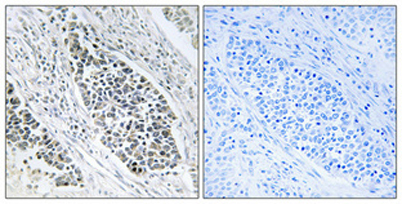
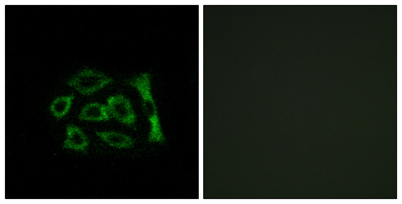
| Dilution | Western Blot: 1/500 - 1/2000. Immunohistochemistry: 1/100 - 1/300. Immunofluorescence: 1/200 - 1/1000. ELISA: 1/20000. Not yet tested in other applications. |
| Purification | The antibody was affinity-purified from rabbit antiserum by affinity-chromatography using epitope-specific immunogen. |
| Concentration | 1 mg/ml |
| Storage stability | -20°C/1 year |
| Molecular Weight (Da) | |
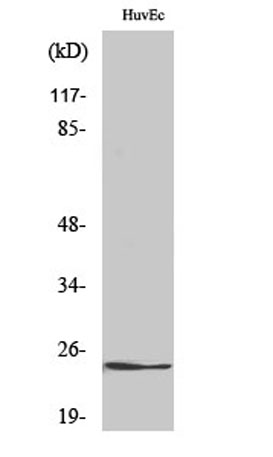
| Observed band (KD) | 24kD |
| Background | KDEL endoplasmic reticulum protein retention receptor 2(KDELR2) Homo sapiens Retention of resident soluble proteins in the lumen of the endoplasmic reticulum (ER) is achieved in both yeast and animal cells by their continual retrieval from the cis-Golgi, or a pre-Golgi compartment. Sorting of these proteins is dependent on a C-terminal tetrapeptide signal, usually lys-asp-glu-leu (KDEL) in animal cells, and his-asp-glu-leu (HDEL) in S. cerevisiae. This process is mediated by a receptor that recognizes, and binds the tetrapeptide-containing protein, and returns it to the ER. In yeast, the sorting receptor encoded by a single gene, ERD2, is a seven-transmembrane protein. Unlike yeast, several human homologs of the ERD2 gene, constituting the KDEL receptor gene family, have been described. KDELR2 was the second member of the family to be identified, and it encodes a protein which is 83% identical to the KDELR1 gene product. Alternative splicing r |
| Function | function:Required for the retention of luminal endoplasmic reticulum proteins. Determines the specificity of the luminal ER protein retention system. Also required for normal vesicular traffic through the Golgi. This receptor recognizes K-D-E-L.,similarity:Belongs to the ERD2 family., |
| Subcellular location | Endoplasmic reticulum membrane ; Multi-pass membrane protein . Golgi apparatus membrane ; Multi-pass membrane protein . Cytoplasmic vesicle, COPI-coated vesicle membrane ; Multi-pass membrane protein . Localized in the Golgi in the absence of bound proteins with the sequence motif K-D-E-L. Trafficks back to the endoplasmic reticulum together with cargo proteins containing the sequence motif K-D-E-L. . |
| Expression | Brain,Placenta,Skin,Testis,Uterus, |

Use collapsible tabs for more detailed information that will help customers make a purchasing decision.
Ex: Shipping and return policies, size guides, and other common questions.