 Français
 English
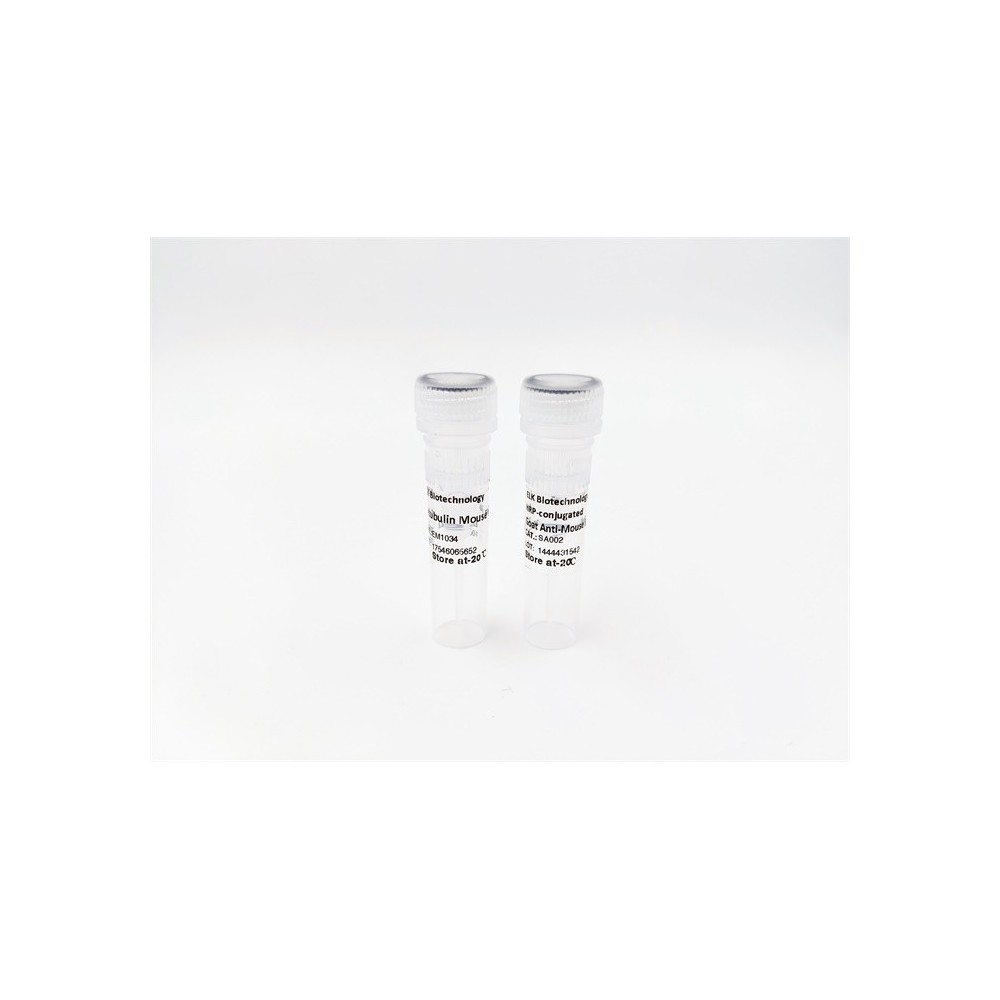

| ELK.No | ES2752 |
| Product name | Matriptase rabbit pAb |
| Reactivity | Human;Rat;Mouse; |
| Applications | WB;IF;ELISA |
| Other name | ST14; PRSS14; SNC19; TADG15; Suppressor of tumorigenicity 14 protein; Matriptase; Membrane-type serine protease 1; MT-SP1; Prostamin; Serine protease 14; Serine protease TADG-15; Tumor-associated differentially-expressed gene 15 protein |
| Size | 50μL |
| Unit price ($) | 148 |
| Human gene ID | 6768 |
| Human Swiss-Prot | Q9Y5Y6 |
| Source | Rabbit |
| Isotype | IgG |
| Target | Matriptase |
| Fields | >>MicroRNAs in cancer |
| Gene name | ST14 |
| Protein name | Suppressor of tumorigenicity 14 protein |
| Human gene link | View Human Gene |
| Human Swiss link | View Human Swiss-Prot |
| Mouse gene ID | |
| Mouse gene link | |
| Mouse Swiss-Prot | P56677 |
| Mouse Swiss link | View Mouse Swiss-Prot |
| Rat gene ID | |
| Rat gene link | |
| Rat Swiss-Prot | |
| Rat Swiss link | |
| Immunogen | The antiserum was produced against synthesized peptide derived from human ST14. AA range:10-59 |
| Specificity | Matriptase Polyclonal Antibody detects endogenous levels of Matriptase protein. |
| Formulation | Liquid in PBS containing 50% glycerol, 0.5% BSA and 0.02% sodium azide. |
| Clonality | Polyclonal |
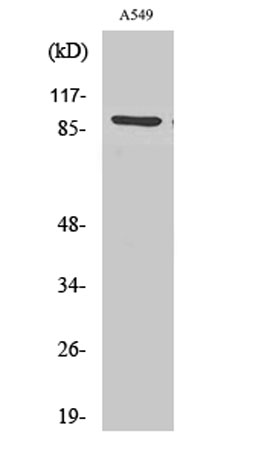
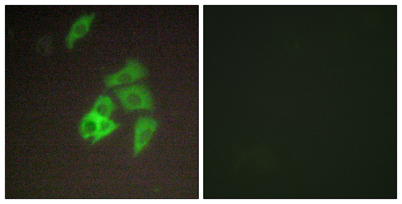
| Dilution | Western Blot: 1/500 - 1/2000. Immunofluorescence: 1/200 - 1/1000. ELISA: 1/10000. Not yet tested in other applications. |
| Purification | The antibody was affinity-purified from rabbit antiserum by affinity-chromatography using epitope-specific immunogen. |
| Concentration | 1 mg/ml |
| Storage stability | -20°C/1 year |
| Molecular Weight (Da) | |
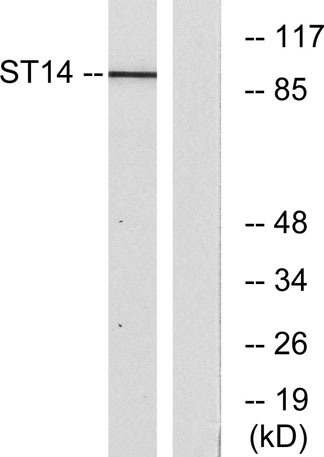
| Observed band (KD) | 95kD |
| Background | The protein encoded by this gene is an epithelial-derived, integral membrane serine protease. This protease forms a complex with the Kunitz-type serine protease inhibitor, HAI-1, and is found to be activated by sphingosine 1-phosphate. This protease has been shown to cleave and activate hepatocyte growth factor/scattering factor, and urokinase plasminogen activator, which suggest the function of this protease as an epithelial membrane activator for other proteases and latent growth factors. The expression of this protease has been associated with breast, colon, prostate, and ovarian tumors, which implicates its role in cancer invasion, and metastasis. [provided by RefSeq, Jul 2008], |
| Function | catalytic activity:Cleaves various synthetic substrates with Arg or Lys at the P1 position and prefers small side-chain amino acids, such as Ala and Gly, at the P2 position.,disease:Defects in ST14 are a cause of ichthyosis autosomal recessive with hypotrichosis (ARIH) [MIM:610765]. ARIH is a skin disorder characterized by congenital ichthyosis associated with the presence of less than the normal amount of hair.,function:Degrades extracellular matrix. Proposed to play a role in breast cancer invasion and metastasis. Exhibits trypsin-like activity as defined by cleavage of synthetic substrates with Arg or Lys as the P1 site.,similarity:Belongs to the peptidase S1 family.,similarity:Contains 1 peptidase S1 domain.,similarity:Contains 2 CUB domains.,similarity:Contains 4 LDL-receptor class A domains.,subunit:Interacts with CDCP1. May interact with TMEFF1., |
| Subcellular location | Membrane ; Single-pass type II membrane protein . |
| Expression | Blood,Colon,Milk,Muscle,Prostate, |

Use collapsible tabs for more detailed information that will help customers make a purchasing decision.
Ex: Shipping and return policies, size guides, and other common questions.