 Français
 English
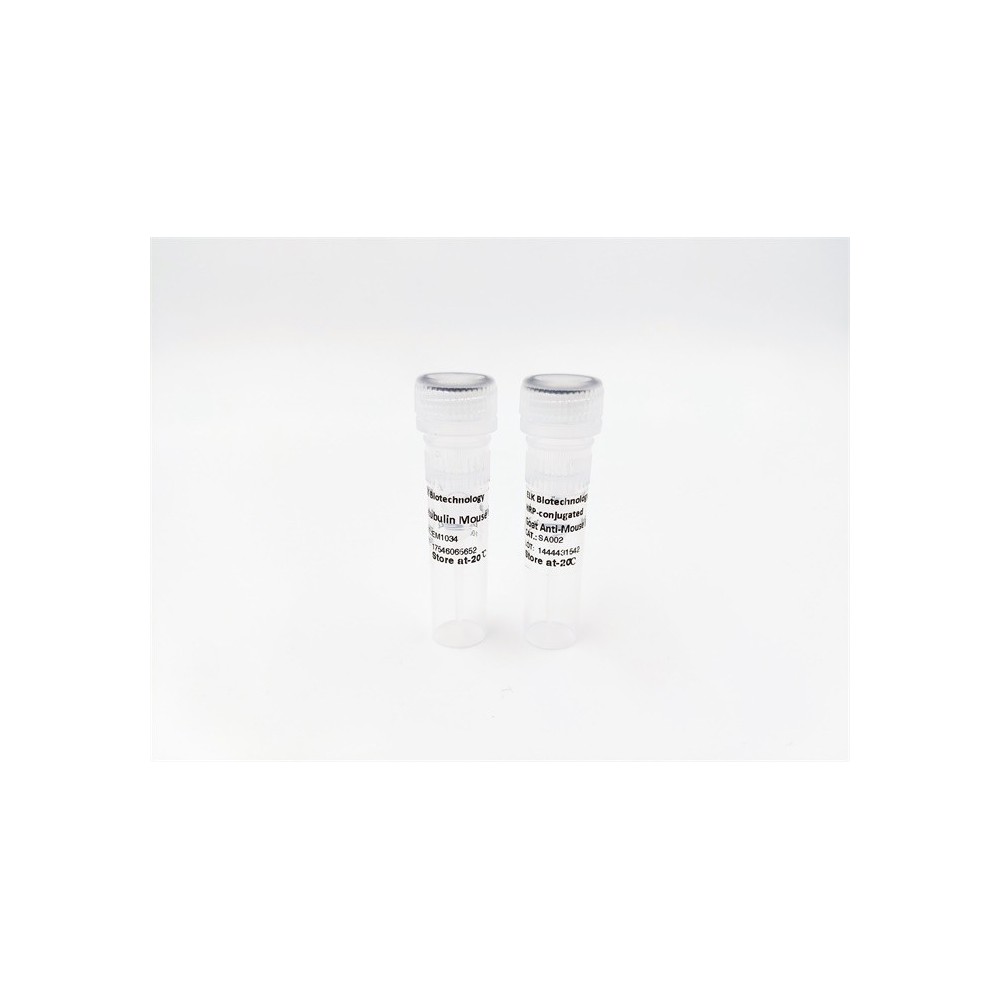

| ELK.No | ES2761 |
| Product name | MCT4 rabbit pAb |
| Reactivity | Human;Mouse;Rat |
| Applications | WB;ELISA |
| Other name | SLC16A3; MCT4; Monocarboxylate transporter 4; MCT 4; Solute carrier family 16 member 3 |
| Size | 100μL |
| Unit price ($) | 248 |
| Human gene ID | 9123 |
| Human Swiss-Prot | O15427 |
| Source | Rabbit |
| Isotype | IgG |
| Target | MCT4 |
| Fields | >>Central carbon metabolism in cancer |
| Gene name | SLC16A3 |
| Protein name | Monocarboxylate transporter 4 |
| Human gene link | View Human Gene |
| Human Swiss link | View Human Swiss-Prot |
| Mouse gene ID | 80879 |
| Mouse gene link | View Mouse Gene |
| Mouse Swiss-Prot | P57787 |
| Mouse Swiss link | View Mouse Swiss-Prot |
| Rat gene ID | 80878 |
| Rat gene link | View Rat Gene |
| Rat Swiss-Prot | O35910 |
| Rat Swiss link | View Rat Swiss-Prot |
| Immunogen | The antiserum was produced against synthesized peptide derived from human MOT4. AA range:233-282 |
| Specificity | MCT4 Polyclonal Antibody detects endogenous levels of MCT4 protein. |
| Formulation | Liquid in PBS containing 50% glycerol, 0.5% BSA and 0.02% sodium azide. |
| Clonality | Polyclonal |
| Dilution | Western Blot: 1/500 - 1/2000. ELISA: 1/40000. Not yet tested in other applications. |
| Purification | The antibody was affinity-purified from rabbit antiserum by affinity-chromatography using epitope-specific immunogen. |
| Concentration | 1 mg/ml |
| Storage stability | -20°C/1 year |
| Molecular Weight (Da) | |
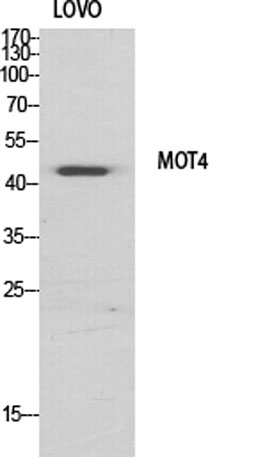
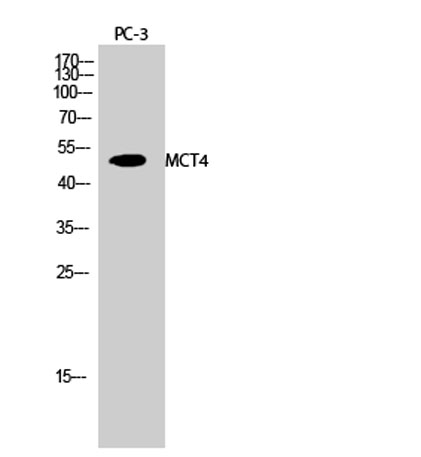
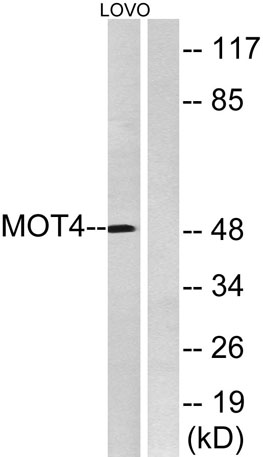
| Observed band (KD) | 49kD |
| Background | Lactic acid and pyruvate transport across plasma membranes is catalyzed by members of the proton-linked monocarboxylate transporter (MCT) family, which has been designated solute carrier family-16. Each MCT appears to have slightly different substrate and inhibitor specificities and transport kinetics, which are related to the metabolic requirements of the tissues in which it is found. The MCTs, which include MCT1 (SLC16A1; MIM 600682) and MCT2 (SLC16A7; MIM 603654), are characterized by 12 predicted transmembrane domains (Price et al., 1998 [PubMed 9425115]).[supplied by OMIM, Mar 2008], |
| Function | function:Proton-linked monocarboxylate transporter. Catalyzes the rapid transport across the plasma membrane of many monocarboxylates such as lactate, pyruvate, branched-chain oxo acids derived from leucine, valine and isoleucine, and the ketone bodies acetoacetate, beta-hydroxybutyrate and acetate.,similarity:Belongs to the major facilitator superfamily. Monocarboxylate porter (TC 2.A.1.13) family.,tissue specificity:Highly expressed in skeletal muscle., |
| Subcellular location | Cell membrane; Multi-pass membrane protein. |
| Expression | Highly expressed in skeletal muscle. |

Use collapsible tabs for more detailed information that will help customers make a purchasing decision.
Ex: Shipping and return policies, size guides, and other common questions.