 Français
 English
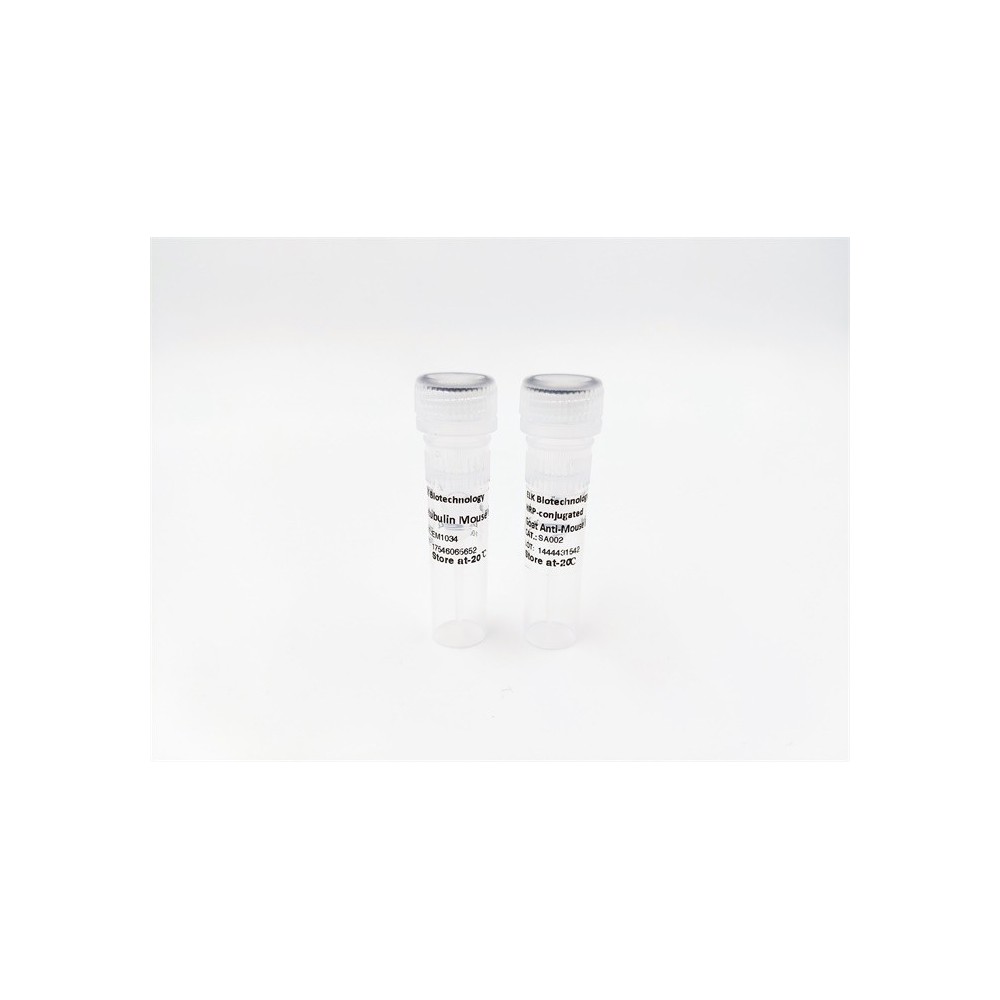

| ELK.No | ES3129 |
| Product name | p53RFP rabbit pAb |
| Reactivity | Human;Mouse |
| Applications | WB;ELISA |
| Other name | RNF144B; IBRDC2; P53RFP; E3 ubiquitin-protein ligase RNF144B; IBR domain-containing protein 2; RING finger protein 144B; p53-inducible RING finger protein |
| Size | 50μL |
| Unit price ($) | 148 |
| Human gene ID | 255488 |
| Human Swiss-Prot | Q7Z419 |
| Source | Rabbit |
| Isotype | IgG |
| Target | p53RFP |
| Fields | |
| Gene name | RNF144B |
| Protein name | E3 ubiquitin-protein ligase RNF144B |
| Human gene link | View Human Gene |
| Human Swiss link | View Human Swiss-Prot |
| Mouse gene ID | 218215 |
| Mouse gene link | View Mouse Gene |
| Mouse Swiss-Prot | Q8BKD6 |
| Mouse Swiss link | View Mouse Swiss-Prot |
| Rat gene ID | |
| Rat gene link | |
| Rat Swiss-Prot | |
| Rat Swiss link | |
| Immunogen | Synthesized peptide derived from the Internal region of human p53RFP. |
| Specificity | p53RFP Polyclonal Antibody detects endogenous levels of p53RFP protein. |
| Formulation | Liquid in PBS containing 50% glycerol, 0.5% BSA and 0.02% sodium azide. |
| Clonality | Polyclonal |
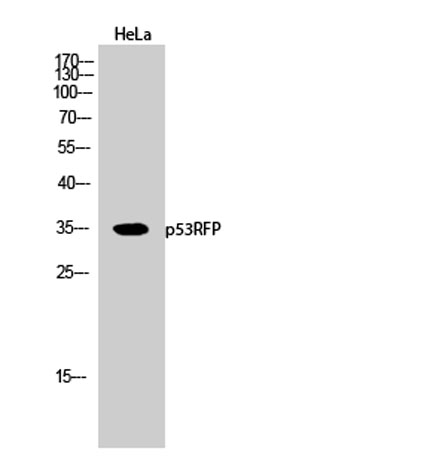
| Dilution | Western Blot: 1/500 - 1/2000. ELISA: 1/40000. Not yet tested in other applications. |
| Purification | The antibody was affinity-purified from rabbit antiserum by affinity-chromatography using epitope-specific immunogen. |
| Concentration | 1 mg/ml |
| Storage stability | -20°C/1 year |
| Molecular Weight (Da) | |
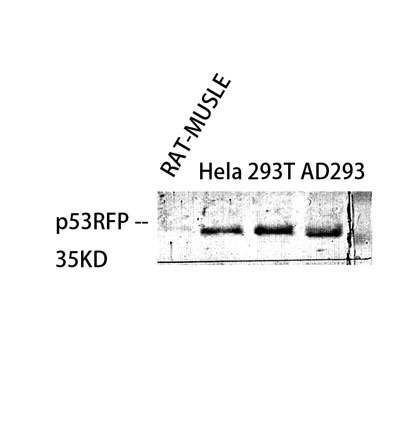
| Observed band (KD) | 35kD |
| Background | caution:Lacks the His residue in the RING-type domain 2 that is one of the conserved features of the family.,domain:The RING-type zinc finger domain mediates binding to an E2 ubiquitin-conjugating enzyme.,function:E3 ubiquitin-protein ligase which accepts ubiquitin from E2 ubiquitin-conjugating enzymes UBE2L3 and UBE2L6 in the form of a thioester and then directly transfers the ubiquitin to targeted substrates such as LCMT2, thereby promoting their degradation. Induces apoptosis via a TP53/p53-dependent but caspase-independent mechanism.,pathway:Protein modification; protein ubiquitination.,PTM:Auto-ubiquitinated.,similarity:Belongs to the RBR family. RNF144 subfamily.,similarity:Contains 1 IBR-type zinc finger.,similarity:Contains 2 RING-type zinc fingers.,subunit:Interacts with UBE2L3, UBE2L6 and LCMT2.,tissue specificity:Broadly expressed, with lowest levels in brain, spleen and thymus., |
| Function | caution:Lacks the His residue in the RING-type domain 2 that is one of the conserved features of the family.,domain:The RING-type zinc finger domain mediates binding to an E2 ubiquitin-conjugating enzyme.,function:E3 ubiquitin-protein ligase which accepts ubiquitin from E2 ubiquitin-conjugating enzymes UBE2L3 and UBE2L6 in the form of a thioester and then directly transfers the ubiquitin to targeted substrates such as LCMT2, thereby promoting their degradation. Induces apoptosis via a TP53/p53-dependent but caspase-independent mechanism.,pathway:Protein modification; protein ubiquitination.,PTM:Auto-ubiquitinated.,similarity:Belongs to the RBR family. RNF144 subfamily.,similarity:Contains 1 IBR-type zinc finger.,similarity:Contains 2 RING-type zinc fingers.,subunit:Interacts with UBE2L3, UBE2L6 and LCMT2.,tissue specificity:Broadly expressed, with lowest levels in brain, spleen and thymu |
| Subcellular location | Mitochondrion membrane ; Single-pass membrane protein . Cytoplasm . Mostly cytosololic, accumulates in submitochondrial domains specifically upon apoptosis induction, in synchrony with BAX activation. |
| Expression | Broadly expressed, with lowest levels in brain and thymus, and highest levels detectable in heart, ovary and testis. |

Use collapsible tabs for more detailed information that will help customers make a purchasing decision.
Ex: Shipping and return policies, size guides, and other common questions.