 Français
 English
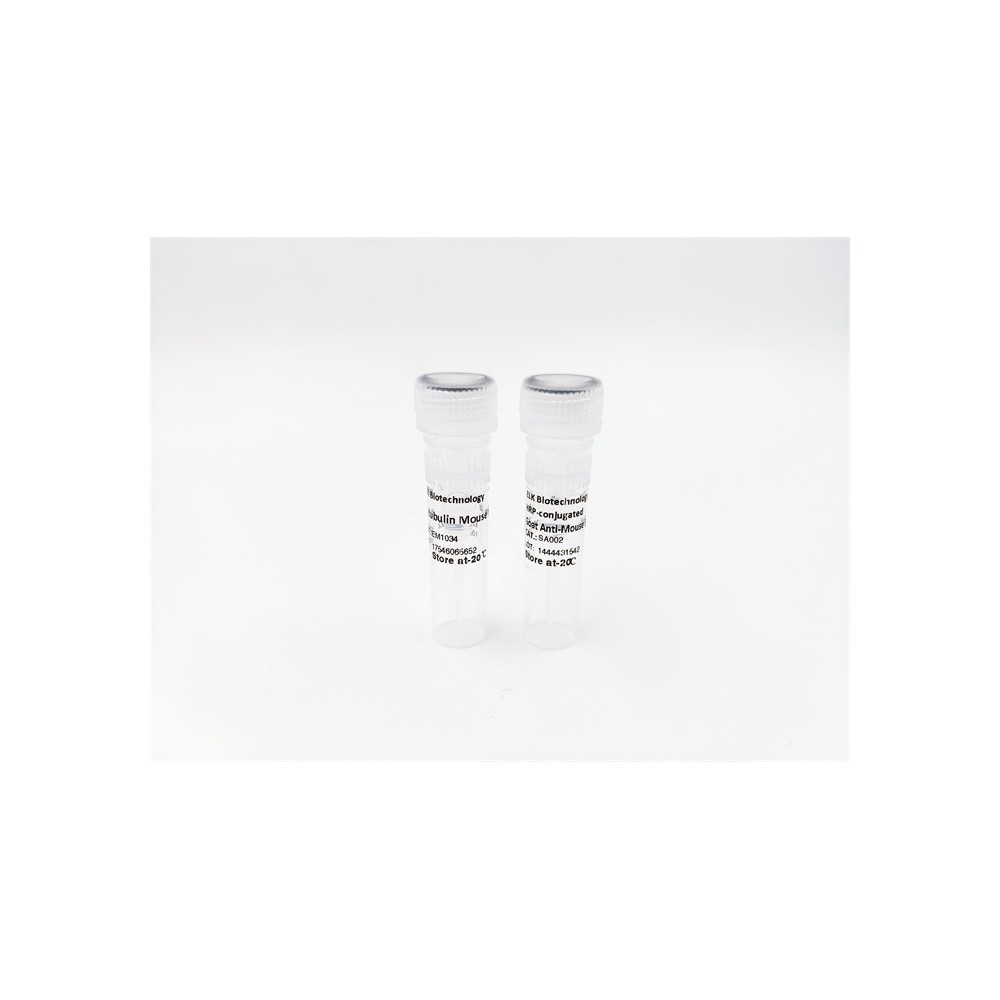

| ELK.No | ES3180 |
| Product name | Peroxin 3 rabbit pAb |
| Reactivity | Human;Mouse;Rat |
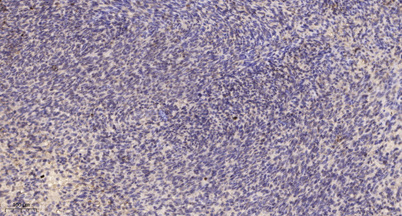
| Applications | WB;ELISA;IHC |
| Other name | PEX3; Peroxisomal biogenesis factor 3; Peroxin-3; Peroxisomal assembly protein PEX3 |
| Size | 100μL |
| Unit price ($) | 248 |
| Human gene ID | 8504 |
| Human Swiss-Prot | P56589 |
| Source | Rabbit |
| Isotype | IgG |
| Target | Peroxin 3 |
| Fields | >>Peroxisome |
| Gene name | PEX3 |
| Protein name | Peroxisomal biogenesis factor 3 |
| Human gene link | View Human Gene |
| Human Swiss link | View Human Swiss-Prot |
| Mouse gene ID | 56535 |
| Mouse gene link | View Mouse Gene |
| Mouse Swiss-Prot | Q9QXY9 |
| Mouse Swiss link | View Mouse Swiss-Prot |
| Rat gene ID | 83519 |
| Rat gene link | View Rat Gene |
| Rat Swiss-Prot | Q9JJK4 |
| Rat Swiss link | View Rat Swiss-Prot |
| Immunogen | The antiserum was produced against synthesized peptide derived from human PEX3. AA range:12-61 |
| Specificity | Peroxin 3 Polyclonal Antibody detects endogenous levels of Peroxin 3 protein. |
| Formulation | Liquid in PBS containing 50% glycerol, 0.5% BSA and 0.02% sodium azide. |
| Clonality | Polyclonal |
| Dilution | WB 1:500-2000;IHC-p 1:50-300; ELISA 2000-20000 |
| Purification | The antibody was affinity-purified from rabbit antiserum by affinity-chromatography using epitope-specific immunogen. |
| Concentration | 1 mg/ml |
| Storage stability | -20°C/1 year |
| Molecular Weight (Da) | |
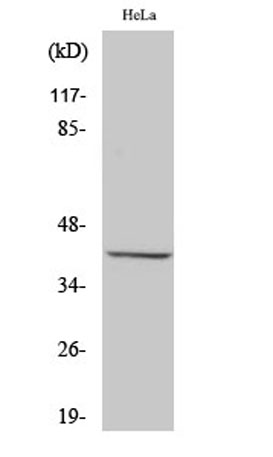
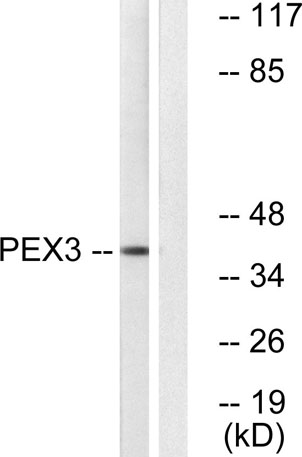
| Observed band (KD) | 42kD |
| Background | The product of this gene is involved in peroxisome biosynthesis and integrity. It assembles membrane vesicles before the matrix proteins are translocated. Peroxins (PEXs) are proteins that are essential for the assembly of functional peroxisomes. The peroxisome biogenesis disorders (PBDs) are a group of genetically heterogeneous autosomal recessive, lethal diseases characterized by multiple defects in peroxisome function. The peroxisomal biogenesis disorders are a heterogeneous group with at least 14 complementation groups and with more than 1 phenotype being observed in cases falling into particular complementation groups. Although the clinical features of PBD patients vary, cells from all PBD patients exhibit a defect in the import of one or more classes of peroxisomal matrix proteins into the organelle. Defects in this gene are a cause Zellweger syndrome (ZWS). [provided by RefSeq, Oct 20 |
| Function | disease:Defects in PEX3 are a cause of Zellweger syndrome (ZwS) [MIM:214100]. ZWS is a fatal peroxisome biogenesis disorder characterized by dysmorphic facial features, hepatomegaly, ocular abnormalities, renal cysts, hearing impairment, profound psychomotor retardation, severe hypotonia and neonatal seizures. Death occurs within the first year of life.,disease:Defects in PEX3 are the cause of peroxisome biogenesis disorder complementation group 12 (PBD-CG12) [MIM:603164]; also known as PBD-CGG. PBD refers to a group of peroxisomal disorders arising from a failure of protein import into the peroxisomal membrane or matrix. The PBD group is comprised of four disorders: Zellweger syndrome (ZWS), neonatal adrenoleukodystrophy (NALD), infantile Refsum disease (IRD), and classical rhizomelic chondrodysplasia punctata (RCDP). ZWS, NALD and IRD are distinct from RCDP and constitute a clinical co |
| Subcellular location | Peroxisome membrane ; Multi-pass membrane protein . |
| Expression | Found in all examined tissues. |

Use collapsible tabs for more detailed information that will help customers make a purchasing decision.
Ex: Shipping and return policies, size guides, and other common questions.