 Français
 English
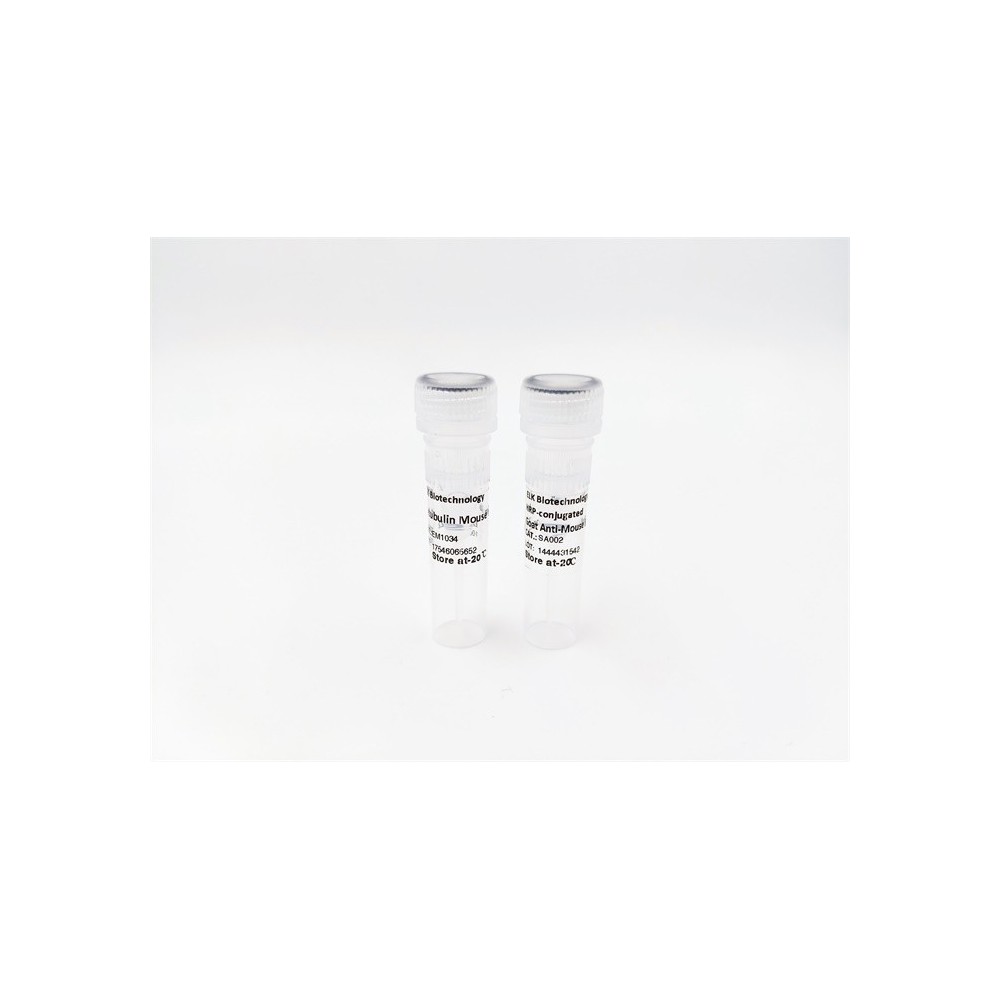

| ELK.No | ES3196 |
| Product name | pHyde rabbit pAb |
| Reactivity | Human;Mouse;Rat |
| Applications | WB;IHC;IF;ELISA |
| Other name | STEAP3; TSAP6; Metalloreductase STEAP3; Dudulin-2; Six-transmembrane epithelial antigen of prostate 3; Tumor suppressor-activated pathway protein 6; hTSAP6; pHyde; hpHyde |
| Size | 50μL |
| Unit price ($) | 148 |
| Human gene ID | 55240 |
| Human Swiss-Prot | Q658P3 |
| Source | Rabbit |
| Isotype | IgG |
| Target | pHyde |
| Fields | >>p53 signaling pathway;>>Ferroptosis |
| Gene name | STEAP3 |
| Protein name | Metalloreductase STEAP3 |
| Human gene link | View Human Gene |
| Human Swiss link | View Human Swiss-Prot |
| Mouse gene ID | 68428 |
| Mouse gene link | View Mouse Gene |
| Mouse Swiss-Prot | Q8CI59 |
| Mouse Swiss link | View Mouse Swiss-Prot |
| Rat gene ID | 170824 |
| Rat gene link | View Rat Gene |
| Rat Swiss-Prot | Q5RKL5 |
| Rat Swiss link | View Rat Swiss-Prot |
| Immunogen | The antiserum was produced against synthesized peptide derived from human STEA3. AA range:421-470 |
| Specificity | pHyde Polyclonal Antibody detects endogenous levels of pHyde protein. |
| Formulation | Liquid in PBS containing 50% glycerol, 0.5% BSA and 0.02% sodium azide. |
| Clonality | Polyclonal |
| Dilution | Western Blot: 1/500 - 1/2000. Immunohistochemistry: 1/100 - 1/300. Immunofluorescence: 1/200 - 1/1000. ELISA: 1/10000. Not yet tested in other applications. |
| Purification | The antibody was affinity-purified from rabbit antiserum by affinity-chromatography using epitope-specific immunogen. |
| Concentration | 1 mg/ml |
| Storage stability | -20°C/1 year |
| Molecular Weight (Da) | |
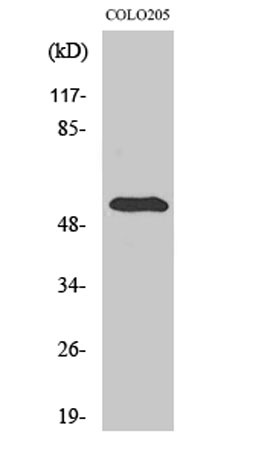
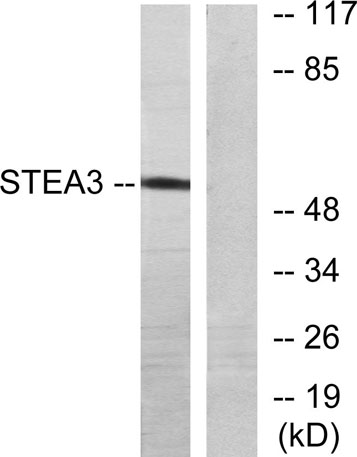
| Observed band (KD) | 54kD |
| Background | STEAP3 metalloreductase(STEAP3) Homo sapiens This gene encodes a multipass membrane protein that functions as an iron transporter. The encoded protein can reduce both iron (Fe3+) and copper (Cu2+) cations. This protein may mediate downstream responses to p53, including promoting apoptosis. Deficiency in this gene can cause anemia. Alternative splicing results in multiple transcript variants. [provided by RefSeq, Aug 2015], |
| Function | caution:Was initially thought to have tumor suppressor function in prostate cancer. However, it was shown that it is probably not the case (PubMed:12866033).,cofactor:FAD.,function:Endosomal ferrireductase required for efficient transferrin-dependent iron uptake in erythroid cells. Participates in erythroid iron homeostasis by reducing Fe(3+) to Fe(2+). Can also reduce of Cu(2+) to Cu(1+), suggesting that it participates in copper homeostasis. Uses NAD(+) as acceptor (By similarity). May play a role downstream of p53/TP53 to interface apoptosis and cell cycle progression. Indirectly involved in exosome secretion by facilitating the secretion of proteins such as TCTP.,induction:By p53/TP53.,similarity:Belongs to the STEAP family.,similarity:Contains 1 ferric oxidoreductase domain.,subcellular location:Localizes to vesicular-like structures at the plasma membrane and around the nucleus.,su |
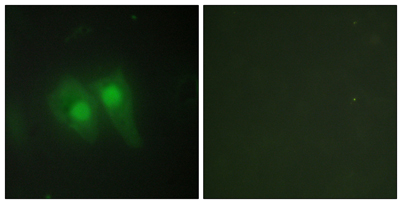
| Subcellular location | Endosome membrane ; Multi-pass membrane protein . Localizes to vesicular-like structures at the plasma membrane and around the nucleus. |
| Expression | Expressed in adult bone marrow, placenta, liver, skeletal muscle and pancreas. Down-regulated in hepatocellular carcinoma. |

Use collapsible tabs for more detailed information that will help customers make a purchasing decision.
Ex: Shipping and return policies, size guides, and other common questions.