 Français
 English
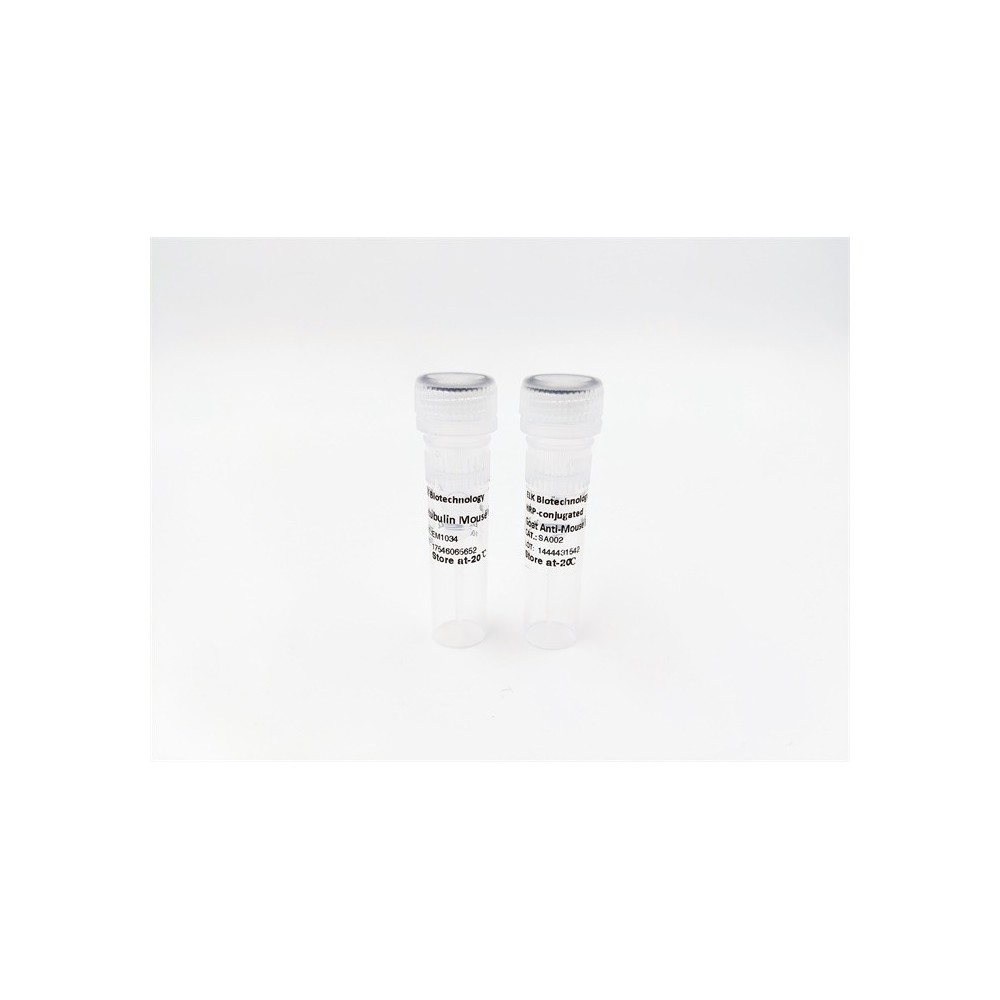

| ELK.No | ES3285 |
| Product name | PUMA rabbit pAb |
| Reactivity | Human;Mouse;Rat |
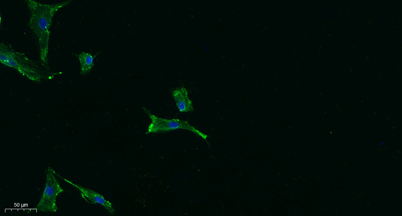
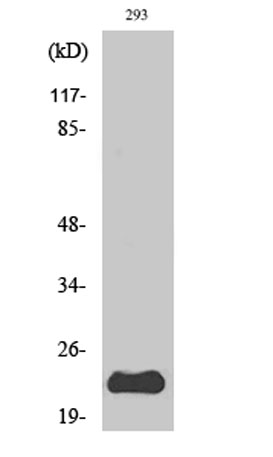
| Applications | WB IF;ELISA |
| Other name | BBC3; PUMA; Bcl-2-binding component 3; JFY-1; p53 up-regulated modulator of apoptosis |
| Size | 100μL |
| Unit price ($) | 248 |
| Human gene ID | 27113 |
| Human Swiss-Prot | Q9BXH1 |
| Source | Rabbit |
| Isotype | IgG |
| Target | PUMA |
| Fields | >>Platinum drug resistance;>>p53 signaling pathway;>>Apoptosis;>>Apoptosis - multiple species;>>Hippo signaling pathway;>>Huntington disease;>>Measles;>>Pathways in cancer;>>Colorectal cancer |
| Gene name | BBC3 |
| Protein name | Bcl-2-binding component 3 |
| Human gene link | View Human Gene |
| Human Swiss link | View Human Swiss-Prot |
| Mouse gene ID | 170770 |
| Mouse gene link | View Mouse Gene |
| Mouse Swiss-Prot | Q99ML1 |
| Mouse Swiss link | View Mouse Swiss-Prot |
| Rat gene ID | 317673 |
| Rat gene link | View Rat Gene |
| Rat Swiss-Prot | Q80ZG6 |
| Rat Swiss link | View Rat Swiss-Prot |
| Immunogen | The antiserum was produced against synthesized peptide derived from human PUMA. AA range:120-169 |
| Specificity | PUMA Polyclonal Antibody detects endogenous levels of PUMA protein. |
| Formulation | Liquid in PBS containing 50% glycerol, 0.5% BSA and 0.02% sodium azide. |
| Clonality | Polyclonal |
| Dilution | WB 1:500-2000 IF 1:100-300 ELISA 1:5000-20000 Not yet tested in other applications. |
| Purification | The antibody was affinity-purified from rabbit antiserum by affinity-chromatography using epitope-specific immunogen. |
| Concentration | 1 mg/ml |
| Storage stability | -20°C/1 year |
| Molecular Weight (Da) | |
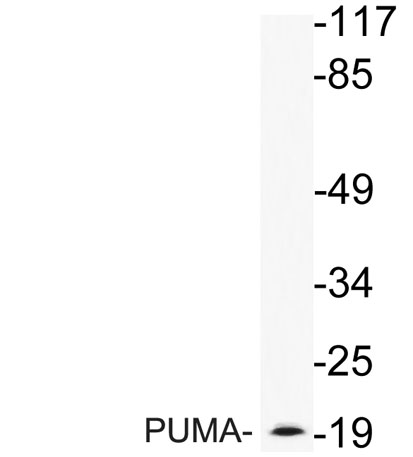
| Observed band (KD) | 23kD |
| Background | This gene encodes a member of the BCL-2 family of proteins. This family member belongs to the BH3-only pro-apoptotic subclass. The protein cooperates with direct activator proteins to induce mitochondrial outer membrane permeabilization and apoptosis. It can bind to anti-apoptotic Bcl-2 family members to induce mitochondrial dysfunction and caspase activation. Because of its pro-apoptotic role, this gene is a potential drug target for cancer therapy and for tissue injury. Alternative splicing results in multiple transcript variants. [provided by RefSeq, Dec 2011], |
| Function | function:Essential mediator of p53-dependent and p53-independent apoptosis.,induction:By DNA damage, glucocorticoid treatment, growth factor deprivation and p53.,similarity:Belongs to the Bcl-2 family.,subcellular location:Localized to the mitochondria in order to induce cytochrome c release.,subunit:Interacts with MCL1 and BCL2A1 (By similarity). Interacts with BCL2 and BCL2L1/BCL-XL.,tissue specificity:Ubiquitously expressed., |
| Subcellular location | Mitochondrion . Localized to the mitochondria in order to induce cytochrome c release. |
| Expression | Ubiquitously expressed. |

Use collapsible tabs for more detailed information that will help customers make a purchasing decision.
Ex: Shipping and return policies, size guides, and other common questions.