 Français
 English
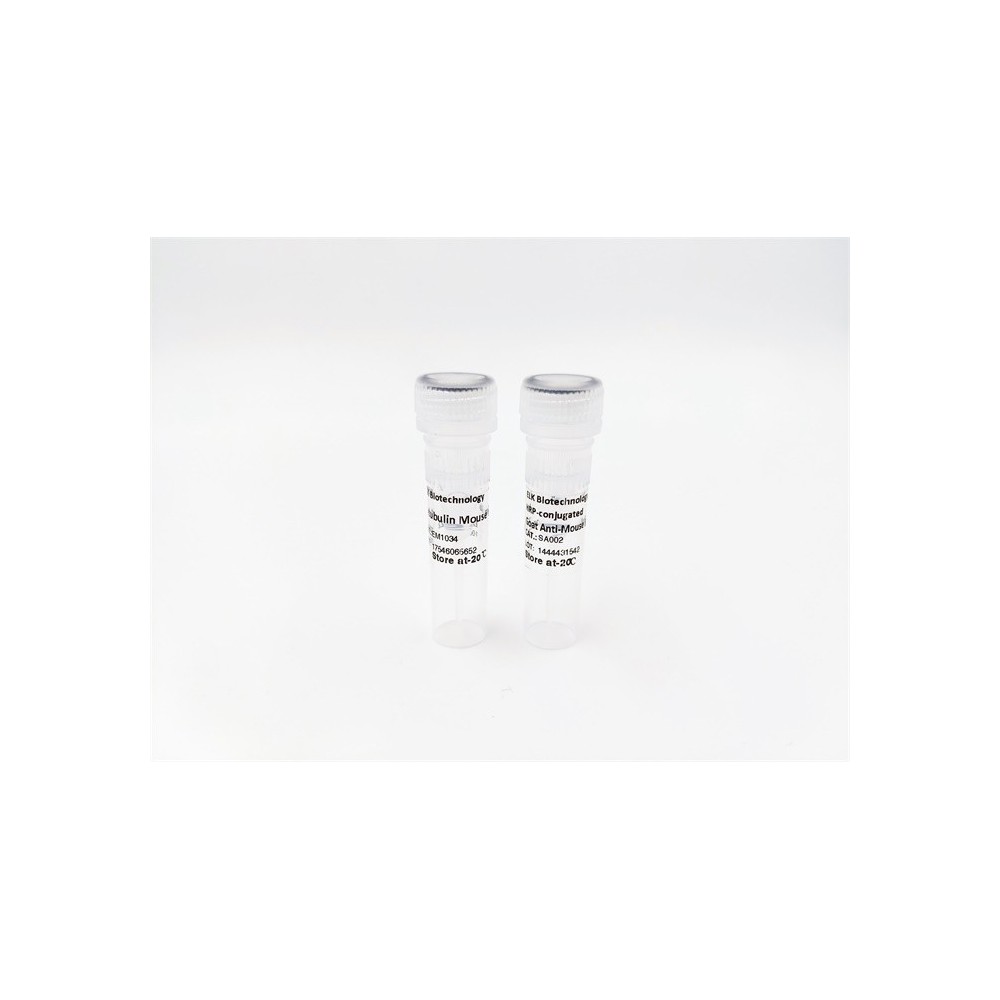

| ELK.No | ES3328 |
| Product name | RARβ rabbit pAb |
| Reactivity | Human;Mouse |
| Applications | WB;IHC;IF;ELISA |
| Other name | RARB; HAP; NR1B2; Retinoic acid receptor beta; RAR-beta; HBV-activated protein; Nuclear receptor subfamily 1 group B member 2; RAR-epsilon |
| Size | 50μL |
| Unit price ($) | 148 |
| Human gene ID | 5915 |
| Human Swiss-Prot | P10826 |
| Source | Rabbit |
| Isotype | IgG |
| Target | RARβ |
| Fields | >>Pathways in cancer;>>Small cell lung cancer;>>Non-small cell lung cancer;>>Gastric cancer |
| Gene name | RARB |
| Protein name | Retinoic acid receptor beta |
| Human gene link | View Human Gene |
| Human Swiss link | View Human Swiss-Prot |
| Mouse gene ID | 218772 |
| Mouse gene link | View Mouse Gene |
| Mouse Swiss-Prot | P22605 |
| Mouse Swiss link | View Mouse Swiss-Prot |
| Rat gene ID | |
| Rat gene link | |
| Rat Swiss-Prot | |
| Rat Swiss link | |
| Immunogen | The antiserum was produced against synthesized peptide derived from human Retinoic Acid Receptor beta. AA range:331-380 |
| Specificity | RARβ Polyclonal Antibody detects endogenous levels of RARβ protein. |
| Formulation | Liquid in PBS containing 50% glycerol, 0.5% BSA and 0.02% sodium azide. |
| Clonality | Polyclonal |
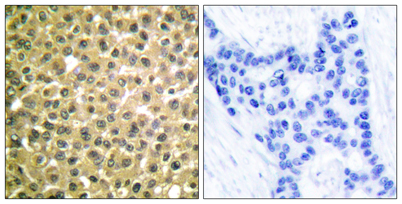
| Dilution | Western Blot: 1/500 - 1/2000. Immunohistochemistry: 1/100 - 1/300. ELISA: 1/20000. Not yet tested in other applications. |
| Purification | The antibody was affinity-purified from rabbit antiserum by affinity-chromatography using epitope-specific immunogen. |
| Concentration | 1 mg/ml |
| Storage stability | -20°C/1 year |
| Molecular Weight (Da) | |
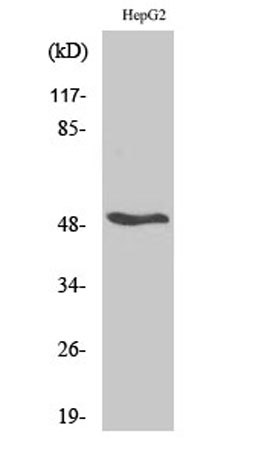
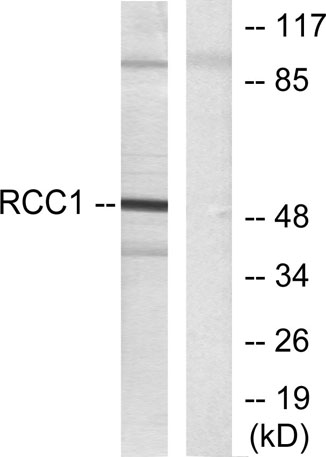
| Observed band (KD) | 50kD |
| Background | This gene encodes retinoic acid receptor beta, a member of the thyroid-steroid hormone receptor superfamily of nuclear transcriptional regulators. This receptor localizes to the cytoplasm and to subnuclear compartments. It binds retinoic acid, the biologically active form of vitamin A which mediates cellular signalling in embryonic morphogenesis, cell growth and differentiation. It is thought that this protein limits growth of many cell types by regulating gene expression. The gene was first identified in a hepatocellular carcinoma where it flanks a hepatitis B virus integration site. Alternate promoter usage and differential splicing result in multiple transcript variants. [provided by RefSeq, Mar 2014], |
| Function | domain:Composed of three domains: a modulating N-terminal domain, a DNA-binding domain and a C-terminal steroid-binding domain.,function:This is a receptor for retinoic acid. This metabolite has profound effects on vertebrate development. Retinoic acid is a morphogen and is a powerful teratogen. This receptor controls cell function by directly regulating gene expression.,similarity:Belongs to the nuclear hormone receptor family.,similarity:Belongs to the nuclear hormone receptor family. NR1 subfamily.,similarity:Contains 1 nuclear receptor DNA-binding domain., |
| Subcellular location | Nucleus . Cytoplasm .; [Isoform Beta-1]: Nucleus.; [Isoform Beta-2]: Nucleus.; [Isoform Beta-4]: Cytoplasm. |
| Expression | Expressed in aortic endothelial cells (at protein level). |

Use collapsible tabs for more detailed information that will help customers make a purchasing decision.
Ex: Shipping and return policies, size guides, and other common questions.