 Français
 English

| ELK.No | ES3483 |
| Product name | SP-B rabbit pAb |
| Reactivity | Human;Rat;Mouse; |
| Applications | WB;ELISA;IHC |
| Other name | SFTPB; SFTP3; Pulmonary surfactant-associated protein B; SP-B; 18 kDa pulmonary-surfactant protein; 6 kDa protein; Pulmonary surfactant-associated proteolipid SPL(Phe) |
| Size | 100μL |
| Unit price ($) | 248 |
| Human gene ID | 6439 |
| Human Swiss-Prot | P07988 |
| Source | Rabbit |
| Isotype | IgG |
| Target | SP-B |
| Fields | |
| Gene name | SFTPB |
| Protein name | Pulmonary surfactant-associated protein B |
| Human gene link | View Human Gene |
| Human Swiss link | View Human Swiss-Prot |
| Mouse gene ID | |
| Mouse gene link | |
| Mouse Swiss-Prot | P50405 |
| Mouse Swiss link | View Mouse Swiss-Prot |
| Rat gene ID | |
| Rat gene link | |
| Rat Swiss-Prot | |
| Rat Swiss link | |
| Immunogen | The antiserum was produced against synthesized peptide derived from human SP-B. AA range:243-292 |
| Specificity | SP-B Polyclonal Antibody detects endogenous levels of SP-B protein. |
| Formulation | Liquid in PBS containing 50% glycerol, 0.5% BSA and 0.02% sodium azide. |
| Clonality | Polyclonal |
| Dilution | WB 1:500-2000;IHC-p 1:50-300; ELISA 2000-20000 |
| Purification | The antibody was affinity-purified from rabbit antiserum by affinity-chromatography using epitope-specific immunogen. |
| Concentration | 1 mg/ml |
| Storage stability | -20°C/1 year |
| Molecular Weight (Da) | |
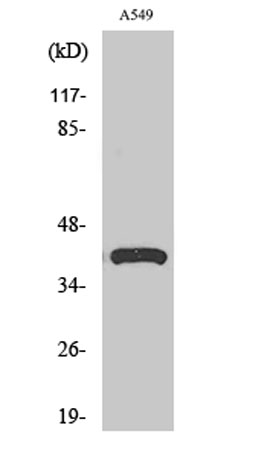
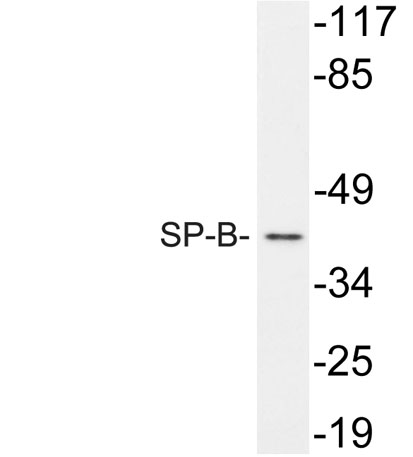
| Observed band (KD) | 42kD |
| Background | This gene encodes the pulmonary-associated surfactant protein B (SPB), an amphipathic surfactant protein essential for lung function and homeostasis after birth. Pulmonary surfactant is a surface-active lipoprotein complex composed of 90% lipids and 10% proteins which include plasma proteins and apolipoproteins SPA, SPB, SPC and SPD. The surfactant is secreted by the alveolar cells of the lung and maintains the stability of pulmonary tissue by reducing the surface tension of fluids that coat the lung. The SPB enhances the rate of spreading and increases the stability of surfactant monolayers in vitro. Multiple mutations in this gene have been identified, which cause pulmonary surfactant metabolism dysfunction type 1, also called pulmonary alveolar proteinosis due to surfactant protein B deficiency, and are associated with fatal respiratory distress in the neonatal period. Alternatively spliced trans |
| Function | disease:Defects in SFTPB are the cause of pulmonary surfactant metabolism dysfunction type 1 (SMDP1) [MIM:265120]; also called pulmonary alveolar proteinosis due to surfactant protein B deficiency. Inborn errors of pulmonary surfactant metabolism are genetically heterogeneous disorders resulting in severe respiratory insufficiency or failure in full-term neonates or infants. These disorders are associated with various pathologic entities, including pulmonary alveolar proteinosis (PAP), desquamative interstitial pneumonitis (DIP), or cellular non-specific interstitial pneumonitis (NSIP).,function:Pulmonary surfactant-associated proteins promote alveolar stability by lowering the surface tension at the air-liquid interface in the peripheral air spaces. SP-B increases the collapse pressure of palmitic acid to nearly 70 millinewtons per meter.,miscellaneous:Pulmonary surfactant consists of 9 |
| Subcellular location | Secreted, extracellular space, surface film. |
| Expression | Brain,Lung, |

Use collapsible tabs for more detailed information that will help customers make a purchasing decision.
Ex: Shipping and return policies, size guides, and other common questions.