 Français
 English

| ELK.No | ES3534 |
| Product name | Synaptotagmin XI rabbit pAb |
| Reactivity | Human;Mouse;Rat |
| Applications | WB;ELISA |
| Other name | SYT11; KIAA0080; Synaptotagmin-11; Synaptotagmin XI; SytXI |
| Size | 100μL |
| Unit price ($) | 248 |
| Human gene ID | 23208 |
| Human Swiss-Prot | Q9BT88 |
| Source | Rabbit |
| Isotype | IgG |
| Target | Synaptotagmin XI |
| Fields | |
| Gene name | SYT11 |
| Protein name | Synaptotagmin-11 |
| Human gene link | View Human Gene |
| Human Swiss link | View Human Swiss-Prot |
| Mouse gene ID | 229521 |
| Mouse gene link | View Mouse Gene |
| Mouse Swiss-Prot | Q9R0N3 |
| Mouse Swiss link | View Mouse Swiss-Prot |
| Rat gene ID | |
| Rat gene link | |
| Rat Swiss-Prot | O08835 |
| Rat Swiss link | View Rat Swiss-Prot |
| Immunogen | The antiserum was produced against synthesized peptide derived from human SYT11. AA range:181-230 |
| Specificity | Synaptotagmin XI Polyclonal Antibody detects endogenous levels of Synaptotagmin XI protein. |
| Formulation | Liquid in PBS containing 50% glycerol, 0.5% BSA and 0.02% sodium azide. |
| Clonality | Polyclonal |
| Dilution | Western Blot: 1/500 - 1/2000. ELISA: 1/10000. Not yet tested in other applications. |
| Purification | The antibody was affinity-purified from rabbit antiserum by affinity-chromatography using epitope-specific immunogen. |
| Concentration | 1 mg/ml |
| Storage stability | -20°C/1 year |
| Molecular Weight (Da) | |
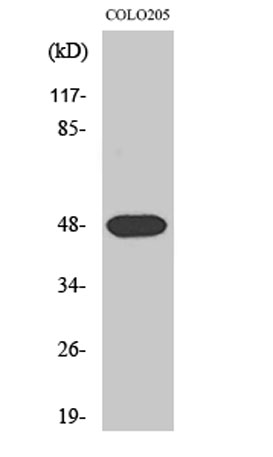
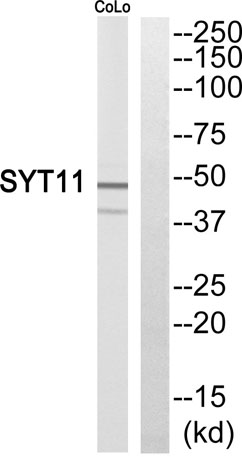
| Observed band (KD) | 48kD |
| Background | synaptotagmin 11(SYT11) Homo sapiens This gene is a member of the synaptotagmin gene family and encodes a protein similar to other family members that are known calcium sensors and mediate calcium-dependent regulation of membrane trafficking in synaptic transmission. The encoded protein is also a substrate for ubiquitin-E3-ligase parkin. The gene has previously been referred to as synaptotagmin XII but has been renamed synaptotagmin XI to be consistent with mouse and rat official nomenclature. [provided by RefSeq, Apr 2010], |
| Function | cofactor:Binds 3 calcium ions per subunit. The ions are bound to the C2 domains.,function:May be involved in Ca(2+)-dependent exocytosis of secretory vesicles through Ca(2+) and phospholipid binding to the C2 domain or may serve as Ca(2+) sensors in the process of vesicular trafficking and exocytosis.,PTM:Ubiquitinated and targeted to the proteasome complex for degradation.,similarity:Belongs to the synaptotagmin family.,similarity:Contains 2 C2 domains.,subcellular location:In substantia nigra, observed in neuronal cell bodies and neurites. Found in the core of the Lewy bodies in the brain of sporadic Parkinson disease patients.,subunit:Homodimer. Can also form heterodimers (By similarity). Interacts with PARK2., |
| Subcellular location | Cytoplasmic vesicle membrane ; Single-pass membrane protein . Perikaryon . Golgi apparatus, trans-Golgi network membrane ; Single-pass membrane protein . Recycling endosome membrane ; Single-pass membrane protein . Lysosome membrane ; Single-pass membrane protein . Cytoplasmic vesicle, phagosome . Cell projection, axon . Cell projection, dendrite . Cell junction, synapse, postsynaptic density . Recycling endosome membrane ; Single-pass membrane protein . Cytoplasmic vesicle, clathrin-coated vesicle membrane ; Single-pass membrane protein . Perikaryon . Localized in vesicles that travels in axonal and dendritic shafts in both anterograde and retrograde directions. In macrophages and microglia, recruited in phagosomes at early stages of phagocytosis (By similarity). Found in the core of the |
| Expression | Amygdala,Bone marrow,Brain,Lymph, |

Use collapsible tabs for more detailed information that will help customers make a purchasing decision.
Ex: Shipping and return policies, size guides, and other common questions.