 Français
 English

| ELK.No | ES3763 |
| Product name | FTO rabbit pAb |
| Reactivity | Human;Mouse;Rat |
| Applications | WB;ELISA |
| Other name | FTO; KIAA1752; Alpha-ketoglutarate-dependent dioxygenase FTO; Fat mass and obesity-associated protein |
| Size | 50μL |
| Unit price ($) | 148 |
| Human gene ID | 79068 |
| Human Swiss-Prot | Q9C0B1 |
| Source | Rabbit |
| Isotype | IgG |
| Target | FTO |
| Fields | |
| Gene name | FTO |
| Protein name | Alpha-ketoglutarate-dependent dioxygenase FTO |
| Human gene link | View Human Gene |
| Human Swiss link | View Human Swiss-Prot |
| Mouse gene ID | 26383 |
| Mouse gene link | View Mouse Gene |
| Mouse Swiss-Prot | Q8BGW1 |
| Mouse Swiss link | View Mouse Swiss-Prot |
| Rat gene ID | 291905 |
| Rat gene link | View Rat Gene |
| Rat Swiss-Prot | Q2A121 |
| Rat Swiss link | View Rat Swiss-Prot |
| Immunogen | The antiserum was produced against synthesized peptide derived from human FTO. AA range:19-68 |
| Specificity | FTO Polyclonal Antibody detects endogenous levels of FTO protein. |
| Formulation | Liquid in PBS containing 50% glycerol, 0.5% BSA and 0.02% sodium azide. |
| Clonality | Polyclonal |
| Dilution | Western Blot: 1/500 - 1/2000. ELISA: 1/20000. Not yet tested in other applications. |
| Purification | The antibody was affinity-purified from rabbit antiserum by affinity-chromatography using epitope-specific immunogen. |
| Concentration | 1 mg/ml |
| Storage stability | -20°C/1 year |
| Molecular Weight (Da) | |
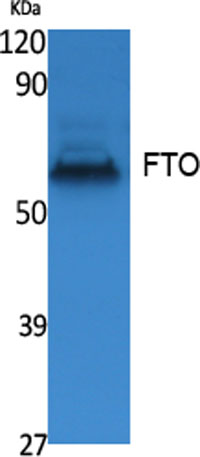
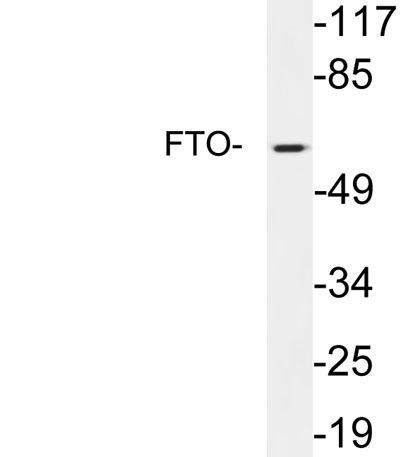
| Observed band (KD) | 58kD |
| Background | This gene is a nuclear protein of the AlkB related non-haem iron and 2-oxoglutarate-dependent oxygenase superfamily but the exact physiological function of this gene is not known. Other non-heme iron enzymes function to reverse alkylated DNA and RNA damage by oxidative demethylation. Studies in mice and humans indicate a role in nervous and cardiovascular systems and a strong association with body mass index, obesity risk, and type 2 diabetes. [provided by RefSeq, Jul 2011], |
| Function | function:The precise function of this protein remains to be determined.,polymorphism:At least one intronic variation within the gene predisposes to childhood and adult obesity.,similarity:Belongs to the fto family.,tissue specificity:Ubiquitously expressed, with relatively high expression in adrenal glands and brain; especially in hypothalamus and pituitary., |
| Subcellular location | Nucleus . Nucleus speckle . Cytoplasm . Localizes mainly in the nucleus, where it is able to demethylate N(6)-methyladenosine (m6A) and N(6),2'-O-dimethyladenosine cap (m6A(m)) in U6 small nuclear RNA (snRNA), N(1)-methyladenine from tRNAs and internal m6A in mRNAs (PubMed:30197295). In the cytoplasm, mediates demethylation of m6A and m6A(m) in mRNAs and N(1)-methyladenine from tRNAs (PubMed:30197295). . |
| Expression | Ubiquitously expressed, with relatively high expression in adrenal glands and brain; especially in hypothalamus and pituitary (PubMed:17434869, PubMed:17496892). Highly expressed in highly expressed in acute myeloid leukemias (AML) with t(11;11)(q23;23) with KMT2A/MLL1 rearrangements, t(15;17)(q21;q21)/PML-RARA, FLT3-ITD, and/or NPM1 mutations (PubMed:28017614). |

Use collapsible tabs for more detailed information that will help customers make a purchasing decision.
Ex: Shipping and return policies, size guides, and other common questions.