 Français
 English

| ELK.No | ES3765 |
| Product name | Gl Syn rabbit pAb |
| Reactivity | Human;Mouse;Rat |
| Applications | WB;ELISA |
| Other name | GLUL; GLNS; Glutamine synthetase; GS; Glutamate decarboxylase; Glutamate--ammonia ligase |
| Size | 50μL |
| Unit price ($) | 148 |
| Human gene ID | 2752 |
| Human Swiss-Prot | P15104 |
| Source | Rabbit |
| Isotype | IgG |
| Target | Gl Syn |
| Fields | >>Arginine biosynthesis;>>Alanine, aspartate and glutamate metabolism;>>Glyoxylate and dicarboxylate metabolism;>>Nitrogen metabolism;>>Metabolic pathways;>>Biosynthesis of amino acids;>>Necroptosis;>>Glutamatergic synapse;>>GABAergic synapse |
| Gene name | GLUL |
| Protein name | Glutamine synthetase |
| Human gene link | View Human Gene |
| Human Swiss link | View Human Swiss-Prot |
| Mouse gene ID | 14645 |
| Mouse gene link | View Mouse Gene |
| Mouse Swiss-Prot | P15105 |
| Mouse Swiss link | View Mouse Swiss-Prot |
| Rat gene ID | 24957 |
| Rat gene link | View Rat Gene |
| Rat Swiss-Prot | P09606 |
| Rat Swiss link | View Rat Swiss-Prot |
| Immunogen | The antiserum was produced against synthesized peptide derived from human Gl Syn. AA range:295-344 |
| Specificity | Gl Syn Polyclonal Antibody detects endogenous levels of Gl Syn protein. |
| Formulation | Liquid in PBS containing 50% glycerol, 0.5% BSA and 0.02% sodium azide. |
| Clonality | Polyclonal |
| Dilution | Western Blot: 1/500 - 1/2000. ELISA: 1/20000. Not yet tested in other applications. |
| Purification | The antibody was affinity-purified from rabbit antiserum by affinity-chromatography using epitope-specific immunogen. |
| Concentration | 1 mg/ml |
| Storage stability | -20°C/1 year |
| Molecular Weight (Da) | |
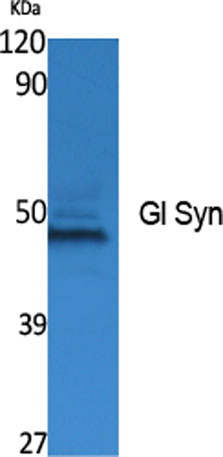
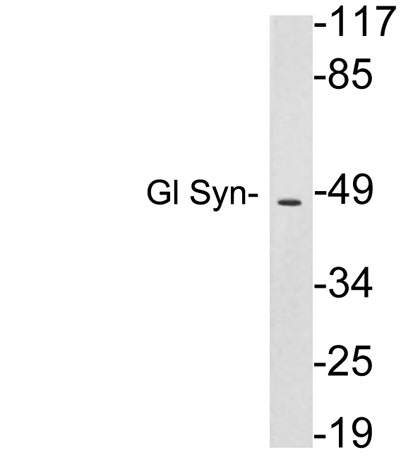
| Observed band (KD) | 42kD |
| Background | The protein encoded by this gene belongs to the glutamine synthetase family. It catalyzes the synthesis of glutamine from glutamate and ammonia in an ATP-dependent reaction. This protein plays a role in ammonia and glutamate detoxification, acid-base homeostasis, cell signaling, and cell proliferation. Glutamine is an abundant amino acid, and is important to the biosynthesis of several amino acids, pyrimidines, and purines. Mutations in this gene are associated with congenital glutamine deficiency, and overexpression of this gene was observed in some primary liver cancer samples. There are six pseudogenes of this gene found on chromosomes 2, 5, 9, 11, and 12. Alternative splicing results in multiple transcript variants. [provided by RefSeq, Dec 2014], |
| Function | catalytic activity:ATP + L-glutamate + NH(3) = ADP + phosphate + L-glutamine.,disease:Defects in GLUL are the cause of congenital systemic glutamine deficiency (CSGD) [MIM:610015]. CSGD is a rare developmental disorder with severe brain malformation resulting in multi-organ failure and neonatal death. Glutamine is largely absent from affected patients serum, urine and cerebrospinal fluid.,online information:Glutamine synthetase entry,similarity:Belongs to the glutamine synthetase family.,subunit:Homooctamer., |
| Subcellular location | Cytoplasm, cytosol . Microsome . Mitochondrion . Cell membrane ; Lipid-anchor . Mainly localizes in the cytosol, with a fraction associated with the cell membrane. . |
| Expression | Expressed in endothelial cells. |

Use collapsible tabs for more detailed information that will help customers make a purchasing decision.
Ex: Shipping and return policies, size guides, and other common questions.