 Français
 English

| ELK.No | ES3767 |
| Product name | ING4 rabbit pAb |
| Reactivity | Human;Mouse;Rat |
| Applications | WB;ELISA |
| Other name | ING4; My036; Inhibitor of growth protein 4; p29ING4 |
| Size | 50μL |
| Unit price ($) | 148 |
| Human gene ID | 51147 |
| Human Swiss-Prot | Q9UNL4 |
| Source | Rabbit |
| Isotype | IgG |
| Target | ING4 |
| Fields | |
| Gene name | ING4 |
| Protein name | Inhibitor of growth protein 4 |
| Human gene link | View Human Gene |
| Human Swiss link | View Human Swiss-Prot |
| Mouse gene ID | 28019 |
| Mouse gene link | View Mouse Gene |
| Mouse Swiss-Prot | Q8C0D7 |
| Mouse Swiss link | View Mouse Swiss-Prot |
| Rat gene ID | |
| Rat gene link | |
| Rat Swiss-Prot | |
| Rat Swiss link | |
| Immunogen | The antiserum was produced against synthesized peptide derived from human ING4. AA range:107-156 |
| Specificity | ING4 Polyclonal Antibody detects endogenous levels of ING4 protein. |
| Formulation | Liquid in PBS containing 50% glycerol, 0.5% BSA and 0.02% sodium azide. |
| Clonality | Polyclonal |
| Dilution | Western Blot: 1/500 - 1/2000. ELISA: 1/20000. Not yet tested in other applications. |
| Purification | The antibody was affinity-purified from rabbit antiserum by affinity-chromatography using epitope-specific immunogen. |
| Concentration | 1 mg/ml |
| Storage stability | -20°C/1 year |
| Molecular Weight (Da) | |
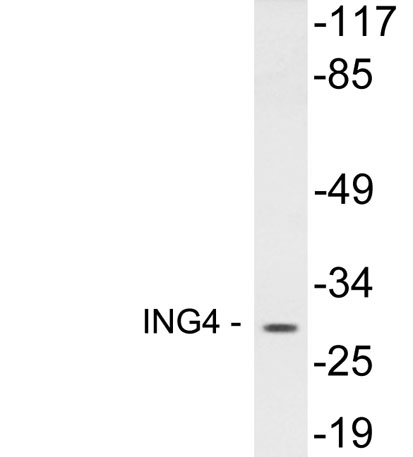
| Observed band (KD) | 28kD |
| Background | This gene encodes a tumor suppressor protein that contains a PHD-finger, which is a common motif in proteins involved in chromatin remodeling. This protein can bind TP53 and EP300/p300, a component of the histone acetyl transferase complex, suggesting its involvement in the TP53-dependent regulatory pathway. Multiple alternatively spliced transcript variants have been observed that encode distinct proteins. [provided by RefSeq, Jul 2008], |
| Function | function:Component of the HBO1 complex which has a histone H4-specific acetyltransferase activity, a reduced activity toward histone H3 and is responsible for the bulk of histone H4 acetylation in vivo. Through chromatin acetylation it may function in DNA replication. May inhibit tumor progression by modulating the transcriptional output of signaling pathways which regulate cell proliferation. Can suppress brain tumor angiogenesis through transcriptional repression of RELA/NFKB3 target genes when complexed with RELA. May also specifically suppress loss of contact inhibition elicited by activated oncogenes such as MYC. Represses hypoxia inducible factor's (HIF) activity by interacting with HIF prolyl hydroxylase 2 (EGLN1).,similarity:Belongs to the ING family.,similarity:Contains 1 PHD-type zinc finger.,subunit:Component of the HBO1 complex composed at least of ING4 or ING5, MYTS2/HBO1, E |
| Subcellular location | Nucleus . |
| Expression | B-cell,Epithelium,Fetal brain,Lung,Pituitary,Placenta, |


Use collapsible tabs for more detailed information that will help customers make a purchasing decision.
Ex: Shipping and return policies, size guides, and other common questions.