 Français
 English
Fractalkine Receptor rabbit pAb
AO-06-ES3842-50

| ELK.No | ES3842 |
| Product name | Fractalkine Receptor rabbit pAb |
| Reactivity | Human;Mouse;Rat |
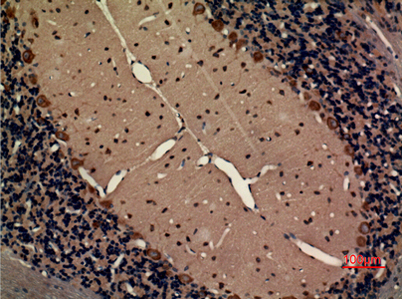
| Applications | WB;IHC;IF;ELISA |
| Other name | CX3CR1; CMKBRL1; GPR13; CX3C chemokine receptor 1; C-X3-C CKR-1; CX3CR1; Beta chemokine receptor-like 1; CMK-BRL-1; CMK-BRL1; Fractalkine receptor; G-protein coupled receptor 13; V28 |
| Size | 50μL |
| Unit price ($) | 148 |
| Human gene ID | 1524 |
| Human Swiss-Prot | P49238 |
| Source | Rabbit |
| Isotype | IgG |
| Target | Fractalkine Receptor |
| Fields | >>Cytokine-cytokine receptor interaction;>>Viral protein interaction with cytokine and cytokine receptor;>>Chemokine signaling pathway |
| Gene name | CX3CR1 |
| Protein name | CX3C chemokine receptor 1 |
| Human gene link | View Human Gene |
| Human Swiss link | View Human Swiss-Prot |
| Mouse gene ID | 13051 |
| Mouse gene link | View Mouse Gene |
| Mouse Swiss-Prot | Q9Z0D9 |
| Mouse Swiss link | View Mouse Swiss-Prot |
| Rat gene ID | 171056 |
| Rat gene link | View Rat Gene |
| Rat Swiss-Prot | P35411 |
| Rat Swiss link | View Rat Swiss-Prot |
| Immunogen | Synthesized peptide derived from Fractalkine Receptor . at AA range: 120-200 |
| Specificity | Fractalkine Receptor Polyclonal Antibody detects endogenous levels of Fractalkine Receptor protein. |
| Formulation | Liquid in PBS containing 50% glycerol, 0.5% BSA and 0.02% sodium azide. |
| Clonality | Polyclonal |
| Dilution | Western Blot: 1/500 - 1/2000. IHC-p: 1:100-300 ELISA: 1/20000. Not yet tested in other applications. |
| Purification | The antibody was affinity-purified from rabbit antiserum by affinity-chromatography using epitope-specific immunogen. |
| Concentration | 1 mg/ml |
| Storage stability | -20°C/1 year |
| Molecular Weight (Da) | |
| Observed band (KD) | 40kD |
| Background | Fractalkine is a transmembrane protein and chemokine involved in the adhesion and migration of leukocytes. The protein encoded by this gene is a receptor for fractalkine. The encoded protein also is a coreceptor for HIV-1, and some variations in this gene lead to increased susceptibility to HIV-1 infection and rapid progression to AIDS. Four transcript variants encoding two different isoforms have been found for this gene. [provided by RefSeq, Jan 2010], |
| Function | function:Receptor for the CX3C chemokine fractalkine and mediates both its adhesive and migratory functions. Acts as coreceptor with CD4 for HIV-1 virus envelope protein (in vitro). Isoform 2 and isoform 3 seem to be more potent HIV-1 coreceptors than isoform 1.,polymorphism:Variations in CX3CR1 are associated with rapid progression to AIDS [MIM:609423]. Increased susceptibility to HIV infection and rapid progression to AIDS are associated with the Ile-249/Met-280 haplotype.,similarity:Belongs to the G-protein coupled receptor 1 family.,subunit:Interacts with human respiratory syncytial virus (HRSV) protein G; this interaction modulates host immune response. Interacts with HIV-1 envelope polyprotein gp160.,tissue specificity:Expressed in lymphoid and neural tissues., |
| Subcellular location | Cell membrane ; Multi-pass membrane protein . |
| Expression | Expressed in lymphoid and neural tissues (PubMed:7590284). Expressed in lymphocyte subsets, such as natural killer (NK) cells, gamma-delta T-cells and terminally differentiated CD8(+) T-cells (PubMed:12055230). Expressed in smooth muscle cells in atherosclerotic plaques (PubMed:14581400). |



Use collapsible tabs for more detailed information that will help customers make a purchasing decision.
Ex: Shipping and return policies, size guides, and other common questions.