 Français
 English

| ELK.No | ES3858 |
| Product name | CA IV rabbit pAb |
| Reactivity | Human;Rat;Mouse; |
| Applications | WB;ELISA |
| Other name | CA4; Carbonic anhydrase 4; Carbonate dehydratase IV; Carbonic anhydrase IV; CA-IV |
| Size | 50μL |
| Unit price ($) | 148 |
| Human gene ID | 762 |
| Human Swiss-Prot | P22748 |
| Source | Rabbit |
| Isotype | IgG |
| Target | CA IV |
| Fields | >>Nitrogen metabolism;>>Metabolic pathways;>>Proximal tubule bicarbonate reclamation |
| Gene name | CA4 |
| Protein name | Carbonic anhydrase 4 |
| Human gene link | View Human Gene |
| Human Swiss link | View Human Swiss-Prot |
| Mouse gene ID | |
| Mouse gene link | |
| Mouse Swiss-Prot | Q64444 |
| Mouse Swiss link | View Mouse Swiss-Prot |
| Rat gene ID | |
| Rat gene link | |
| Rat Swiss-Prot | |
| Rat Swiss link | |
| Immunogen | Synthesized peptide derived from the Internal region of human CA IV. |
| Specificity | CA IV Polyclonal Antibody detects endogenous levels of CA IV protein. |
| Formulation | Liquid in PBS containing 50% glycerol, 0.5% BSA and 0.02% sodium azide. |
| Clonality | Polyclonal |
| Dilution | Western Blot: 1/500 - 1/2000. ELISA: 1/20000. Not yet tested in other applications. |
| Purification | The antibody was affinity-purified from rabbit antiserum by affinity-chromatography using epitope-specific immunogen. |
| Concentration | 1 mg/ml |
| Storage stability | -20°C/1 year |
| Molecular Weight (Da) | |
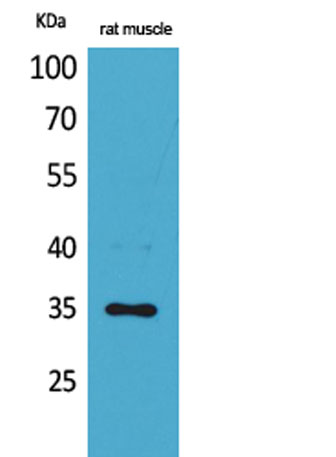
| Observed band (KD) | 35kD |
| Background | Carbonic anhydrases (CAs) are a large family of zinc metalloenzymes that catalyze the reversible hydration of carbon dioxide. They participate in a variety of biological processes, including respiration, calcification, acid-base balance, bone resorption, and the formation of aqueous humor, cerebrospinal fluid, saliva, and gastric acid. They show extensive diversity in tissue distribution and in their subcellular localization. This gene encodes a glycosylphosphatidyl-inositol-anchored membrane isozyme expressed on the luminal surfaces of pulmonary (and certain other) capillaries and proximal renal tubules. Its exact function is not known; however, it may have a role in inherited renal abnormalities of bicarbonate transport. [provided by RefSeq, Jul 2008], |
| Function | catalytic activity:H(2)CO(3) = CO(2) + H(2)O.,cofactor:Zinc.,disease:Defects in CA4 are the cause of retinitis pigmentosa type 17 (RP17) [MIM:600852]. RP leads to degeneration of retinal photoreceptor cells. Patients typically have night vision blindness and loss of midperipheral visual field. As their condition progresses, they lose their far peripheral visual field and eventually central vision as well. RP17 inheritance is autosomal dominant.,enzyme regulation:Inhibited by acetazolamide.,function:Reversible hydration of carbon dioxide. May stimulate the sodium/bicarbonate transporter activity of SLC4A4.,similarity:Belongs to the alpha-carbonic anhydrase family.,subunit:Interacts with SLC4A4.,tissue specificity:Expressed in the endothelium of the choriocapillaris in eyes (at protein level)., |
| Subcellular location | Cell membrane ; Lipid-anchor, GPI-anchor . |
| Expression | Expressed in the endothelium of the choriocapillaris in eyes (at protein level). Not expressed in the retinal epithelium at detectable levels. |

Use collapsible tabs for more detailed information that will help customers make a purchasing decision.
Ex: Shipping and return policies, size guides, and other common questions.