 Français
 English
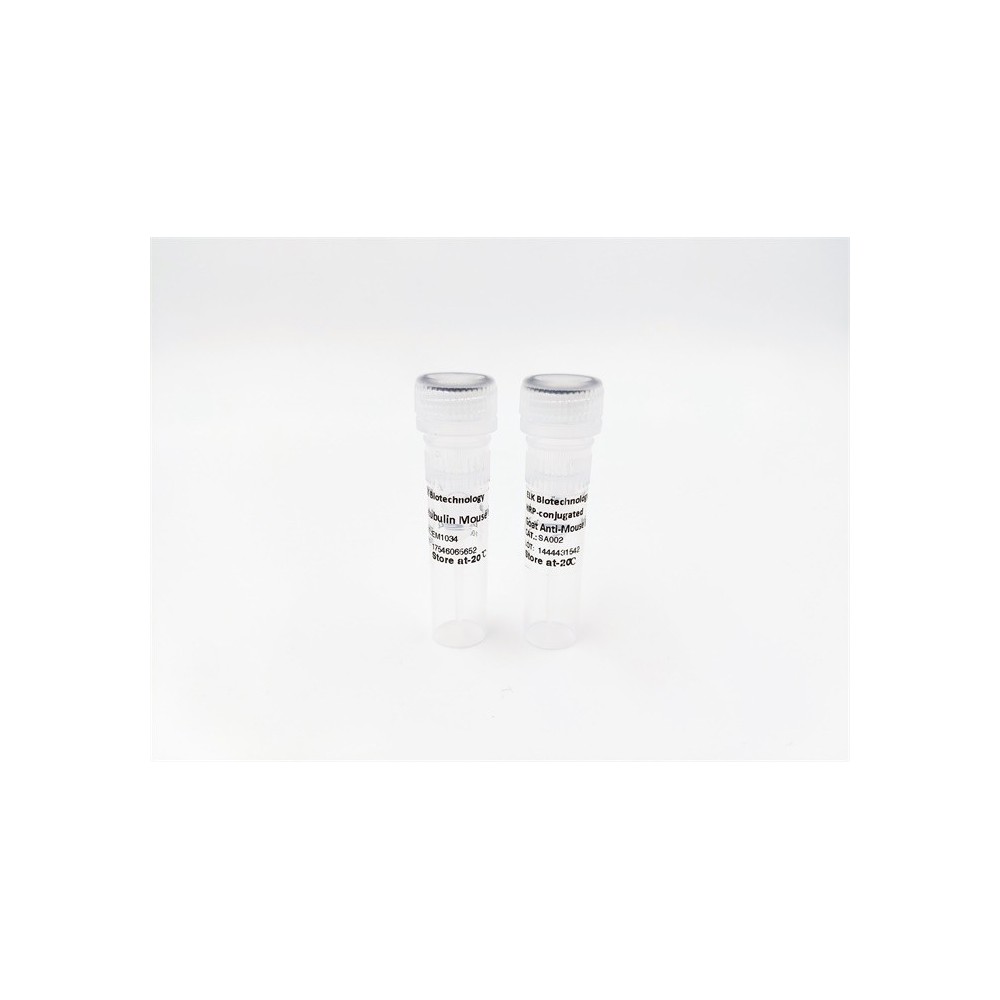

| ELK.No | ES4077 |
| Product name | Smad1 rabbit pAb |
| Reactivity | Human;Mouse;Rat |
| Applications | WB;IHC;IF;ELISA |
| Other name | SMAD1; BSP1; MADH1; MADR1; Mothers against decapentaplegic homolog 1; MAD homolog 1; Mothers against DPP homolog 1; JV4-1; Mad-related protein 1; SMAD family member 1; SMAD 1; Smad1; hSMAD1; Transforming growth factor-beta-signaling protein 1; BSP-1 |
| Size | 50μL |
| Unit price ($) | 148 |
| Human gene ID | 4086 |
| Human Swiss-Prot | Q15797 |
| Source | Rabbit |
| Isotype | IgG |
| Target | Smad1 |
| Fields | >>TGF-beta signaling pathway;>>Hippo signaling pathway;>>Signaling pathways regulating pluripotency of stem cells;>>Transcriptional misregulation in cancer |
| Gene name | SMAD1 |
| Protein name | Mothers against decapentaplegic homolog 1 |
| Human gene link | View Human Gene |
| Human Swiss link | View Human Swiss-Prot |
| Mouse gene ID | 17125 |
| Mouse gene link | View Mouse Gene |
| Mouse Swiss-Prot | P70340 |
| Mouse Swiss link | View Mouse Swiss-Prot |
| Rat gene ID | |
| Rat gene link | |
| Rat Swiss-Prot | P97588 |
| Rat Swiss link | View Rat Swiss-Prot |
| Immunogen | Synthesized peptide derived from Smad1 . at AA range: 150-230 |
| Specificity | Smad1 Polyclonal Antibody detects endogenous levels of Smad1 protein only when non-phosphorylation at S214. |
| Formulation | Liquid in PBS containing 50% glycerol, 0.5% BSA and 0.02% sodium azide. |
| Clonality | Polyclonal |
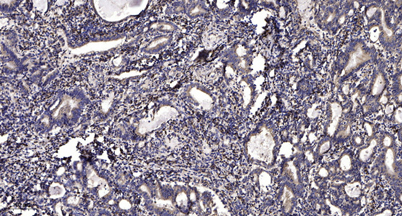
| Dilution | WB 1:500-2000;IHC-p 1:50-300; ELISA 2000-20000 |
| Purification | The antibody was affinity-purified from rabbit antiserum by affinity-chromatography using epitope-specific immunogen. |
| Concentration | 1 mg/ml |
| Storage stability | -20°C/1 year |
| Molecular Weight (Da) | |
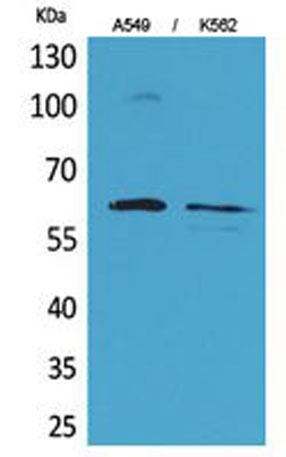
| Observed band (KD) | 52kD |
| Background | The protein encoded by this gene belongs to the SMAD, a family of proteins similar to the gene products of the Drosophila gene 'mothers against decapentaplegic' (Mad) and the C. elegans gene Sma. SMAD proteins are signal transducers and transcriptional modulators that mediate multiple signaling pathways. This protein mediates the signals of the bone morphogenetic proteins (BMPs), which are involved in a range of biological activities including cell growth, apoptosis, morphogenesis, development and immune responses. In response to BMP ligands, this protein can be phosphorylated and activated by the BMP receptor kinase. The phosphorylated form of this protein forms a complex with SMAD4, which is important for its function in the transcription regulation. This protein is a target for SMAD-specific E3 ubiquitin ligases, such as SMURF1 and SMURF2, and undergoes ubiquitination and proteasome-med |
| Function | function:Transcriptional modulator activated by BMP (bone morphogenetic proteins) type 1 receptor kinase. SMAD1 is a receptor-regulated SMAD (R-SMAD).,PTM:Phosphorylated on serine by BMP type 1 receptor kinase.,PTM:Ubiquitin-mediated proteolysis by SMAD-specific E3 ubiquitin ligase SMURF1.,similarity:Belongs to the dwarfin/SMAD family.,similarity:Contains 1 MH1 (MAD homology 1) domain.,similarity:Contains 1 MH2 (MAD homology 2) domain.,subcellular location:Cytoplasmic in the absence of ligand. Migrates to the nucleus when complexed with SMAD4.,subunit:Interacts with HGS, NANOG and ZCCHC12 (By similarity). May form trimers with another SMAD1 and the co-SMAD SMAD4. Interacts with PEBP2-alpha subunit, CREB-binding protein (CBP), p300, SMURF1, SMURF2 and HOXC8. Associates with ZNF423 or ZNF521 in response to BMP2 leading to activate transcription of BMP target genes. Interacts with LBXCOR1., |
| Subcellular location | Cytoplasm . Nucleus . Cytoplasmic in the absence of ligand. Migrates to the nucleus when complexed with SMAD4 (PubMed:15647271). Co-localizes with LEMD3 at the nucleus inner membrane (PubMed:15647271). Exported from the nucleus to the cytoplasm when dephosphorylated (By similarity). . |
| Expression | Ubiquitous. Highest expression seen in the heart and skeletal muscle. |

Use collapsible tabs for more detailed information that will help customers make a purchasing decision.
Ex: Shipping and return policies, size guides, and other common questions.