 Français
 English

| ELK.No | ES4080 |
| Product name | CD10 rabbit pAb |
| Reactivity | Human;Mouse;Rat |
| Applications | WB;IHC;IF;ELISA |
| Other name | MME; EPN; Neprilysin; Atriopeptidase; Common acute lymphocytic leukemia antigen; CALLA; Enkephalinase; Neutral endopeptidase 24.11; NEP; Neutral endopeptidase; Skin fibroblast elastase; SFE; CD10 |
| Size | 100μL |
| Unit price ($) | 248 |
| Human gene ID | 4311 |
| Human Swiss-Prot | P08473 |
| Source | Rabbit |
| Isotype | IgG |
| Target | CD10 |
| Fields | >>Renin-angiotensin system;>>Hematopoietic cell lineage;>>Protein digestion and absorption;>>Alzheimer disease |
| Gene name | MME |
| Protein name | Neprilysin |
| Human gene link | View Human Gene |
| Human Swiss link | View Human Swiss-Prot |
| Mouse gene ID | 17380 |
| Mouse gene link | View Mouse Gene |
| Mouse Swiss-Prot | Q61391 |
| Mouse Swiss link | View Mouse Swiss-Prot |
| Rat gene ID | 24590 |
| Rat gene link | View Rat Gene |
| Rat Swiss-Prot | P07861 |
| Rat Swiss link | View Rat Swiss-Prot |
| Immunogen | The antiserum was produced against synthesized peptide derived from the Internal region of human MME. AA range:491-540 |
| Specificity | CD10 Polyclonal Antibody detects endogenous levels of CD10 protein. |
| Formulation | Liquid in PBS containing 50% glycerol, 0.5% BSA and 0.02% sodium azide. |
| Clonality | Polyclonal |
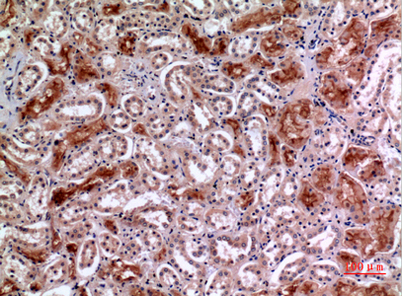
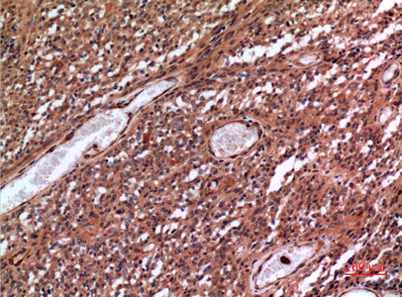
| Dilution | Western Blot: 1/500 - 1/2000. IHC-p: 1/100-1/300. ELISA: 1/20000. Not yet tested in other applications. |
| Purification | The antibody was affinity-purified from rabbit antiserum by affinity-chromatography using epitope-specific immunogen. |
| Concentration | 1 mg/ml |
| Storage stability | -20°C/1 year |
| Molecular Weight (Da) | |
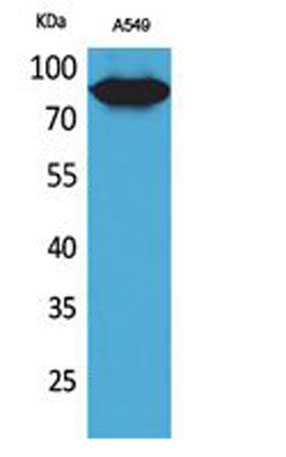
| Observed band (KD) | 85kD |
| Background | This gene encodes a common acute lymphocytic leukemia antigen that is an important cell surface marker in the diagnosis of human acute lymphocytic leukemia (ALL). This protein is present on leukemic cells of pre-B phenotype, which represent 85% of cases of ALL. This protein is not restricted to leukemic cells, however, and is found on a variety of normal tissues. It is a glycoprotein that is particularly abundant in kidney, where it is present on the brush border of proximal tubules and on glomerular epithelium. The protein is a neutral endopeptidase that cleaves peptides at the amino side of hydrophobic residues and inactivates several peptide hormones including glucagon, enkephalins, substance P, neurotensin, oxytocin, and bradykinin. This gene, which encodes a 100-kD type II transmembrane glycoprotein, exists in a single copy of greater than 45 kb. The 5' untranslated region of this |
| Function | catalytic activity:Preferential cleavage of polypeptides between hydrophobic residues, particularly with Phe or Tyr at P1'.,cofactor:Binds 1 zinc ion per subunit.,disease:Important cell surface marker in the diagnostic of human acute lymphocytic leukemia.,enzyme regulation:Inhibited in a dose dependent manner by opiorphin.,function:Thermolysin-like specificity, but is almost confined on acting on polypeptides of up to 30 amino acids. Biologically important in the destruction of opioid peptides such as Met- and Leu-enkephalins by cleavage of a Gly-Phe bond. Involved in the degradation of atrial natriuretic factor (ANF).,similarity:Belongs to the peptidase M13 family., |
| Subcellular location | Cell membrane; Single-pass type II membrane protein. |
| Expression | Adrenal cortex,Brain,Kidney,Placenta, |

Use collapsible tabs for more detailed information that will help customers make a purchasing decision.
Ex: Shipping and return policies, size guides, and other common questions.