 Français
 English
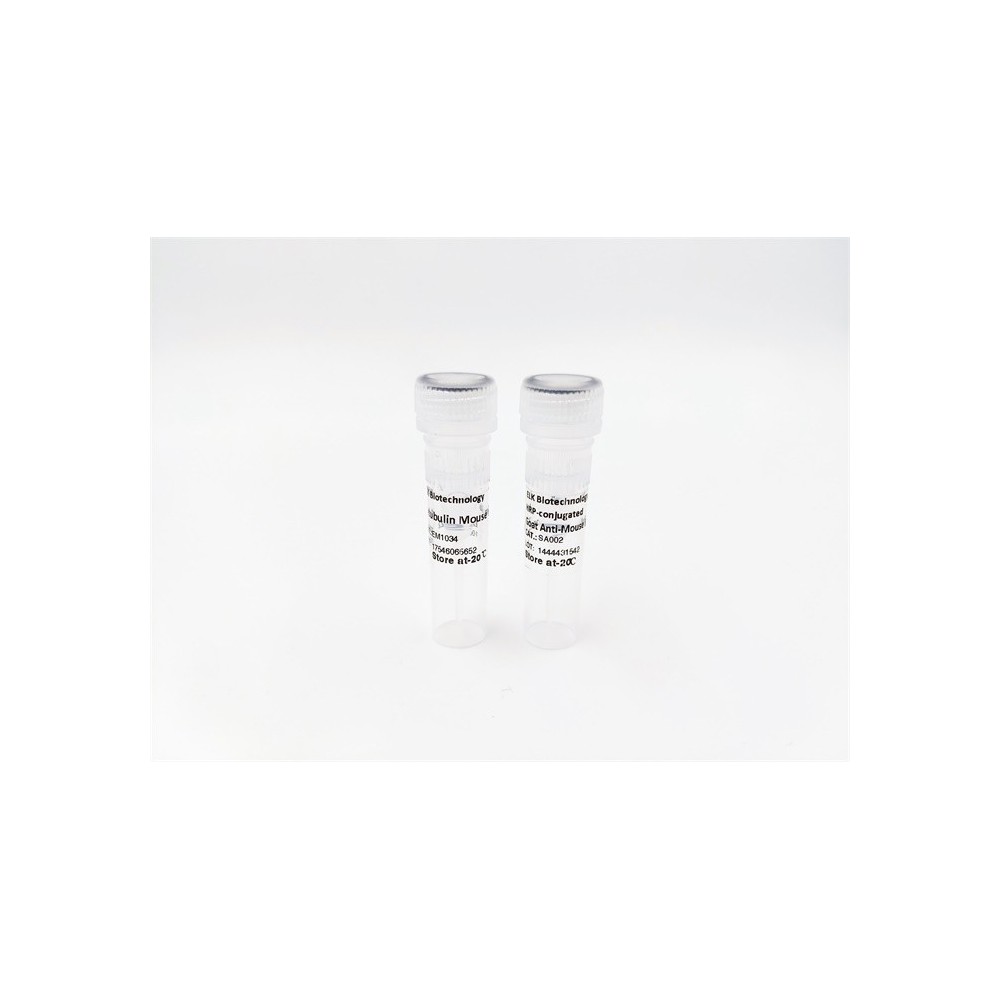

| ELK.No | ES4224 |
| Product name | EF-1 α1/2 rabbit pAb |
| Reactivity | Human;Mouse;Rat |
| Applications | WB;ELISA |
| Other name | EEF1A1; EEF1A; EF1A; LENG7; Elongation factor 1-alpha 1; EF-1-alpha-1; Elongation factor Tu; EF-Tu; Eukaryotic elongation factor 1 A-1; eEF1A-1; Leukocyte receptor cluster member 7; EEF1A2; EEF1AL; STN; Elongation factor 1-alpha 2; EF-1-alpha-2; Eukaryotic elongation factor 1 A-2; eEF1A-2; Statin-S1; EEF1A1P5; EEF1AL3; Putative elongation factor 1-alpha-like 3; EF-1-alpha-like 3; Eukaryotic elongation factor 1 A-like 3; eEF1A-like 3; Eukaryotic translation elongation factor 1 alpha-1 pseudogene 5 |
| Size | 50μL |
| Unit price ($) | 148 |
| Human gene ID | 1915/1917 |
| Human Swiss-Prot | P68104/Q05639/Q5VTE0 |
| Source | Rabbit |
| Isotype | IgG |
| Target | EF-1 α1/2 |
| Fields | >>Nucleocytoplasmic transport;>>Legionellosis;>>Leishmaniasis |
| Gene name | EEF1A1/EEF1A2/EEF1A1P5 |
| Protein name | Elongation factor 1-alpha 1/Elongation factor 1-alpha 2/Putative elongation factor 1-alpha-like 3 |
| Human gene link | View Human Gene |
| Human Swiss link | View Human Swiss-Prot |
| Mouse gene ID | 13627/13628 |
| Mouse gene link | View Mouse Gene |
| Mouse Swiss-Prot | |
| Mouse Swiss link | |
| Rat gene ID | 171361/24799 |
| Rat gene link | View Rat Gene |
| Rat Swiss-Prot | P62630/P62632 |
| Rat Swiss link | View Rat Swiss-Prot |
| Immunogen | Synthesized peptide derived from the N-terminal region of human EF-1 α1/2. |
| Specificity | EF-1 α1/2 Polyclonal Antibody detects endogenous levels of EF-1 α1/2 protein. |
| Formulation | Liquid in PBS containing 50% glycerol, 0.5% BSA and 0.02% sodium azide. |
| Clonality | Polyclonal |
| Dilution | Western Blot: 1/500 - 1/2000. ELISA: 1/20000. Not yet tested in other applications. |
| Purification | The antibody was affinity-purified from rabbit antiserum by affinity-chromatography using epitope-specific immunogen. |
| Concentration | 1 mg/ml |
| Storage stability | -20°C/1 year |
| Molecular Weight (Da) | |
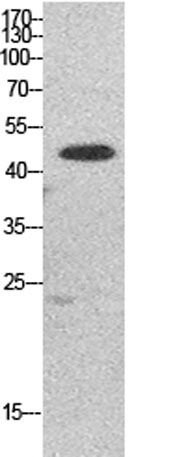
| Observed band (KD) | 50kD |
| Background | This gene encodes an isoform of the alpha subunit of the elongation factor-1 complex, which is responsible for the enzymatic delivery of aminoacyl tRNAs to the ribosome. This isoform (alpha 1) is expressed in brain, placenta, lung, liver, kidney, and pancreas, and the other isoform (alpha 2) is expressed in brain, heart and skeletal muscle. This isoform is identified as an autoantigen in 66% of patients with Felty syndrome. This gene has been found to have multiple copies on many chromosomes, some of which, if not all, represent different pseudogenes. [provided by RefSeq, Jul 2008], |
| Function | caution:Could be the product of a pseudogene.,function:This protein promotes the GTP-dependent binding of aminoacyl-tRNA to the A-site of ribosomes during protein biosynthesis.,similarity:Belongs to the GTP-binding elongation factor family. EF-Tu/EF-1A subfamily.,subunit:Found in a nuclear export complex with XPO5, EEF1A1, Ran and aminoacylated tRNA. Interacts with XPO5. May interact with ERGIC2.,tissue specificity:Brain, placenta, lung, liver, kidney, pancreas but barely detectable in heart and skeletal muscle., |
| Subcellular location | Cytoplasm . Nucleus . Nucleus, nucleolus . Cell membrane . Colocalizes with DLC1 at actin-rich regions in the cell periphery (PubMed:19158340). Translocates together with ZPR1 from the cytoplasm to the nucleus and nucleolus after treatment with mitogens (PubMed:8650580). Localization at the cell membrane depends on EEF1A1 phosphorylation status and the presence of PPP1R16B (PubMed:26497934). . |
| Expression | Brain, placenta, lung, liver, kidney, pancreas but barely detectable in heart and skeletal muscle. |

Use collapsible tabs for more detailed information that will help customers make a purchasing decision.
Ex: Shipping and return policies, size guides, and other common questions.