 Français
 English

| ELK.No | ES4261 |
| Product name | ZNF384 rabbit pAb |
| Reactivity | Human;Rat |
| Applications | WB;ELISA |
| Other name | ZNF384; CAGH1; CIZ; NMP4; TNRC1; Zinc finger protein 384; CAG repeat protein 1; CAS-interacting zinc finger protein; Nuclear matrix transcription factor 4; Nuclear matrix protein 4; Trinucleotide repeat-containing gene 1 protein |
| Size | 100μL |
| Unit price ($) | 248 |
| Human gene ID | 171017 |
| Human Swiss-Prot | Q8TF68 |
| Source | Rabbit |
| Isotype | IgG |
| Target | ZNF384 |
| Fields | |
| Gene name | ZNF384 |
| Protein name | Zinc finger protein 384 |
| Human gene link | View Human Gene |
| Human Swiss link | View Human Swiss-Prot |
| Mouse gene ID | |
| Mouse gene link | |
| Mouse Swiss-Prot | |
| Mouse Swiss link | |
| Rat gene ID | 171018 |
| Rat gene link | View Rat Gene |
| Rat Swiss-Prot | Q9EQJ4 |
| Rat Swiss link | View Rat Swiss-Prot |
| Immunogen | The antiserum was produced against synthesized peptide derived from the N-terminal region of human ZNF384. AA range:1-50 |
| Specificity | ZNF384 Polyclonal Antibody detects endogenous levels of ZNF384 protein. |
| Formulation | Liquid in PBS containing 50% glycerol, 0.5% BSA and 0.02% sodium azide. |
| Clonality | Polyclonal |
| Dilution | Western Blot: 1/500 - 1/2000. ELISA: 1/20000. Not yet tested in other applications. |
| Purification | The antibody was affinity-purified from rabbit antiserum by affinity-chromatography using epitope-specific immunogen. |
| Concentration | 1 mg/ml |
| Storage stability | -20°C/1 year |
| Molecular Weight (Da) | |
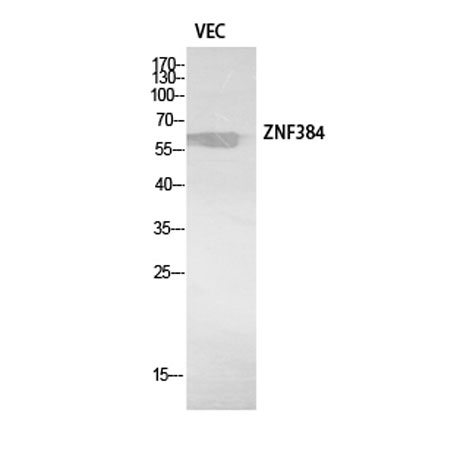
| Observed band (KD) | 64kD |
| Background | zinc finger protein 384(ZNF384) Homo sapiens This gene encodes a C2H2-type zinc finger protein, which may function as a transcription factor. This gene also contains long CAG trinucleotide repeats that encode consecutive glutamine residues. The protein appears to bind and regulate the promoters of the extracellular matrix genes MMP1, MMP3, MMP7 and COL1A1. Studies in mouse suggest that nuclear matrix transcription factors (NP/NMP4) may be part of a general mechanical pathway that couples cell construction and function during extracellular matrix remodeling. Alternative splicing results in multiple transcript variants. Recurrent rearrangements of this gene with the Ewing's sarcoma gene, EWSR1 on chromosome 22, or with the TAF15 gene on chromosome 17, or with the TCF3 (E2A) gene on chromosome 19, have been observed in acute leukemia. A related pseudogene has been identified on chromosome 7. [provided by RefSeq, Apr 2011], |
| Function | alternative products:Additional isoforms seem to exist,caution:The sequence shown here is derived from an Ensembl automatic analysis pipeline and should be considered as preliminary data.,function:Transcription factor that binds the consensus DNA sequence [GC]AAAAA. Seems to bind and regulate the promoters of MMP1, MMP3, MMP7 and COL1A1.,similarity:Belongs to the krueppel C2H2-type zinc-finger protein family.,similarity:Contains 8 C2H2-type zinc fingers.,subunit:Interacts with BCAR1., |
| Subcellular location | Nucleus . |
| Expression | Brain,Brain cortex,Testis, |

Use collapsible tabs for more detailed information that will help customers make a purchasing decision.
Ex: Shipping and return policies, size guides, and other common questions.