 Français
 English

| ELK.No | ES4314 |
| Product name | CD33 rabbit pAb |
| Reactivity | Human;Rat;Mouse; |
| Applications | WB;ELISA |
| Other name | CD33; SIGLEC3; Myeloid cell surface antigen CD33; Sialic acid-binding Ig-like lectin 3; Siglec-3; gp67; CD33 |
| Size | 50μL |
| Unit price ($) | 148 |
| Human gene ID | 945 |
| Human Swiss-Prot | P20138 |
| Source | Rabbit |
| Isotype | IgG |
| Target | CD33 |
| Fields | >>Hematopoietic cell lineage |
| Gene name | CD33 |
| Protein name | Myeloid cell surface antigen CD33 |
| Human gene link | View Human Gene |
| Human Swiss link | View Human Swiss-Prot |
| Mouse gene ID | |
| Mouse gene link | |
| Mouse Swiss-Prot | Q63994 |
| Mouse Swiss link | View Mouse Swiss-Prot |
| Rat gene ID | |
| Rat gene link | |
| Rat Swiss-Prot | |
| Rat Swiss link | |
| Immunogen | The antiserum was produced against synthesized peptide derived from the Internal region of human CD33. AA range:71-120 |
| Specificity | CD33 Polyclonal Antibody detects endogenous levels of CD33 protein. |
| Formulation | Liquid in PBS containing 50% glycerol, 0.5% BSA and 0.02% sodium azide. |
| Clonality | Polyclonal |
| Dilution | Western Blot: 1/500 - 1/2000. ELISA: 1/10000. Not yet tested in other applications. |
| Purification | The antibody was affinity-purified from rabbit antiserum by affinity-chromatography using epitope-specific immunogen. |
| Concentration | 1 mg/ml |
| Storage stability | -20°C/1 year |
| Molecular Weight (Da) | |
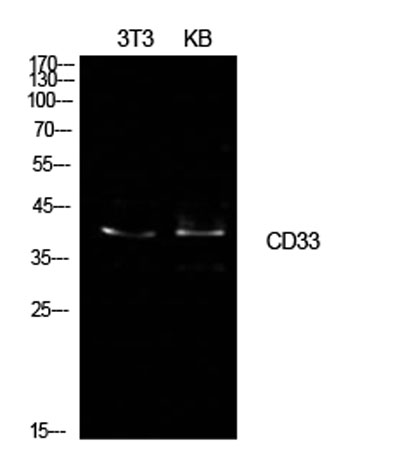
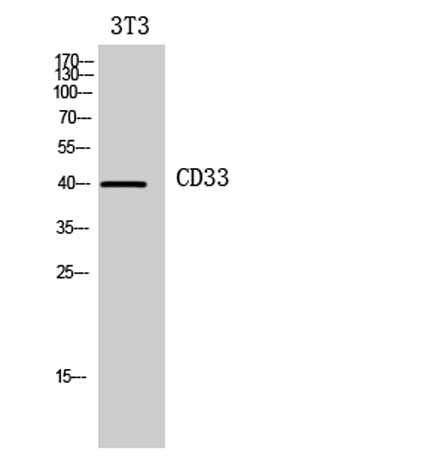
| Observed band (KD) | 40kD |
| Background | domain:Contains 2 copies of a cytoplasmic motif that is referred to as the immunoreceptor tyrosine-based inhibitor motif (ITIM). This motif is involved in modulation of cellular responses. The phosphorylated ITIM motif can bind the SH2 domain of several SH2-containing phosphatases.,function:Putative adhesion molecule of myelomonocytic-derived cells that mediates sialic-acid dependent binding to cells. Preferentially binds to alpha-2,6-linked sialic acid. The sialic acid recognition site may be masked by cis interactions with sialic acids on the same cell surface. In the immune response, may act as an inhibitory receptor upon ligand induced tyrosine phosphorylation by recruiting cytoplasmic phosphatase(s) via their SH2 domain(s) that block signal transduction through dephosphorylation of signaling molecules. Induces apoptosis in acute myeloid leukemia (in vitro).,online information:Siglec-3,PTM:Phosphorylation of Tyr-340 is involved in binding to PTPN6 and PTPN11. Phosphorylation of Tyr-358 is involved in binding to PTPN6.,similarity:Belongs to the immunoglobulin superfamily. SIGLEC (sialic acid binding Ig-like lectin) family.,similarity:Contains 1 Ig-like C2-type (immunoglobulin-like) domain.,similarity:Contains 1 Ig-like V-type (immunoglobulin-like) domain.,subunit:Interacts with PTPN6/SHP-1 and PTPN11/SHP-2 upon phosphorylation.,tissue specificity:Monocytic/myeloid lineage cells., |
| Function | domain:Contains 2 copies of a cytoplasmic motif that is referred to as the immunoreceptor tyrosine-based inhibitor motif (ITIM). This motif is involved in modulation of cellular responses. The phosphorylated ITIM motif can bind the SH2 domain of several SH2-containing phosphatases.,function:Putative adhesion molecule of myelomonocytic-derived cells that mediates sialic-acid dependent binding to cells. Preferentially binds to alpha-2,6-linked sialic acid. The sialic acid recognition site may be masked by cis interactions with sialic acids on the same cell surface. In the immune response, may act as an inhibitory receptor upon ligand induced tyrosine phosphorylation by recruiting cytoplasmic phosphatase(s) via their SH2 domain(s) that block signal transduction through dephosphorylation of signaling molecules. Induces apoptosis in acute myeloid leukemia (in vitro).,online information:Siglec |
| Subcellular location | [Isoform CD33M]: Cell membrane ; Single-pass type I membrane protein.; [Isoform CD33m]: Peroxisome . CD33m isoform does not localize to cell surfaces but instead accumulates in peroxisomes. . |
| Expression | Monocytic/myeloid lineage cells. In the brain, CD33 is mainly expressed on microglial cells. |

Use collapsible tabs for more detailed information that will help customers make a purchasing decision.
Ex: Shipping and return policies, size guides, and other common questions.