 Français
 English
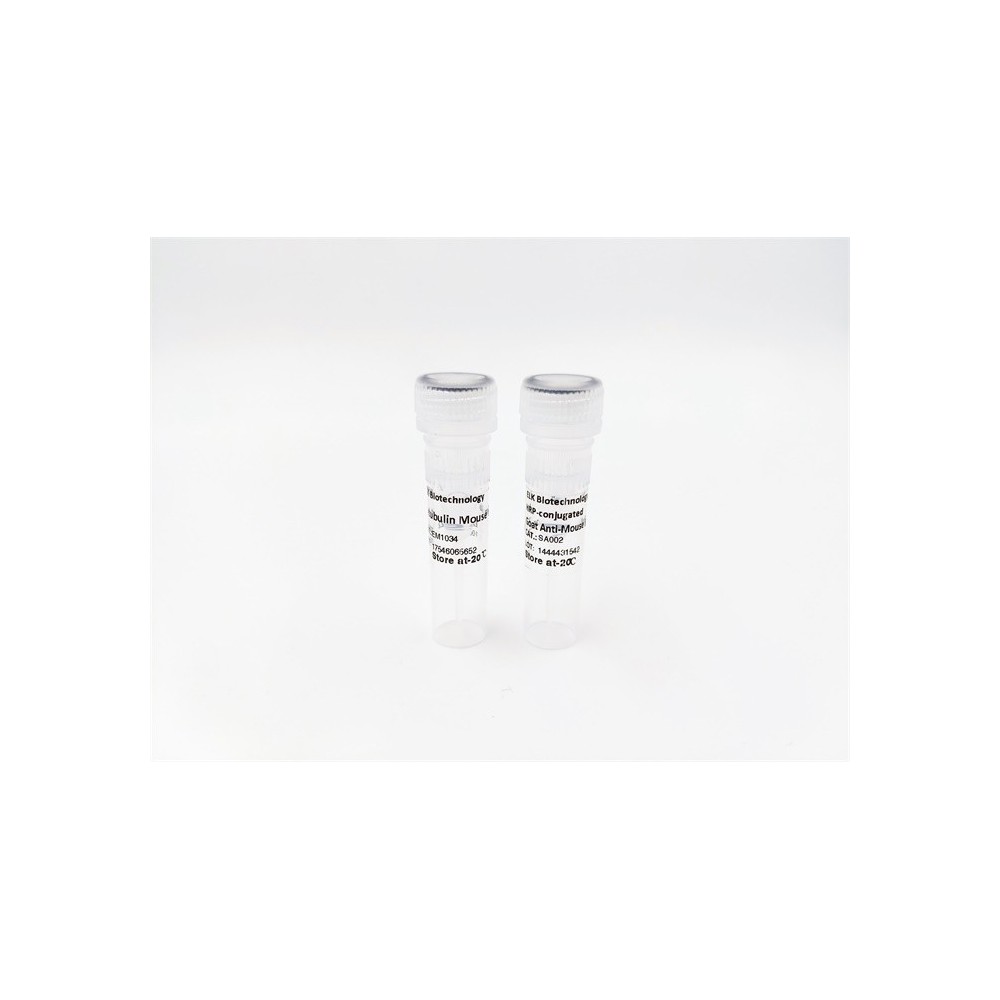

| ELK.No | ES4328 |
| Product name | CD96 rabbit pAb |
| Reactivity | Human;Rat;Mouse; |
| Applications | WB;ELISA |
| Other name | CD96; T-cell surface protein tactile; Cell surface antigen CD96; T cell-activated increased late expression protein; CD96 |
| Size | 50μL |
| Unit price ($) | 148 |
| Human gene ID | 10225 |
| Human Swiss-Prot | P40200 |
| Source | Rabbit |
| Isotype | IgG |
| Target | CD96 |
| Fields | |
| Gene name | CD96 |
| Protein name | T-cell surface protein tactile |
| Human gene link | View Human Gene |
| Human Swiss link | View Human Swiss-Prot |
| Mouse gene ID | |
| Mouse gene link | |
| Mouse Swiss-Prot | Q3U0X8 |
| Mouse Swiss link | View Mouse Swiss-Prot |
| Rat gene ID | |
| Rat gene link | |
| Rat Swiss-Prot | |
| Rat Swiss link | |
| Immunogen | The antiserum was produced against synthesized peptide derived from the Internal region of human CD96. AA range:291-340 |
| Specificity | CD96 Polyclonal Antibody detects endogenous levels of CD96 protein. |
| Formulation | Liquid in PBS containing 50% glycerol, 0.5% BSA and 0.02% sodium azide. |
| Clonality | Polyclonal |
| Dilution | Western Blot: 1/500 - 1/2000. ELISA: 1/10000. Not yet tested in other applications. |
| Purification | The antibody was affinity-purified from rabbit antiserum by affinity-chromatography using epitope-specific immunogen. |
| Concentration | 1 mg/ml |
| Storage stability | -20°C/1 year |
| Molecular Weight (Da) | |
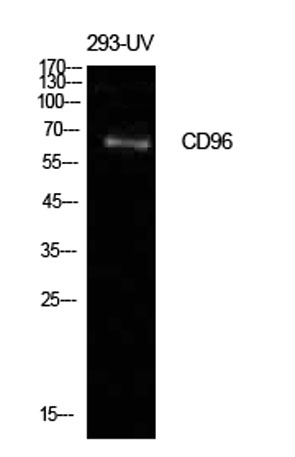
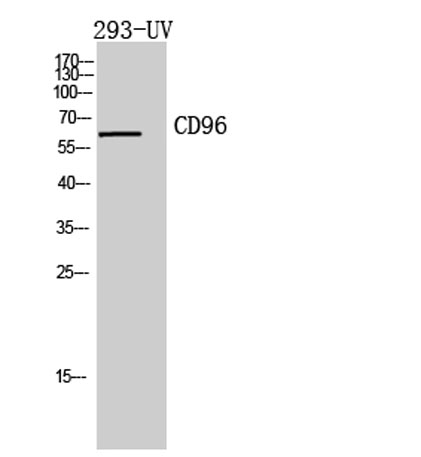
| Observed band (KD) | 65kD |
| Background | The protein encoded by this gene belongs to the immunoglobulin superfamily. It is a type I membrane protein. The protein may play a role in the adhesive interactions of activated T and NK cells during the late phase of the immune response. It may also function in antigen presentation. Alternative splicing generates multiple transcript variants encoding distinct isoforms. [provided by RefSeq, Jan 2016], |
| Function | developmental stage:Expressed at low levels on peripheral T-cells and is strongly up-regulated after activation, peaking 6 to 9 days after the activating stimulus.,disease:A chromosomal aberration involving CD96 is associated with C syndrome [MIM:211750]. Translocation t(3;18)(q13.13;q12.1). CD96 gene was located at the 3q13.13 breakpoint. Precise structural analysis around the breakpoint showed that the gene was disrupted by the translocation in exon 5, probably leading to premature termination or loss of expression of CD96 protein. No gene was detected at the chromosome 18 breakpoint.,disease:Defects in CD96 are a cause of C syndrome [MIM:211750]; also called Opitz trigonocephaly syndrome. This syndrome is characterized by trigonocephaly and associated anomalies, such as unusual facies, wide alveolar ridges, multiple buccal frenula, limb defects, visceral anomalies, redundant skin, psy |
| Subcellular location | Membrane; Single-pass type I membrane protein. |
| Expression | Expressed on normal T-cell lines and clones, and some transformed T-cells, but no other cultured cell lines tested. It is expressed at very low levels on activated B-cells. |

Use collapsible tabs for more detailed information that will help customers make a purchasing decision.
Ex: Shipping and return policies, size guides, and other common questions.