 Français
 English

| ELK.No | ES4342 |
| Product name | BST-2 rabbit pAb |
| Reactivity | Human;Rat;Mouse; |
| Applications | WB;IHC;IF;ELISA |
| Other name | BST2; Bone marrow stromal antigen 2; BST-2; HM1.24 antigen; Tetherin; CD317 |
| Size | 100μL |
| Unit price ($) | 248 |
| Human gene ID | 684 |
| Human Swiss-Prot | Q10589 |
| Source | Rabbit |
| Isotype | IgG |
| Target | BST-2 |
| Fields | >>Viral life cycle - HIV-1;>>Herpes simplex virus 1 infection;>>Human immunodeficiency virus 1 infection |
| Gene name | BST2 |
| Protein name | Bone marrow stromal antigen 2 |
| Human gene link | View Human Gene |
| Human Swiss link | View Human Swiss-Prot |
| Mouse gene ID | |
| Mouse gene link | |
| Mouse Swiss-Prot | Q8R2Q8 |
| Mouse Swiss link | View Mouse Swiss-Prot |
| Rat gene ID | |
| Rat gene link | |
| Rat Swiss-Prot | |
| Rat Swiss link | |
| Immunogen | The antiserum was produced against synthesized peptide derived from the Internal region of human BST2. AA range:101-150 |
| Specificity | BST-2 Polyclonal Antibody detects endogenous levels of BST-2 protein. |
| Formulation | Liquid in PBS containing 50% glycerol, 0.5% BSA and 0.02% sodium azide. |
| Clonality | Polyclonal |
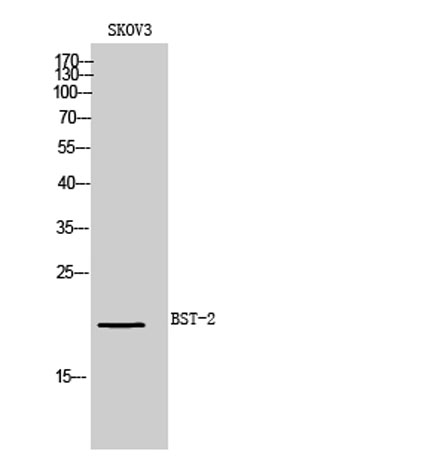
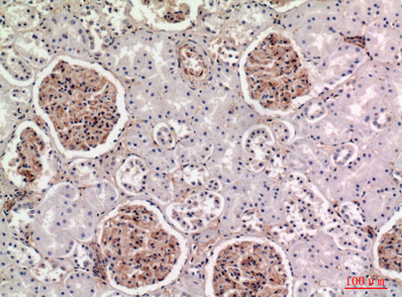
| Dilution | Western Blot: 1/500 - 1/2000. IHC-p: 1:100-1:300. ELISA: 1/10000. Not yet tested in other applications. |
| Purification | The antibody was affinity-purified from rabbit antiserum by affinity-chromatography using epitope-specific immunogen. |
| Concentration | 1 mg/ml |
| Storage stability | -20°C/1 year |
| Molecular Weight (Da) | |
| Observed band (KD) | 20kD |
| Background | Bone marrow stromal cells are involved in the growth and development of B-cells. The specific function of the protein encoded by the bone marrow stromal cell antigen 2 is undetermined; however, this protein may play a role in pre-B-cell growth and in rheumatoid arthritis. [provided by RefSeq, Jul 2008], |
| Function | disease:May play a role in B-cell activation in rheumatoid arthritis (RA).,function:May be involved in the sorting of secreted proteins (By similarity). May be involved in pre-B-cell growth. Antiretroviral defense protein, that blocks release of retrovirus from the cell surface. Depleted unpon HIV-1 infection by viral VPU protein through 20S proteasome degradation.,induction:During B-cell activation (at protein level), or by interferon alpha as part of entiviral state cellular program.,subunit:Homodimer.,tissue specificity:Predominantly expressed in liver, lung, heart and placenta. Lower levels in pancreas, kidney, skeletal muscle and brain. Overexpressed in multiple myeloma cells. Highly expressed during B-cell development, from pro-B precursors to plasma cells. Highy expressed on T-cells, monocytes, NK cells and dendritic cells (at protein level)., |
| Subcellular location | Golgi apparatus, trans-Golgi network. Cell membrane ; Single-pass type II membrane protein. Cell membrane ; Lipid-anchor, GPI-anchor . Membrane raft. Cytoplasm. Apical cell membrane . Shuttles between the cell membrane, where it is present predominantly in membrane/lipid rafts, and the trans-Golgi network. Forms a complex with MMP14 and localizes to the cytoplasm.; Golgi apparatus, trans-Golgi network . Late endosome . (Microbial infection) HIV-1 VPU and HIV-2 ENV can target it to the trans-Golgi network thus sequestering it away from virus assembly sites on the cell membrane. Targeted to late endosomes upon KSHV infection and subsequent ubiquitination. . |
| Expression | Predominantly expressed in liver, lung, heart and placenta. Lower levels in pancreas, kidney, skeletal muscle and brain. Overexpressed in multiple myeloma cells. Highly expressed during B-cell development, from pro-B precursors to plasma cells. Highly expressed on T-cells, monocytes, NK cells and dendritic cells (at protein level). |

Use collapsible tabs for more detailed information that will help customers make a purchasing decision.
Ex: Shipping and return policies, size guides, and other common questions.