 Français
 English
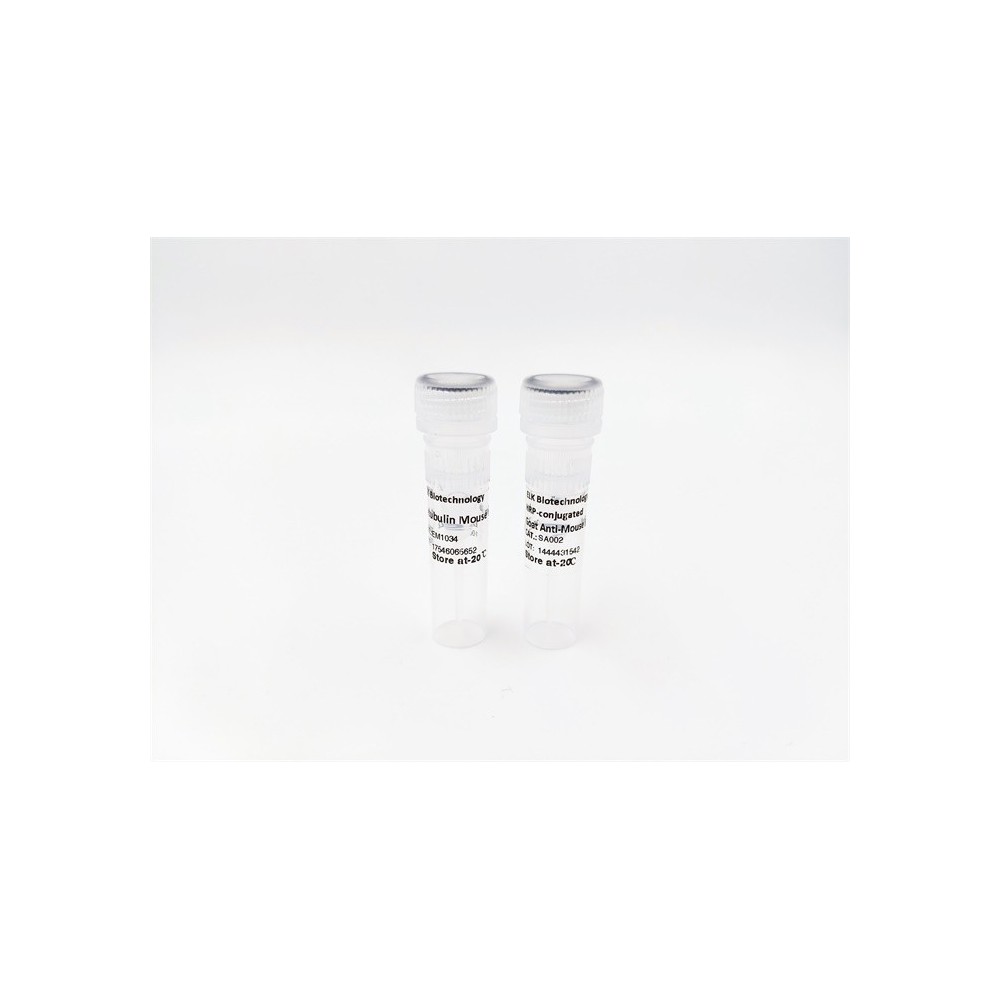

| ELK.No | ES4348 |
| Product name | CD158a rabbit pAb |
| Reactivity | Human;Rat;Mouse; |
| Applications | WB;ELISA |
| Other name | KIR2DL1; CD158A; NKAT1; Killer cell immunoglobulin-like receptor 2DL1; CD158 antigen-like family member A; MHC class I NK cell receptor; Natural killer-associated transcript 1; NKAT-1; p58 natural killer cell receptor clones CL-42/47.11; p58 NK receptor CL-42/47.11; p58.1 MHC class-I-specific NK receptor; CD158a |
| Size | 100μL |
| Unit price ($) | 248 |
| Human gene ID | 3802 |
| Human Swiss-Prot | P43626 |
| Source | Rabbit |
| Isotype | IgG |
| Target | CD158a |
| Fields | >>Antigen processing and presentation;>>Natural killer cell mediated cytotoxicity;>>Graft-versus-host disease |
| Gene name | KIR2DL1 |
| Protein name | Killer cell immunoglobulin-like receptor 2DL1 |
| Human gene link | View Human Gene |
| Human Swiss link | View Human Swiss-Prot |
| Mouse gene ID | |
| Mouse gene link | |
| Mouse Swiss-Prot | |
| Mouse Swiss link | |
| Rat gene ID | |
| Rat gene link | |
| Rat Swiss-Prot | |
| Rat Swiss link | |
| Immunogen | The antiserum was produced against synthesized peptide derived from the Internal region of human KIR2DL1. AA range:131-180 |
| Specificity | CD158a Polyclonal Antibody detects endogenous levels of CD158a protein. |
| Formulation | Liquid in PBS containing 50% glycerol, 0.5% BSA and 0.02% sodium azide. |
| Clonality | Polyclonal |
| Dilution | Western Blot: 1/500 - 1/2000. ELISA: 1/10000. Not yet tested in other applications. |
| Purification | The antibody was affinity-purified from rabbit antiserum by affinity-chromatography using epitope-specific immunogen. |
| Concentration | 1 mg/ml |
| Storage stability | -20°C/1 year |
| Molecular Weight (Da) | |
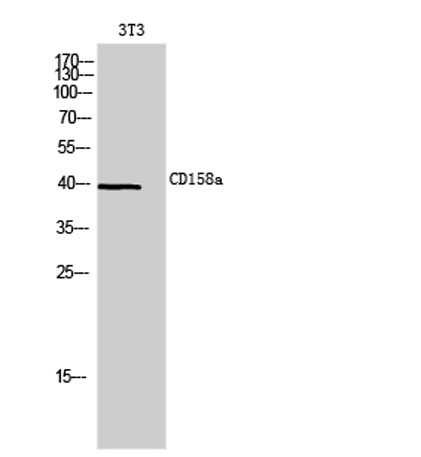
| Observed band (KD) | 39kD |
| Background | Killer cell immunoglobulin-like receptors (KIRs) are transmembrane glycoproteins expressed by natural killer cells and subsets of T cells. The KIR genes are polymorphic and highly homologous and they are found in a cluster on chromosome 19q13.4 within the 1 Mb leukocyte receptor complex (LRC). The gene content of the KIR gene cluster varies among haplotypes, although several "framework" genes are found in all haplotypes (KIR3DL3, KIR3DP1, KIR3DL4, KIR3DL2). The KIR proteins are classified by the number of extracellular immunoglobulin domains (2D or 3D) and by whether they have a long (L) or short (S) cytoplasmic domain. KIR proteins with the long cytoplasmic domain transduce inhibitory signals upon ligand binding via an immune tyrosine-based inhibitory motif (ITIM), while KIR proteins with the short cytoplasmic domain lack the |
| Function | function:Receptor on natural killer (NK) cells for HLA-C alleles. Inhibits the activity of NK cells thus preventing cell lysis.,miscellaneous:PubMed:15580659, identified a chromosomal rearrangement producing a recombinant gene composed of the promoter and first exon of KIR2DL5A fused to KIR3DP1 which was originally thought to be a pseudogene. This leads to the expression in 4.5 percent of a Spanish Caucasoid population of an mRNA which may encode a chimeric protein KIR2DL5A/KIR3DP1.,similarity:Belongs to the immunoglobulin superfamily.,similarity:Contains 2 Ig-like C2-type (immunoglobulin-like) domains.,similarity:Contains 3 Ig-like C2-type (immunoglobulin-like) domains.,tissue specificity:Expressed in peripheral blood cells., |
| Subcellular location | Cell membrane ; Single-pass type I membrane protein. |
| Expression | Expressed by NK cells. |


Use collapsible tabs for more detailed information that will help customers make a purchasing decision.
Ex: Shipping and return policies, size guides, and other common questions.