 Français
 English
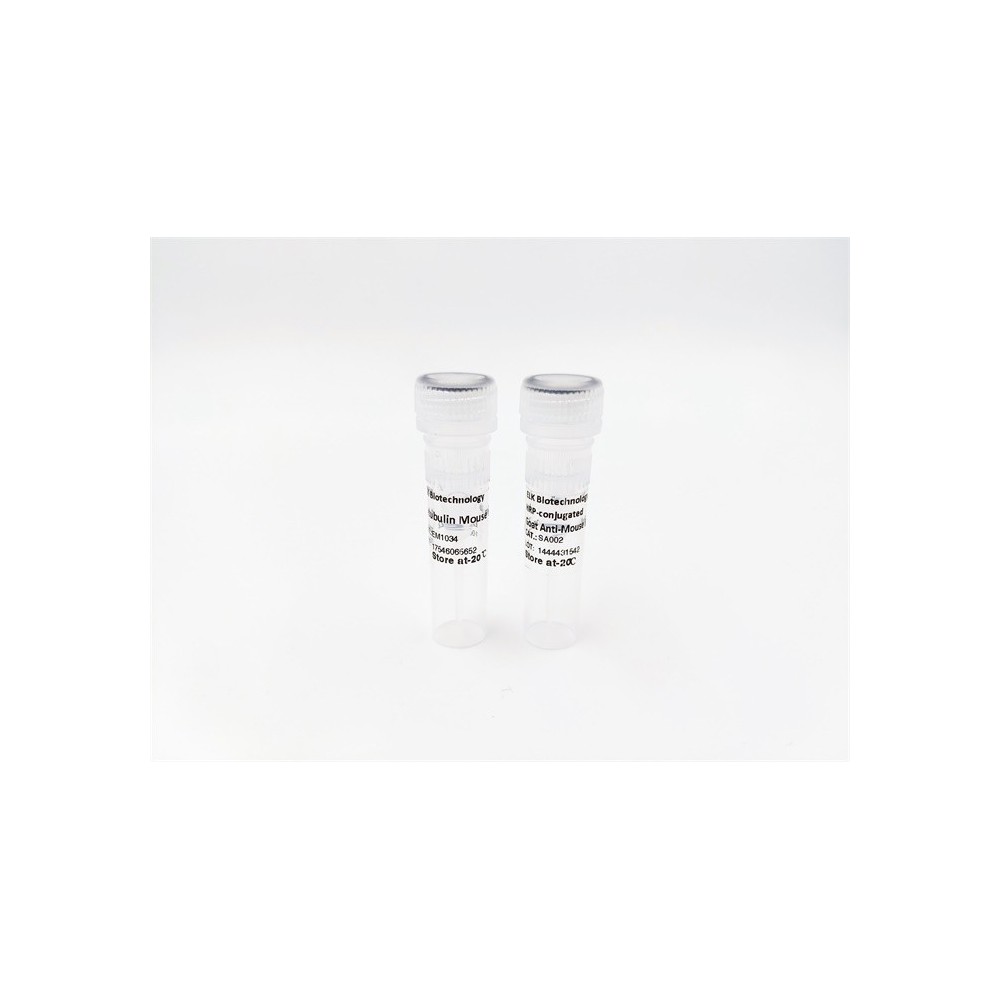

| ELK.No | ES4363 |
| Product name | CD209 rabbit pAb |
| Reactivity | Human;Mouse;Rat |
| Applications | WB;ELISA |
| Other name | CD209; CLEC4L; CD209 antigen; C-type lectin domain family 4 member L; Dendritic cell-specific ICAM-3-grabbing non-integrin 1; DC-SIGN; DC-SIGN1; CD209 |
| Size | 50μL |
| Unit price ($) | 148 |
| Human gene ID | 30835 |
| Human Swiss-Prot | Q9NNX6 |
| Source | Rabbit |
| Isotype | IgG |
| Target | CD209 |
| Fields | >>Phagosome;>>C-type lectin receptor signaling pathway;>>Tuberculosis;>>Measles |
| Gene name | CD209 |
| Protein name | CD209 antigen |
| Human gene link | View Human Gene |
| Human Swiss link | View Human Swiss-Prot |
| Mouse gene ID | |
| Mouse gene link | |
| Mouse Swiss-Prot | |
| Mouse Swiss link | |
| Rat gene ID | |
| Rat gene link | |
| Rat Swiss-Prot | |
| Rat Swiss link | |
| Immunogen | Synthesized peptide derived from CD209 antigen at AA range: 261-310 |
| Specificity | CD209 Polyclonal Antibody detects endogenous levels of CD209 protein. |
| Formulation | Liquid in PBS containing 50% glycerol, 0.5% BSA and 0.02% sodium azide. |
| Clonality | Polyclonal |
| Dilution | Western Blot: 1/500 - 1/2000. ELISA: 1/10000. Not yet tested in other applications. |
| Purification | The antibody was affinity-purified from rabbit antiserum by affinity-chromatography using epitope-specific immunogen. |
| Concentration | 1 mg/ml |
| Storage stability | -20°C/1 year |
| Molecular Weight (Da) | |
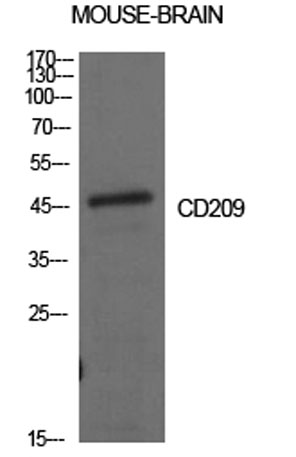
| Observed band (KD) | 45kD |
| Background | This gene encodes a transmembrane receptor and is often referred to as DC-SIGN because of its expression on the surface of dendritic cells and macrophages. The encoded protein is involved in the innate immune system and recognizes numerous evolutionarily divergent pathogens ranging from parasites to viruses with a large impact on public health. The protein is organized into three distinct domains: an N-terminal transmembrane domain, a tandem-repeat neck domain and C-type lectin carbohydrate recognition domain. The extracellular region consisting of the C-type lectin and neck domains has a dual function as a pathogen recognition receptor and a cell adhesion receptor by binding carbohydrate ligands on the surface of microbes and endogenous cells. The neck region is important for homo-oligomerization which allows the receptor to bind multivalent ligands with high avidity. Variations in the number of 23 amino a |
| Function | alternative products:Additional isoforms seem to exist. Several splicing events may be used independently in a modular way. Deletion of the transmembrane domain encoding exon through alternative splicing produces soluble isoforms,caution:The sequence shown here is derived from an Ensembl automatic analysis pipeline and should be considered as preliminary data.,domain:The tandem repeat domain, also called neck domain, mediates oligermerization.,function:On DCs it is a high affinity receptor for ICAM2 and ICAM3 by binding to mannose-like carbohydrates. May act as a DC rolling receptor that mediates transendothelial migration of DC presursors from blood to tissues by binding endothelial ICAM2. Seems to regulate DC-induced T-cell proliferation by binding to ICAM3 on T-cells in the immunological synapse formed between DC and T-cells.,function:Pathogen-recognition receptor expressed on the sur |
| Subcellular location | [Isoform 1]: Cell membrane ; Single-pass type II membrane protein .; [Isoform 2]: Cell membrane ; Single-pass type II membrane protein .; [Isoform 3]: Cell membrane ; Single-pass type II membrane protein .; [Isoform 4]: Cell membrane ; Single-pass type II membrane protein .; [Isoform 5]: Cell membrane ; Single-pass type II membrane protein .; [Isoform 6]: Secreted .; [Isoform 7]: Secreted .; [Isoform 8]: Secreted .; [Isoform 9]: Secreted .; [Isoform 10]: Secreted .; [Isoform 11]: Secreted .; [Isoform 12]: Secreted . |
| Expression | Predominantly expressed in dendritic cells and in DC-residing tissues. Also found in placental macrophages, endothelial cells of placental vascular channels, peripheral blood mononuclear cells, and THP-1 monocytes. |

Use collapsible tabs for more detailed information that will help customers make a purchasing decision.
Ex: Shipping and return policies, size guides, and other common questions.