 Français
 English
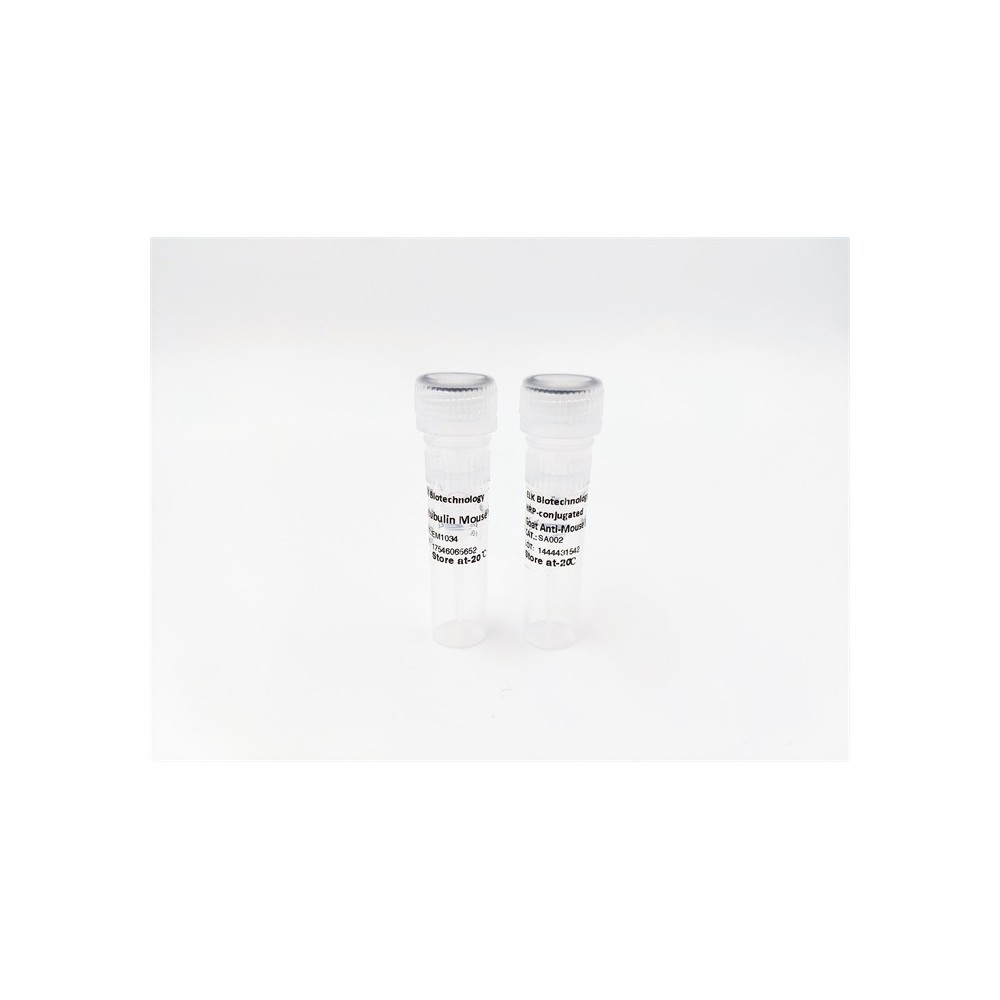

| ELK.No | ES4364 |
| Product name | CD305 rabbit pAb |
| Reactivity | Human;Rat;Mouse; |
| Applications | WB;ELISA |
| Other name | LAIR1; CD305; Leukocyte-associated immunoglobulin-like receptor 1; LAIR-1; hLAIR1; CD305 |
| Size | 100μL |
| Unit price ($) | 248 |
| Human gene ID | 3903 |
| Human Swiss-Prot | Q6GTX8 |
| Source | Rabbit |
| Isotype | IgG |
| Target | CD305 |
| Fields | |
| Gene name | LAIR1 |
| Protein name | Leukocyte-associated immunoglobulin-like receptor 1 |
| Human gene link | View Human Gene |
| Human Swiss link | View Human Swiss-Prot |
| Mouse gene ID | 52855 |
| Mouse gene link | View Mouse Gene |
| Mouse Swiss-Prot | Q8BG84 |
| Mouse Swiss link | View Mouse Swiss-Prot |
| Rat gene ID | 574531 |
| Rat gene link | View Rat Gene |
| Rat Swiss-Prot | P0C1X9 |
| Rat Swiss link | View Rat Swiss-Prot |
| Immunogen | The antiserum was produced against synthesized peptide derived from the Internal region of human LAIR1. AA range:21-70 |
| Specificity | CD305 Polyclonal Antibody detects endogenous levels of CD305 protein. |
| Formulation | Liquid in PBS containing 50% glycerol, 0.5% BSA and 0.02% sodium azide. |
| Clonality | Polyclonal |
| Dilution | Western Blot: 1/500 - 1/2000. ELISA: 1/10000. Not yet tested in other applications. |
| Purification | The antibody was affinity-purified from rabbit antiserum by affinity-chromatography using epitope-specific immunogen. |
| Concentration | 1 mg/ml |
| Storage stability | -20°C/1 year |
| Molecular Weight (Da) | |
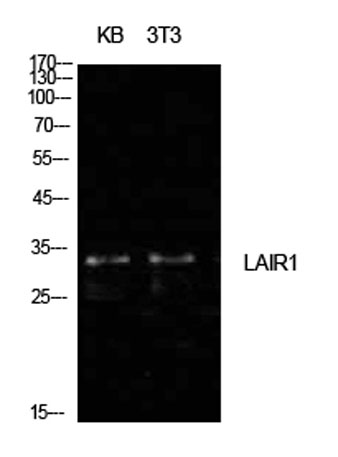
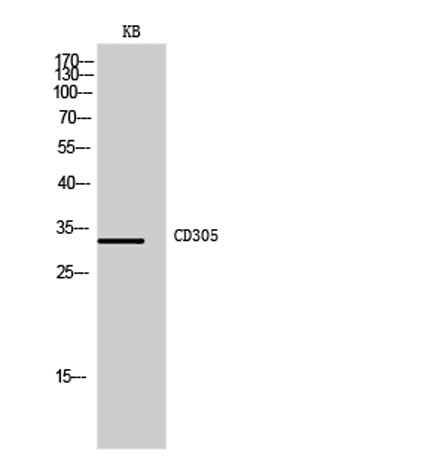
| Observed band (KD) | 32kD |
| Background | The protein encoded by this gene is an inhibitory receptor found on peripheral mononuclear cells, including natural killer cells, T cells, and B cells. Inhibitory receptors regulate the immune response to prevent lysis of cells recognized as self. The gene is a member of both the immunoglobulin superfamily and the leukocyte-associated inhibitory receptor family. The gene maps to a region of 19q13.4 called the leukocyte receptor cluster, which contains at least 29 genes encoding leukocyte-expressed receptors of the immunoglobulin superfamily. The encoded protein has been identified as an anchor for tyrosine phosphatase SHP-1, and may induce cell death in myeloid leukemias. Alternative splicing results in multiple transcript variants. [provided by RefSeq, Jan 2014], |
| Function | developmental stage:Complete loss of expression when naive B-cells proliferates and differentiates into Ig-producing plasma cells under in vitro stimulation.,domain:ITIM (immunoreceptor tyrosine-based inhibitor motif) motif is a cytoplasmic motif present in 2 copies in the intracellular part of LAIR1. When phosphorylated, ITIM motif can bind the SH2 domain of several SH2-containing phosphatases, leading to down-regulation of cell activation.,function:Functions as an inhibitory receptor that plays a constitutive negative regulatory role on cytolytic function of natural killer (NK) cells, B-cells and T-cells. Activation by Tyr phosphorylation results in recruitment and activation of the phosphatases PTPN6 and PTPN11. It also reduces the increase of intracellular calcium evoked by B-cell receptor ligation. May also play its inhibitory role independently of SH2-containing phosphatases. Modul |
| Subcellular location | Cell membrane ; Single-pass type I membrane protein . |
| Expression | Expressed on the majority of peripheral mononuclear cells, including natural killer (NK) cells, T-cells, B-cells, monocytes, and dendritic cells. Highly expressed in naive T-cells and B-cells but no expression on germinal center B-cells. Abnormally low expression in naive B-cells from HIV-1 infected patients. Very low expression in NK cells from a patient with chronic active Epstein-Barr virus infection. |

Use collapsible tabs for more detailed information that will help customers make a purchasing decision.
Ex: Shipping and return policies, size guides, and other common questions.