 Français
 English
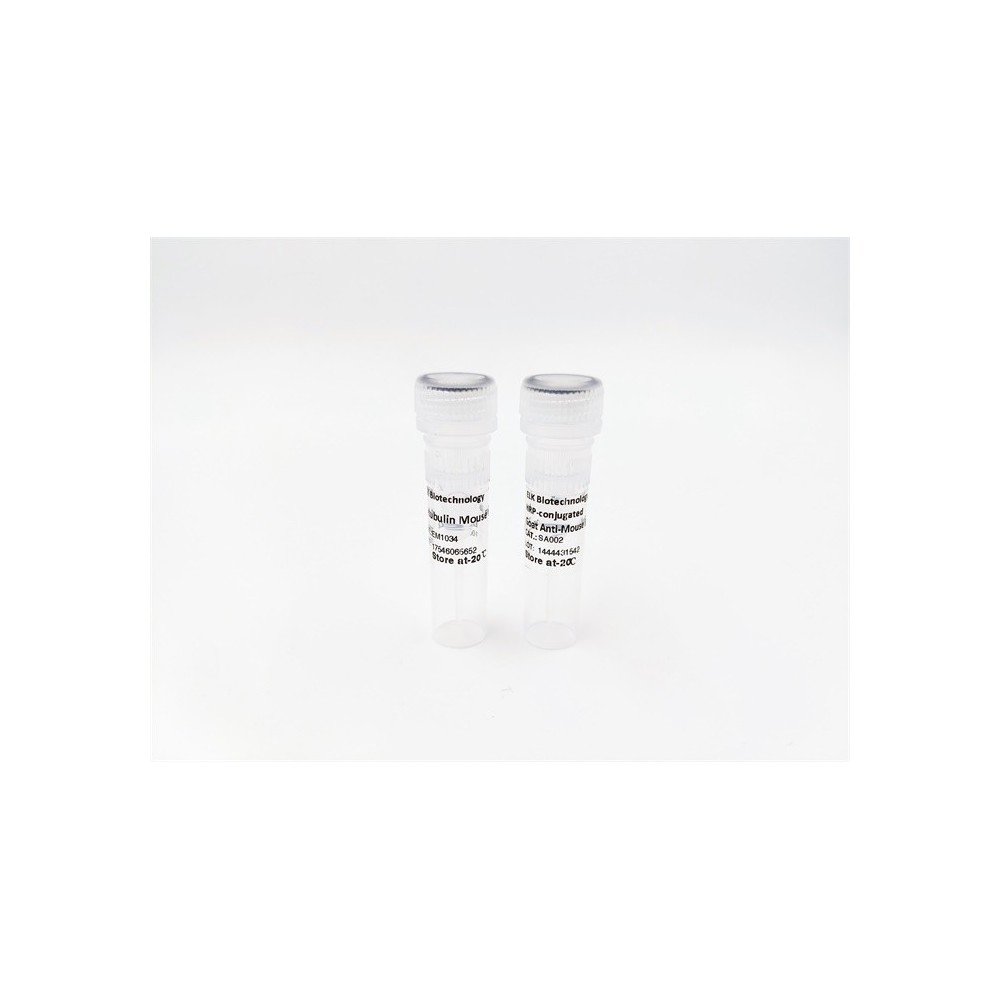

| ELK.No | ES4370 |
| Product name | EMAP II rabbit pAb |
| Reactivity | Human;Rat;Mouse; |
| Applications | WB;ELISA |
| Other name | AIMP1; EMAP2; SCYE1; Aminoacyl tRNA synthase complex-interacting multifunctional protein 1; Multisynthase complex auxiliary component p43 |
| Size | 100μL |
| Unit price ($) | 248 |
| Human gene ID | 9255 |
| Human Swiss-Prot | Q12904 |
| Source | Rabbit |
| Isotype | IgG |
| Target | EMAP II |
| Fields | |
| Gene name | AIMP1 |
| Protein name | Aminoacyl tRNA synthase complex-interacting multifunctional protein 1 |
| Human gene link | View Human Gene |
| Human Swiss link | View Human Swiss-Prot |
| Mouse gene ID | |
| Mouse gene link | |
| Mouse Swiss-Prot | P31230 |
| Mouse Swiss link | View Mouse Swiss-Prot |
| Rat gene ID | |
| Rat gene link | |
| Rat Swiss-Prot | |
| Rat Swiss link | |
| Immunogen | The antiserum was produced against synthesized peptide derived from the Internal region of human AIMP1. AA range:91-140 |
| Specificity | EMAP II Polyclonal Antibody detects endogenous levels of EMAP II protein. |
| Formulation | Liquid in PBS containing 50% glycerol, 0.5% BSA and 0.02% sodium azide. |
| Clonality | Polyclonal |
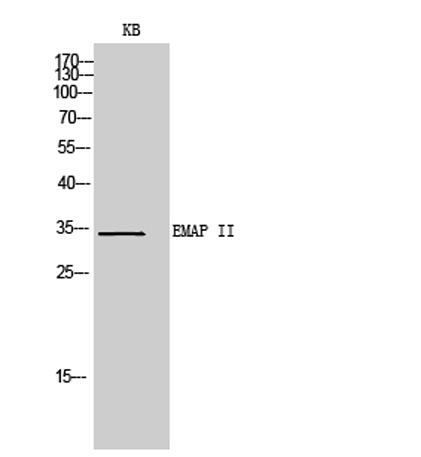
| Dilution | Western Blot: 1/500 - 1/2000. ELISA: 1/10000. Not yet tested in other applications. |
| Purification | The antibody was affinity-purified from rabbit antiserum by affinity-chromatography using epitope-specific immunogen. |
| Concentration | 1 mg/ml |
| Storage stability | -20°C/1 year |
| Molecular Weight (Da) | |
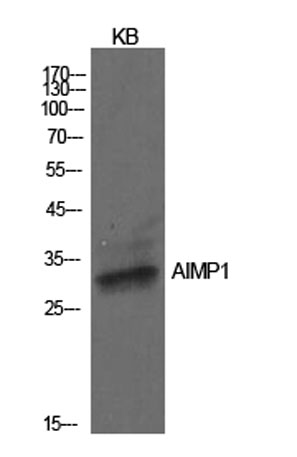
| Observed band (KD) | 34kD |
| Background | The protein encoded by this gene is a cytokine that is specifically induced by apoptosis, and it is involved in the control of angiogenesis, inflammation, and wound healing. The release of this cytokine renders the tumor-associated vasculature sensitive to tumor necrosis factor. The precursor protein is identical to the p43 subunit, which is associated with the multi-tRNA synthetase complex, and it modulates aminoacylation activity of tRNA synthetase in normal cells. This protein is also involved in the stimulation of inflammatory responses after proteolytic cleavage in tumor cells. Multiple transcript variants encoding different isoforms have been found for this gene. A pseudogene has been identified on chromosome 20. [provided by RefSeq, Dec 2008], |
| Function | angiogenesis, blood vessel development, regulation of endothelial cell proliferation, negative regulation of endothelial cell proliferation, vasculature development, monosaccharide metabolic process, glucose metabolic process, tRNA metabolic process, translation, tRNA aminoacylation for protein translation, apoptosis, cell motion, chemotaxis,defense response, inflammatory response, cell adhesion, cell-cell signaling, behavior, locomotory behavior, cell death,negative regulation of cell proliferation, response to wounding, programmed cell death, death, cell migration, hexose metabolic process, biological adhesion, ncRNA metabolic process, regulation of cell proliferation, taxis, amino acid activation, tRNA aminoacylation, blood vessel morphogenesis, cell motility, leukocyte migration, localization of cell, |
| Subcellular location | Nucleus . Cytoplasm, cytosol . Secreted . Endoplasmic reticulum . Golgi apparatus . Enriched in secretory vesicles of pancreatic alpha cells and secreted from the pancreas in response to low glucose levels (By similarity). Secreted in response to hypoxia (PubMed:10850427). Also secreted in response to both apoptotic and necrotic cell death. . |
| Expression | Trachea, |

Use collapsible tabs for more detailed information that will help customers make a purchasing decision.
Ex: Shipping and return policies, size guides, and other common questions.