 Français
 English
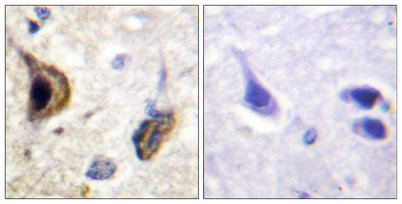
KIR5.1 (phospho Ser416) rabbit pAb
AO-06-ES4392-50

| ELK.No | ES4392 |
| Product name | KIR5.1 (phospho Ser416) rabbit pAb |
| Reactivity | Human;Mouse;Rat |
| Applications | WB;IHC;IF;ELISA |
| Other name | KCNJ16; Inward rectifier potassium channel 16; Inward rectifier K(+) channel Kir5.1; Potassium channel; inwardly rectifying subfamily J member 16 |
| Size | 50μL |
| Unit price ($) | 148 |
| Human gene ID | |
| Human Swiss-Prot | |
| Source | Rabbit |
| Isotype | IgG |
| Target | KIR5.1 |
| Fields | |
| Gene name | KCNJ16 |
| Protein name | Inward rectifier potassium channel 16 |
| Human gene link | |
| Human Swiss link | |
| Mouse gene ID | 16517 |
| Mouse gene link | View Mouse Gene |
| Mouse Swiss-Prot | |
| Mouse Swiss link | |
| Rat gene ID | |
| Rat gene link | |
| Rat Swiss-Prot | P52191 |
| Rat Swiss link | View Rat Swiss-Prot |
| Immunogen | The antiserum was produced against synthesized peptide derived from mouse Kir5.1 around the phosphorylation site of Ser417. AA range:369-418 |
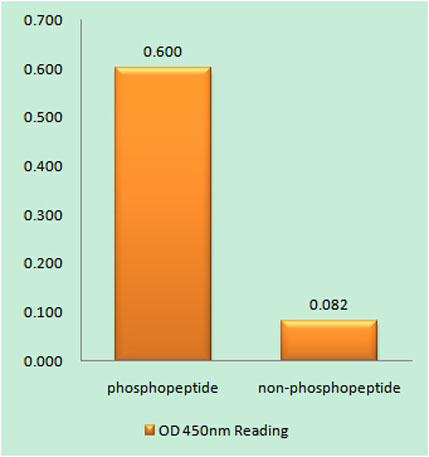
| Specificity | Phospho-KIR5.1 (S416) Polyclonal Antibody detects endogenous levels of KIR5.1 protein only when phosphorylated at S416. |
| Formulation | Liquid in PBS containing 50% glycerol, 0.5% BSA and 0.02% sodium azide. |
| Clonality | Polyclonal |
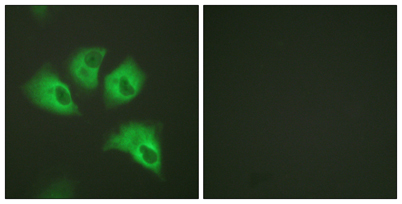
| Dilution | Western Blot: 1/500 - 1/2000. Immunohistochemistry: 1/100 - 1/300. Immunofluorescence: 1/200 - 1/1000. ELISA: 1/5000. Not yet tested in other applications. |
| Purification | The antibody was affinity-purified from rabbit antiserum by affinity-chromatography using epitope-specific immunogen. |
| Concentration | 1 mg/ml |
| Storage stability | -20°C/1 year |
| Molecular Weight (Da) | |
| Observed band (KD) | 48kD |
| Background | KCNJ16 (Potassium Voltage-Gated Channel Subfamily J Member 16) is a Protein Coding gene. Diseases associated with KCNJ16 include sesame syndrome and body dysmorphic disorder. Among its related pathways are Transmission across Chemical Synapses and Inwardly rectifying K+ channels. GO annotations related to this gene include inward rectifier potassium channel activity. An important paralog of this gene is KCNJ3. nward rectifier potassium channels are characterized by a greater tendency to allow potassium to flow into the cell rather than out of it. Their voltage dependence is regulated by the concentration of extracellular potassium; as external potassium is raised, the voltage range of the channel opening shifts to more positive voltages. The inward rectification is mainly due to the blockage of outward current by internal magnesium. KCNJ16 may be involved in the regulation of fluid and pH balance. In the kidney, together with KCNJ10, mediates basolateral K(+) recycling in distal tubules; this process is critical for Na(+) reabsorption at the tubules (PubMed: 24561201). he inward-rectifier potassium channel family (also known as 2-TM channels) include the strong inward-rectifier channels (Kir2. ), the G-protein-activated inward-rectifier channels (Kir3. ) and the ATP-sensitive channels (Kir6. ), which combine with sulphonylurea receptors. |
| Function | |
| Subcellular location | |
| Expression |

Use collapsible tabs for more detailed information that will help customers make a purchasing decision.
Ex: Shipping and return policies, size guides, and other common questions.