 Français
 English

| ELK.No | ES4470 |
| Product name | Mindin rabbit pAb |
| Reactivity | Human;Mouse;Rat;Monkey |
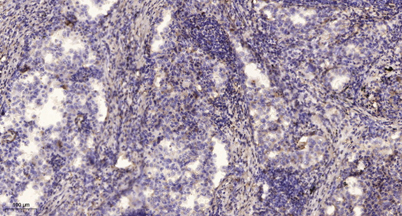
| Applications | WB;IHC |
| Other name | SPON2; DIL1; Spondin-2; Differentially expressed in cancerous and non-cancerous lung cells 1; DIL-1; Mindin |
| Size | 50μL |
| Unit price ($) | 148 |
| Human gene ID | 10417 |
| Human Swiss-Prot | Q9BUD6 |
| Source | Rabbit |
| Isotype | IgG |
| Target | Mindin |
| Fields | |
| Gene name | SPON2 |
| Protein name | Spondin-2 |
| Human gene link | View Human Gene |
| Human Swiss link | View Human Swiss-Prot |
| Mouse gene ID | 100689 |
| Mouse gene link | View Mouse Gene |
| Mouse Swiss-Prot | Q8BMS2 |
| Mouse Swiss link | View Mouse Swiss-Prot |
| Rat gene ID | 171569 |
| Rat gene link | View Rat Gene |
| Rat Swiss-Prot | Q9WV75 |
| Rat Swiss link | View Rat Swiss-Prot |
| Immunogen | The antiserum was produced against synthesized peptide derived from human SPON2. AA range:71-120 |
| Specificity | Mindin Polyclonal Antibody detects endogenous levels of Mindin protein. |
| Formulation | Liquid in PBS containing 50% glycerol, 0.5% BSA and 0.02% sodium azide. |
| Clonality | Polyclonal |
| Dilution | WB 1:500-2000;IHC-p 1:50-300 |
| Purification | The antibody was affinity-purified from rabbit antiserum by affinity-chromatography using epitope-specific immunogen. |
| Concentration | 1 mg/ml |
| Storage stability | -20°C/1 year |
| Molecular Weight (Da) | |
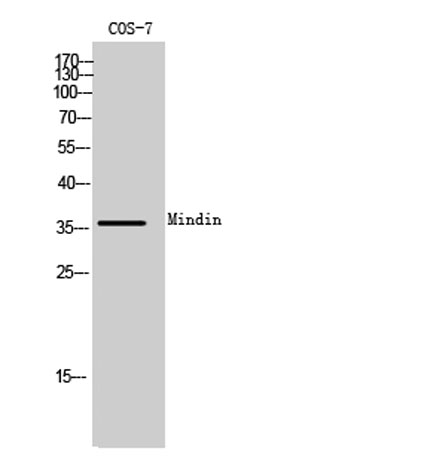
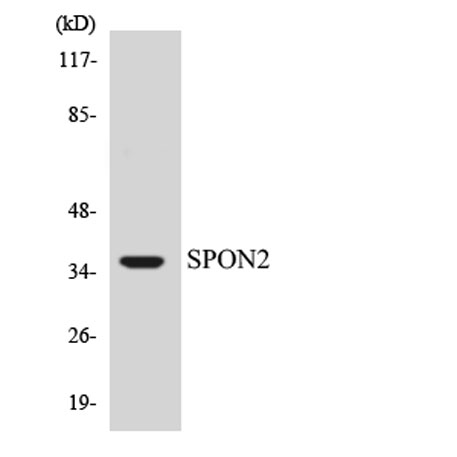
| Observed band (KD) | 37kD |
| Background | function:Cell adhesion protein that promote adhesion and outgrowth of hippocampal embryonic neurons. Binds directly to bacteria and their components and functions as an opsonin for macrophage phagocytosis of bacteria. Essential in the initiation of the innate immune response and represents a unique pattern-recognition molecule in the ECM for microbial pathogens.,similarity:Contains 1 spondin domain.,similarity:Contains 1 TSP type-1 domain.,tissue specificity:Expressed in normal lung tissues but not in lung carcinoma cell lines., |
| Function | function:Cell adhesion protein that promote adhesion and outgrowth of hippocampal embryonic neurons. Binds directly to bacteria and their components and functions as an opsonin for macrophage phagocytosis of bacteria. Essential in the initiation of the innate immune response and represents a unique pattern-recognition molecule in the ECM for microbial pathogens.,similarity:Contains 1 spondin domain.,similarity:Contains 1 TSP type-1 domain.,tissue specificity:Expressed in normal lung tissues but not in lung carcinoma cell lines., |
| Subcellular location | Secreted, extracellular space, extracellular matrix . |
| Expression | Expressed in normal lung tissue but not in lung carcinoma cell lines. |

Use collapsible tabs for more detailed information that will help customers make a purchasing decision.
Ex: Shipping and return policies, size guides, and other common questions.