 Français
 English
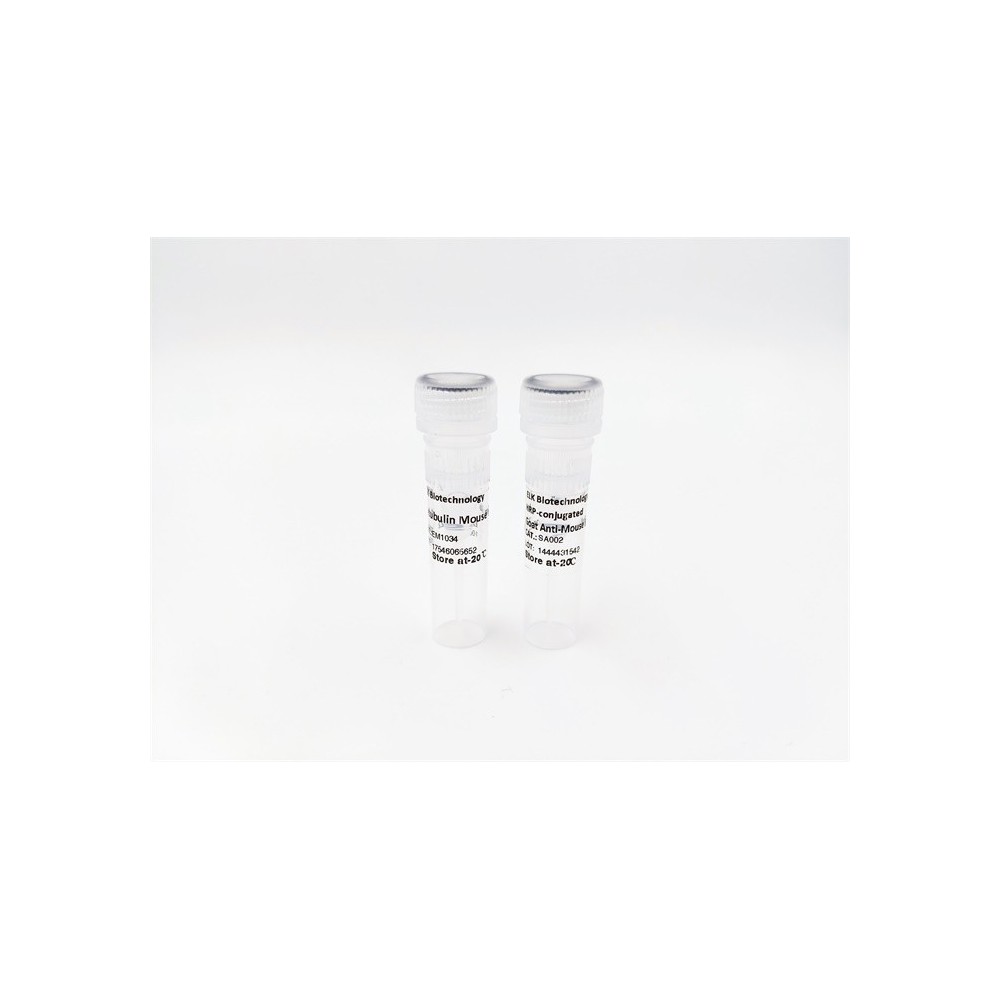

| ELK.No | ES4507 |
| Product name | SLU7 rabbit pAb |
| Reactivity | Human;Mouse;Rat |
| Applications | WB;IHC |
| Other name | SLU7; Pre-mRNA-splicing factor SLU7; hSlu7 |
| Size | 100μL |
| Unit price ($) | 248 |
| Human gene ID | 10569 |
| Human Swiss-Prot | O95391 |
| Source | Rabbit |
| Isotype | IgG |
| Target | SLU7 |
| Fields | >>Spliceosome |
| Gene name | SLU7 |
| Protein name | Pre-mRNA-splicing factor SLU7 |
| Human gene link | View Human Gene |
| Human Swiss link | View Human Swiss-Prot |
| Mouse gene ID | 193116 |
| Mouse gene link | View Mouse Gene |
| Mouse Swiss-Prot | Q8BHJ9 |
| Mouse Swiss link | View Mouse Swiss-Prot |
| Rat gene ID | 303057 |
| Rat gene link | View Rat Gene |
| Rat Swiss-Prot | Q80ZG5 |
| Rat Swiss link | View Rat Swiss-Prot |
| Immunogen | The antiserum was produced against synthesized peptide derived from human SLU7. AA range:113-162 |
| Specificity | SLU7 Polyclonal Antibody detects endogenous levels of SLU7 protein. |
| Formulation | Liquid in PBS containing 50% glycerol, 0.5% BSA and 0.02% sodium azide. |
| Clonality | Polyclonal |
| Dilution | WB 1:500-2000;IHC-p 1:50-300 |
| Purification | The antibody was affinity-purified from rabbit antiserum by affinity-chromatography using epitope-specific immunogen. |
| Concentration | 1 mg/ml |
| Storage stability | -20°C/1 year |
| Molecular Weight (Da) | |
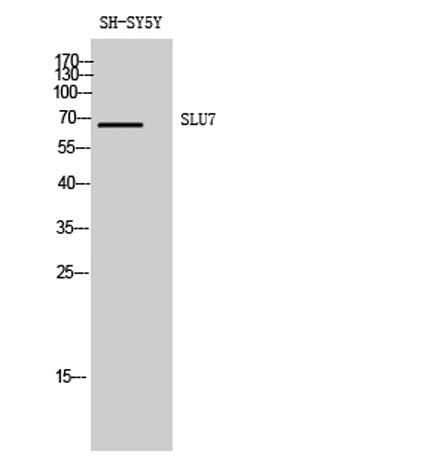
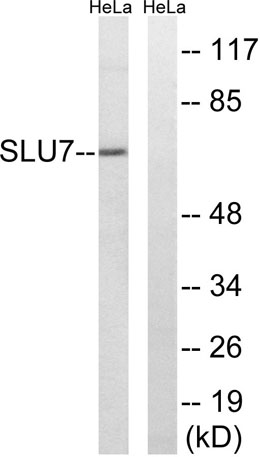
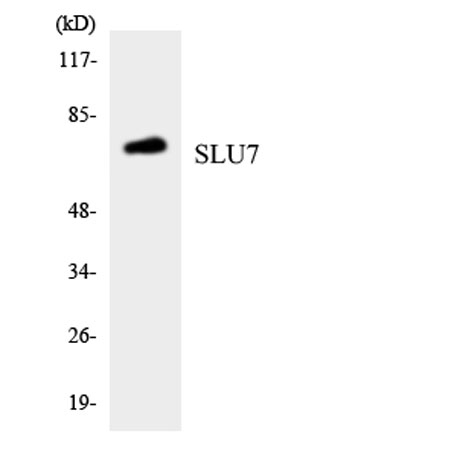
| Observed band (KD) | 65kD |
| Background | Pre-mRNA splicing occurs in two sequential transesterification steps. The protein encoded by this gene is a splicing factor that has been found to be essential during the second catalytic step in the pre-mRNA splicing process. It associates with the spliceosome and contains a zinc knuckle motif that is found in other splicing factors and is involved in protein-nucleic acid and protein-protein interactions. [provided by RefSeq, Jul 2008], |
| Function | domain:The CCHC-type zinc finger is required to retain the protein within the nucleus and prevent its shuttle back to the cytoplasm via the CRM1 pathway.,function:Participates in the second catalytic step of pre-mRNA splicing, when the free hydroxyl group of exon I attacks the 3'-splice site to generate spliced mRNA and the excised lariat intron. Required for holding exon 1 properly in the spliceosome and for correct AG identification when more than one possible AG exists in 3'-splicing site region. May be involved in the activation of proximal AG. Probably also involved in alternative splicing regulation.,similarity:Belongs to the SLU7 family.,similarity:Contains 1 CCHC-type zinc finger.,subcellular location:Predominantly nuclear. Shuttling between the nucleus and the cytoplasm is regulated by the CCHC-type zinc finger. Upon UV-C stress stimulus, the nuclear concentration of the protein |
| Subcellular location | Nucleus . Nucleus speckle . Cytoplasm . Predominantly nuclear. Shuttling between the nucleus and the cytoplasm is regulated by the CCHC-type zinc finger. Upon UV-C stress stimulus, the nuclear concentration of the protein decreases, affecting alternative splicing. Translocates from the nucleus to the cytoplasm after heat shock cell treatment. Accumulates in cytoplasmic vesicle-like organelles after heat shock treatment, which may represent stress granules. . |
| Expression | Colon,Epithelium,Eye, |

Use collapsible tabs for more detailed information that will help customers make a purchasing decision.
Ex: Shipping and return policies, size guides, and other common questions.