 Français
 English
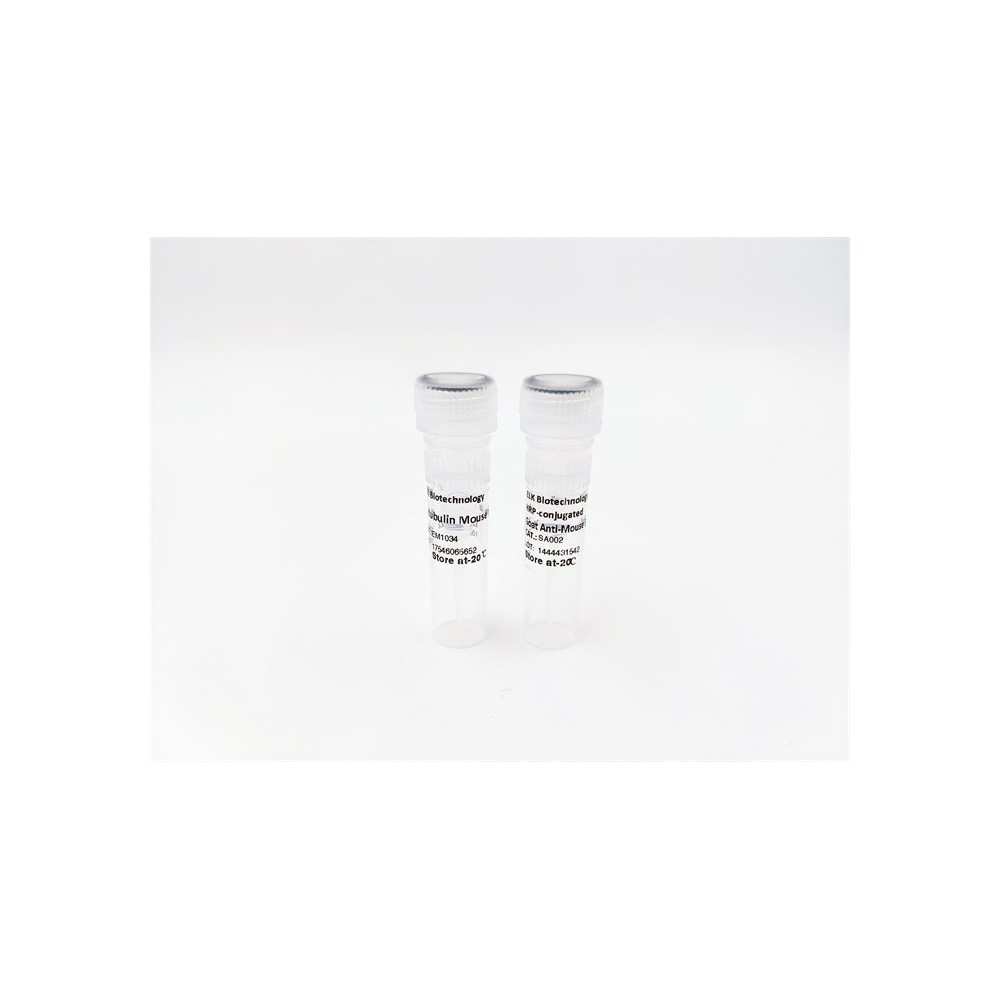

| ELK.No | ES4555 |
| Product name | CysLTR1 rabbit pAb |
| Reactivity | Human;Monkey |
| Applications | WB;IHC;IF;ELISA |
| Other name | CYSLTR1; CYSLT1; Cysteinyl leukotriene receptor 1; CysLTR1; Cysteinyl leukotriene D4 receptor; LTD4 receptor; G-protein coupled receptor HG55; HMTMF81 |
| Size | 100μL |
| Unit price ($) | 248 |
| Human gene ID | 10800 |
| Human Swiss-Prot | Q9Y271 |
| Source | Rabbit |
| Isotype | IgG |
| Target | CysLTR1 |
| Fields | >>Calcium signaling pathway;>>Neuroactive ligand-receptor interaction |
| Gene name | CYSLTR1 |
| Protein name | Cysteinyl leukotriene receptor 1 |
| Human gene link | View Human Gene |
| Human Swiss link | View Human Swiss-Prot |
| Mouse gene ID | |
| Mouse gene link | |
| Mouse Swiss-Prot | Q99JA4 |
| Mouse Swiss link | View Mouse Swiss-Prot |
| Rat gene ID | |
| Rat gene link | |
| Rat Swiss-Prot | |
| Rat Swiss link | |
| Immunogen | The antiserum was produced against synthesized peptide derived from human CLTR1. AA range:131-180 |
| Specificity | CysLTR1 Polyclonal Antibody detects endogenous levels of CysLTR1 protein. |
| Formulation | Liquid in PBS containing 50% glycerol, 0.5% BSA and 0.02% sodium azide. |
| Clonality | Polyclonal |
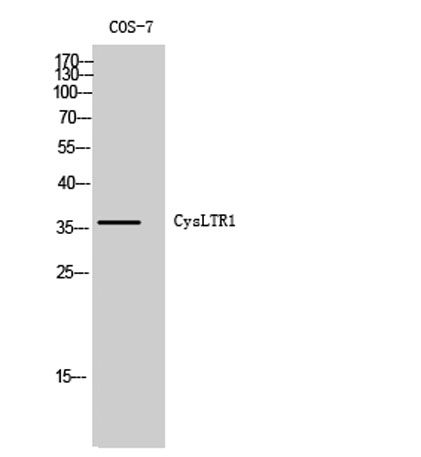
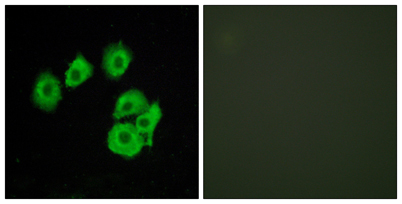
| Dilution | Western Blot: 1/500 - 1/2000. Immunohistochemistry: 1/100 - 1/300. Immunofluorescence: 1/200 - 1/1000. ELISA: 1/10000. Not yet tested in other applications. |
| Purification | The antibody was affinity-purified from rabbit antiserum by affinity-chromatography using epitope-specific immunogen. |
| Concentration | 1 mg/ml |
| Storage stability | -20°C/1 year |
| Molecular Weight (Da) | |
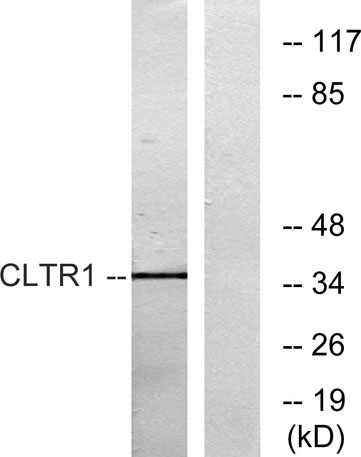
| Observed band (KD) | 36kD |
| Background | This gene encodes a member of the G-protein coupled receptor 1 family. The encoded protein is a receptor for cysteinyl leukotrienes, and is involved in mediating bronchoconstriction via activation of a phosphatidylinositol-calcium second messenger system. Activation of the encoded receptor results in contraction and proliferation of bronchial smooth muscle cells, eosinophil migration, and damage to the mucus layer in the lung. Upregulation of this gene is associated with asthma and dysregulation may also be implicated in cancer. Alternative splicing results in multiple transcript variants. [provided by RefSeq, Aug 2013], |
| Function | function:Receptor for cysteinyl leukotrienes mediating bronchoconstriction of individuals with and without asthma. Stimulation by LTD4 results in the contraction and proliferation of smooth muscle, edema, eosinophil migration and damage to the mucus layer in the lung. This response is mediated via a G-protein that activates a phosphatidylinositol-calcium second messenger system. The rank order of affinities for the leukotrienes is LTD4 >> LTE4 = LTC4 >> LTB4.,miscellaneous:Selective antagonists, such as montelukast (Singulair), zafirlukast (Accolate) and pranlukast (Onon), are used in the treatment of the asthma crisis.,similarity:Belongs to the G-protein coupled receptor 1 family.,tissue specificity:Widely expressed, with highest levels in spleen and peripheral blood leukocytes. Lower expression in several tissues, such as lung (mostly in smooth muscle bundles and alveolar macrophages), |
| Subcellular location | Cell membrane; Multi-pass membrane protein. |
| Expression | Widely expressed, with highest levels in spleen and peripheral blood leukocytes. Lower expression in several tissues, such as lung (mostly in smooth muscle bundles and alveolar macrophages), placenta, small intestine, pancreas, colon and heart. |

Use collapsible tabs for more detailed information that will help customers make a purchasing decision.
Ex: Shipping and return policies, size guides, and other common questions.