 Français
 English

| ELK.No | ES4616 |
| Product name | IRAK-M rabbit pAb |
| Reactivity | Human;Rat;Mouse; |
| Applications | WB;IHC;IF;ELISA |
| Other name | IRAK3; Interleukin-1 receptor-associated kinase 3; IRAK-3; IL-1 receptor-associated kinase M; IRAK-M |
| Size | 50μL |
| Unit price ($) | 148 |
| Human gene ID | 11213 |
| Human Swiss-Prot | Q9Y616 |
| Source | Rabbit |
| Isotype | IgG |
| Target | IRAK-M |
| Fields | >>Neurotrophin signaling pathway |
| Gene name | IRAK3 |
| Protein name | Interleukin-1 receptor-associated kinase 3 |
| Human gene link | View Human Gene |
| Human Swiss link | View Human Swiss-Prot |
| Mouse gene ID | |
| Mouse gene link | |
| Mouse Swiss-Prot | Q8K4B2 |
| Mouse Swiss link | View Mouse Swiss-Prot |
| Rat gene ID | |
| Rat gene link | |
| Rat Swiss-Prot | |
| Rat Swiss link | |
| Immunogen | The antiserum was produced against synthesized peptide derived from human IRAK3. AA range:491-540 |
| Specificity | IRAK-M Polyclonal Antibody detects endogenous levels of IRAK-M protein. |
| Formulation | Liquid in PBS containing 50% glycerol, 0.5% BSA and 0.02% sodium azide. |
| Clonality | Polyclonal |
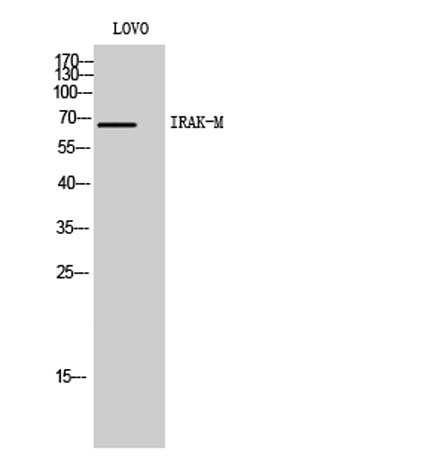
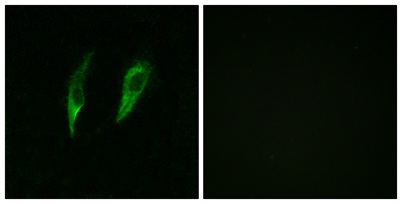
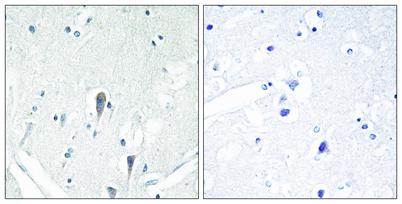
| Dilution | Western Blot: 1/500 - 1/2000. Immunohistochemistry: 1/100 - 1/300. Immunofluorescence: 1/200 - 1/1000. ELISA: 1/20000. Not yet tested in other applications. |
| Purification | The antibody was affinity-purified from rabbit antiserum by affinity-chromatography using epitope-specific immunogen. |
| Concentration | 1 mg/ml |
| Storage stability | -20°C/1 year |
| Molecular Weight (Da) | |
| Observed band (KD) | 68kD |
| Background | This gene encodes a member of the interleukin-1 receptor-associated kinase protein family. Members of this family are essential components of the Toll/IL-R immune signal transduction pathways. This protein is primarily expressed in monocytes and macrophages and functions as a negative regulator of Toll-like receptor signaling. Mutations in this gene are associated with a susceptibility to asthma. Alternate splicing results in multiple transcript variants. [provided by RefSeq, May 2010], |
| Function | catalytic activity:ATP + a protein = ADP + a phosphoprotein.,caution:Ser-293 is present instead of the conserved Asp which is expected to be an active site residue. Low level autophosphorylation activity has been reported in PubMed:10383454, while other authors describe this as an inactive kinase.,cofactor:Magnesium.,disease:Defects in IRAK3 are associated with susceptibility to asthma-related traits type 5 (ASRT5) [MIM:611064]. Asthma-related traits include clinical symptoms of asthma, such as coughing, wheezing, dyspnea, bronchial hyperresponsiveness as assessed by methacholine challenge test, serum IgE levels, atopy, and atopic dermatitis.,function:Inhibits dissociation of IRAK1 and IRAK4 from the Toll-like receptor signaling complex by either inhibiting the phosphorylation of IRAK1 and IRAK4 or stabilizing the receptor complex.,similarity:Belongs to the protein kinase superfamily. TK |
| Subcellular location | Cytoplasm . Nucleus . In dendritic cells, translocates into the nucleus upon IL33 stimulation. . |
| Expression | Expressed in eosinophils, dendritic cells and/or monocytes (at protein level) (PubMed:29686383). Expressed predominantly in peripheral blood lymphocytes (PubMed:10383454). |

Use collapsible tabs for more detailed information that will help customers make a purchasing decision.
Ex: Shipping and return policies, size guides, and other common questions.