 Français
 English

| ELK.No | ES4618 |
| Product name | AKAP 220 rabbit pAb |
| Reactivity | Human;Rat;Mouse; |
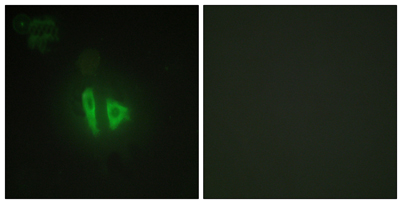
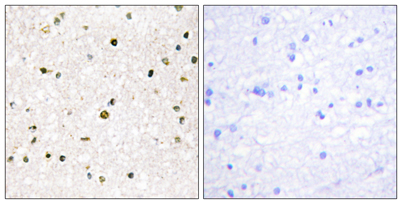
| Applications | IHC;IF;ELISA |
| Other name | AKAP11; AKAP220; KIAA0629; A-kinase anchor protein 11; AKAP-11; A-kinase anchor protein 220 kDa; AKAP 220; hAKAP220; Protein kinase A-anchoring protein 11; PRKA11 |
| Size | 100μL |
| Unit price ($) | 248 |
| Human gene ID | 11215 |
| Human Swiss-Prot | Q9UKA4 |
| Source | Rabbit |
| Isotype | IgG |
| Target | AKAP 220 |
| Fields | |
| Gene name | AKAP11 |
| Protein name | A-kinase anchor protein 11 |
| Human gene link | View Human Gene |
| Human Swiss link | View Human Swiss-Prot |
| Mouse gene ID | |
| Mouse gene link | |
| Mouse Swiss-Prot | |
| Mouse Swiss link | |
| Rat gene ID | |
| Rat gene link | |
| Rat Swiss-Prot | |
| Rat Swiss link | |
| Immunogen | The antiserum was produced against synthesized peptide derived from human AKAP11. AA range:1761-1810 |
| Specificity | AKAP 220 Polyclonal Antibody detects endogenous levels of AKAP 220 protein. |
| Formulation | Liquid in PBS containing 50% glycerol, 0.5% BSA and 0.02% sodium azide. |
| Clonality | Polyclonal |
| Dilution | Immunohistochemistry: 1/100 - 1/300. Immunofluorescence: 1/200 - 1/1000. ELISA: 1/10000. Not yet tested in other applications. |
| Purification | The antibody was affinity-purified from rabbit antiserum by affinity-chromatography using epitope-specific immunogen. |
| Concentration | 1 mg/ml |
| Storage stability | -20°C/1 year |
| Molecular Weight (Da) | 211kD |
| Observed band (KD) | |
| Background | The A-kinase anchor proteins (AKAPs) are a group of structurally diverse proteins, which have the common function of binding to the regulatory subunit of protein kinase A (PKA) and confining the holoenzyme to discrete locations within the cell. This gene encodes a member of the AKAP family. The encoded protein is expressed at high levels throughout spermatogenesis and in mature sperm. It binds the RI and RII subunits of PKA in testis. It may serve a function in cell cycle control of both somatic cells and germ cells in addition to its putative role in spermatogenesis and sperm function. [provided by RefSeq, Jul 2008], |
| Function | domain:RII-alpha binding site, predicted to form an amphipathic helix, could participate in protein-protein interactions with a complementary surface on the R-subunit dimer.,function:Binds to type II regulatory subunits of protein kinase A and anchors/targets them.,similarity:Belongs to the AKAP110 family.,subcellular location:Cytoplasmic in premeiotic pachytene spermatocytes and in the centrosome of developing postmeiotic germ cells, while a midpiece/centrosome localization was found in elongating spermatocytes and mature sperm.,tissue specificity:Expressed in heart, brain, lung, liver, kidney, testis and ovary. Weakly expressed in skeletal muscle, pancreas and spleen., |
| Subcellular location | Cytoplasm. Cytoplasm, cytoskeleton, microtubule organizing center, centrosome. Cytoplasmic in premeiotic pachytene spermatocytes and in the centrosome of developing postmeiotic germ cells, while a midpiece/centrosome localization was found in elongating spermatocytes and mature sperm. |
| Expression | Expressed in heart, brain, lung, liver, kidney, testis and ovary. Weakly expressed in skeletal muscle, pancreas and spleen. |

Use collapsible tabs for more detailed information that will help customers make a purchasing decision.
Ex: Shipping and return policies, size guides, and other common questions.