 Français
 English

| ELK.No | ES4707 |
| Product name | CKR-4 rabbit pAb |
| Reactivity | Human;Mouse;Rat |
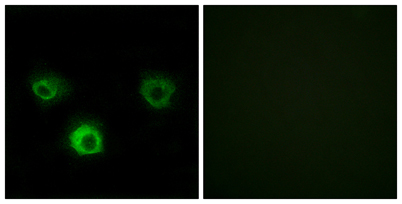
| Applications | IF;ELISA |
| Other name | CCR4; CMKBR4; C-C chemokine receptor type 4; C-C CKR-4; CC-CKR-4; CCR-4; CCR4; K5-5; CD antigen CD194 |
| Size | 50μL |
| Unit price ($) | 148 |
| Human gene ID | 1233 |
| Human Swiss-Prot | P51679 |
| Source | Rabbit |
| Isotype | IgG |
| Target | CKR-4 |
| Fields | >>Cytokine-cytokine receptor interaction;>>Viral protein interaction with cytokine and cytokine receptor;>>Chemokine signaling pathway;>>Kaposi sarcoma-associated herpesvirus infection;>>Viral carcinogenesis |
| Gene name | CCR4 |
| Protein name | C-C chemokine receptor type 4 |
| Human gene link | View Human Gene |
| Human Swiss link | View Human Swiss-Prot |
| Mouse gene ID | 12773 |
| Mouse gene link | View Mouse Gene |
| Mouse Swiss-Prot | P51680 |
| Mouse Swiss link | View Mouse Swiss-Prot |
| Rat gene ID | |
| Rat gene link | |
| Rat Swiss-Prot | |
| Rat Swiss link | |
| Immunogen | The antiserum was produced against synthesized peptide derived from human CCR4. AA range:211-260 |
| Specificity | CKR-4 Polyclonal Antibody detects endogenous levels of CKR-4 protein. |
| Formulation | Liquid in PBS containing 50% glycerol, 0.5% BSA and 0.02% sodium azide. |
| Clonality | Polyclonal |
| Dilution | Immunofluorescence: 1/200 - 1/1000. ELISA: 1/40000. Not yet tested in other applications. |
| Purification | The antibody was affinity-purified from rabbit antiserum by affinity-chromatography using epitope-specific immunogen. |
| Concentration | 1 mg/ml |
| Storage stability | -20°C/1 year |
| Molecular Weight (Da) | |
| Observed band (KD) | 41kD |
| Background | The protein encoded by this gene belongs to the G-protein-coupled receptor family . It is a receptor for the CC chemokine - MIP-1, RANTES, TARC and MCP-1. Chemokines are a group of small polypeptide, structurally related molecules that regulate cell trafficking of various types of leukocytes. The chemokines also play fundamental roles in the development, homeostasis, and function of the immune system, and they have effects on cells of the central nervous system as well as on endothelial cells involved in angiogenesis or angiostasis. [provided by RefSeq, Jul 2008], |
| Function | function:High affinity receptor for the C-C type chemokines CCL17/TARC and CCL22/MDC. The activity of this receptor is mediated by G(i) proteins which activate a phosphatidylinositol-calcium second messenger system. Can function as a chemoattractant homing receptor on circulating memory lymphocytes and as a coreceptor for some primary HIV-2 isolates. In the CNS, could mediate hippocampal-neuron survival.,online information:CC chemokine receptors entry,PTM:In natural killer cells, CCL22 binding induces phosphorylation on yet undefined Ser/Thr residues, most probably by beta-adrenergic receptor kinases 1 and 2.,similarity:Belongs to the G-protein coupled receptor 1 family.,tissue specificity:Predominantly expressed in the thymus, in peripheral blood leukocytes, including T-cells, mostly CD4+ cells, and basophils, and in platelets; at lower levels, in the spleen and in monocytes. Detected a |
| Subcellular location | Cell membrane; Multi-pass membrane protein. |
| Expression | Predominantly expressed in the thymus, in peripheral blood leukocytes, including T-cells, mostly CD4+ cells, and basophils, and in platelets; at lower levels, in the spleen and in monocytes. Detected also in macrophages, IL-2-activated natural killer cells and skin-homing memory T-cells, mostly the ones expressing the cutaneous lymphocyte antigen (CLA). Expressed in brain microvascular and coronary artery endothelial cells. |

Use collapsible tabs for more detailed information that will help customers make a purchasing decision.
Ex: Shipping and return policies, size guides, and other common questions.