 Français
 English
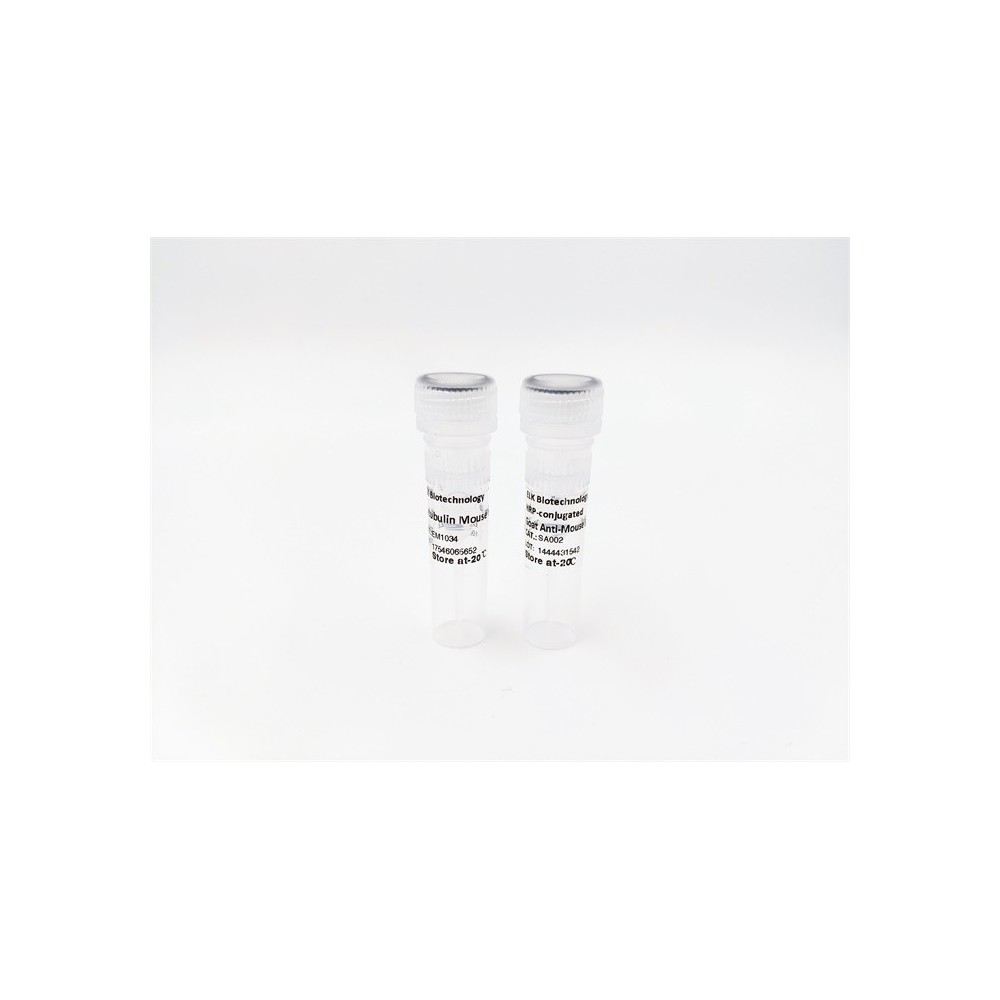

| ELK.No | ES4711 |
| Product name | CKR-7 rabbit pAb |
| Reactivity | Human;Monkey |
| Applications | WB;IF;ELISA |
| Other name | CCR7; CMKBR7; EBI1; EVI1; C-C chemokine receptor type 7; C-C CKR-7; CC-CKR-7; CCR-7; BLR2; CDw197; Epstein-Barr virus-induced G-protein coupled receptor 1; EBI1; EBV-induced G-protein coupled receptor 1; MIP-3 beta receptor; CD antigen CD19 |
| Size | 100μL |
| Unit price ($) | 248 |
| Human gene ID | 1236 |
| Human Swiss-Prot | P32248 |
| Source | Rabbit |
| Isotype | IgG |
| Target | CKR-7 |
| Fields | >>Cytokine-cytokine receptor interaction;>>Viral protein interaction with cytokine and cytokine receptor;>>Chemokine signaling pathway |
| Gene name | CCR7 |
| Protein name | C-C chemokine receptor type 7 |
| Human gene link | View Human Gene |
| Human Swiss link | View Human Swiss-Prot |
| Mouse gene ID | |
| Mouse gene link | |
| Mouse Swiss-Prot | P47774 |
| Mouse Swiss link | View Mouse Swiss-Prot |
| Rat gene ID | |
| Rat gene link | |
| Rat Swiss-Prot | |
| Rat Swiss link | |
| Immunogen | The antiserum was produced against synthesized peptide derived from human CCR7. AA range:170-219 |
| Specificity | CKR-7 Polyclonal Antibody detects endogenous levels of CKR-7 protein. |
| Formulation | Liquid in PBS containing 50% glycerol, 0.5% BSA and 0.02% sodium azide. |
| Clonality | Polyclonal |
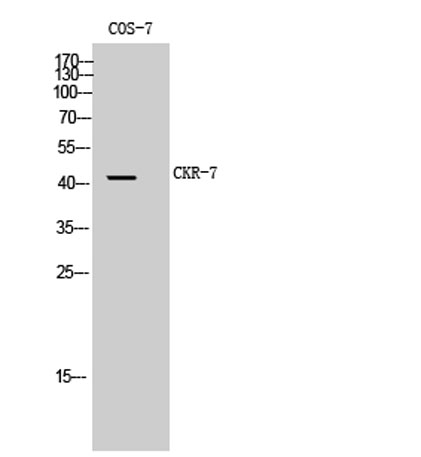
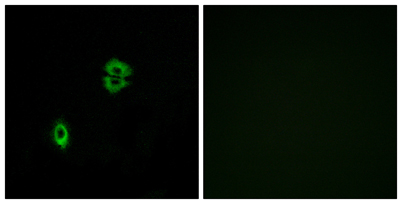
| Dilution | Western Blot: 1/500 - 1/2000. Immunofluorescence: 1/200 - 1/1000. ELISA: 1/40000. Not yet tested in other applications. |
| Purification | The antibody was affinity-purified from rabbit antiserum by affinity-chromatography using epitope-specific immunogen. |
| Concentration | 1 mg/ml |
| Storage stability | -20°C/1 year |
| Molecular Weight (Da) | |
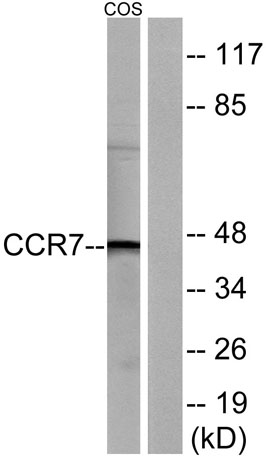
| Observed band (KD) | 43kD |
| Background | The protein encoded by this gene is a member of the G protein-coupled receptor family. This receptor was identified as a gene induced by the Epstein-Barr virus (EBV), and is thought to be a mediator of EBV effects on B lymphocytes. This receptor is expressed in various lymphoid tissues and activates B and T lymphocytes. It has been shown to control the migration of memory T cells to inflamed tissues, as well as stimulate dendritic cell maturation. The chemokine (C-C motif) ligand 19 (CCL19/ECL) has been reported to be a specific ligand of this receptor. Signals mediated by this receptor regulate T cell homeostasis in lymph nodes, and may also function in the activation and polarization of T cells, and in chronic inflammation pathogenesis. Alternative splicing of this gene results in multiple transcript variants. [provided by RefSeq, Sep 2014], |
| Function | function:Receptor for the MIP-3-beta chemokine. Probable mediator of EBV effects on B-lymphocytes or of normal lymphocyte functions.,induction:By EBV.,online information:CC chemokine receptors entry,similarity:Belongs to the G-protein coupled receptor 1 family.,tissue specificity:Expressed in various lymphoid tissues and activated B- and T-lymphocytes, strongly up-regulated in B-cells infected with Epstein-Barr virus and T-cells infected with herpesvirus 6 or 7., |
| Subcellular location | Cell membrane; Multi-pass membrane protein. |
| Expression | Expressed in various lymphoid tissues and activated B- and T-lymphocytes, strongly up-regulated in B-cells infected with Epstein-Barr virus and T-cells infected with herpesvirus 6 or 7. |

Use collapsible tabs for more detailed information that will help customers make a purchasing decision.
Ex: Shipping and return policies, size guides, and other common questions.