 Français
 English
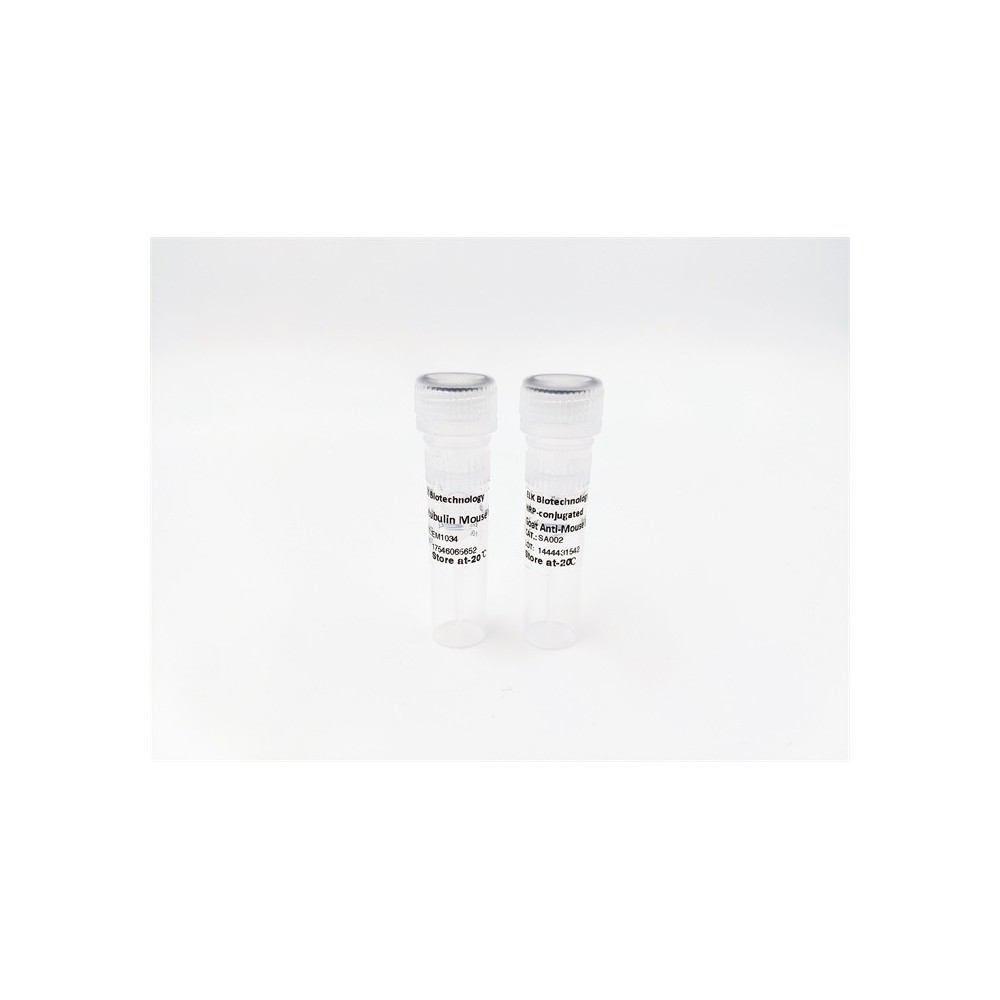

| ELK.No | ES4752 |
| Product name | COL11A1 rabbit pAb |
| Reactivity | Human;Mouse |
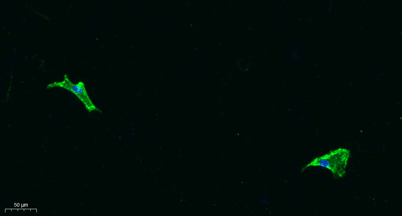
| Applications | WB;IHC;IF;ELISA |
| Other name | COL11A1; COLL6; Collagen alpha-1(XI) chain |
| Size | 100μL |
| Unit price ($) | 248 |
| Human gene ID | 1301 |
| Human Swiss-Prot | P12107 |
| Source | Rabbit |
| Isotype | IgG |
| Target | Collagen XI α1 |
| Fields | >>Protein digestion and absorption |
| Gene name | COL11A1 |
| Protein name | Collagen alpha-1(XI) chain |
| Human gene link | View Human Gene |
| Human Swiss link | View Human Swiss-Prot |
| Mouse gene ID | 12814 |
| Mouse gene link | View Mouse Gene |
| Mouse Swiss-Prot | Q61245 |
| Mouse Swiss link | View Mouse Swiss-Prot |
| Rat gene ID | |
| Rat gene link | |
| Rat Swiss-Prot | |
| Rat Swiss link | |
| Immunogen | The antiserum was produced against synthesized peptide derived from human Collagen XI alpha1. AA range:581-630 |
| Specificity | COL11A1 Polyclonal Antibody detects endogenous levels of COL11A1 protein. |
| Formulation | Liquid in PBS containing 50% glycerol, 0.5% BSA and 0.02% sodium azide. |
| Clonality | Polyclonal |
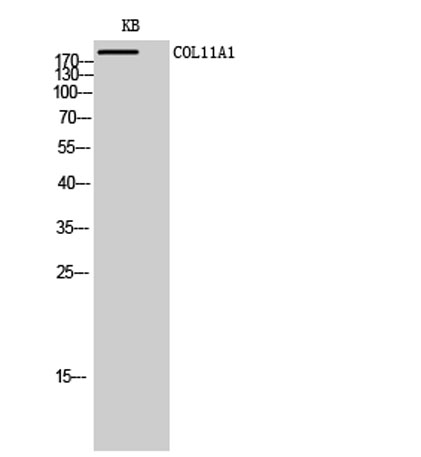
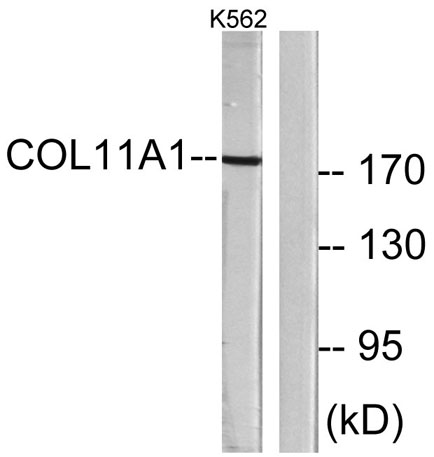
| Dilution | Western Blot: 1/500 - 1/2000. IHC-p: 1:100-300 ELISA: 1/20000. IF 1:100-300 Not yet tested in other applications. |
| Purification | The antibody was affinity-purified from rabbit antiserum by affinity-chromatography using epitope-specific immunogen. |
| Concentration | 1 mg/ml |
| Storage stability | -20°C/1 year |
| Molecular Weight (Da) | |
| Observed band (KD) | 181kD |
| Background | collagen type XI alpha 1 chain(COL11A1) Homo sapiens This gene encodes one of the two alpha chains of type XI collagen, a minor fibrillar collagen. Type XI collagen is a heterotrimer but the third alpha chain is a post-translationally modified alpha 1 type II chain. Mutations in this gene are associated with type II Stickler syndrome and with Marshall syndrome. A single-nucleotide polymorphism in this gene is also associated with susceptibility to lumbar disc herniation. Multiple transcript variants have been identified for this gene. [provided by RefSeq, Nov 2009], |
| Function | alternative products:Additional isoforms seem to exist. There is alternative usage of exon IIA or exon IIB. Transcripts containing exon IIA or IIB are present in cartilage, but exon IIB is preferentially utilized in transcripts from tendon,disease:Defects in COL11A1 are the cause of Marshall syndrome [MIM:154780]. It is an autosomal dominant disorder with ocular, orofacial, auditory and skeletal manifestations. It shares several features with Stickler syndrome, such as midfacial hypoplasia, high myopia, and sensorineural-hearing deficit.,disease:Defects in COL11A1 are the cause of Stickler syndrome type 2 (STL2) [MIM:604841]; also known as Stickler syndrome vitreous type 2. STL2 is an autosomal dominant form of Stickler syndrome, an inherited disorder that associates ocular signs with more or less complete forms of Pierre Robin sequence, bone disorders and sensorineural deafness. Ocular |
| Subcellular location | Secreted, extracellular space, extracellular matrix . |
| Expression | Cartilage, placenta and some tumor or virally transformed cell lines. Isoforms using exon IIA or IIB are found in the cartilage while isoforms using only exon IIB are found in the tendon. |

Use collapsible tabs for more detailed information that will help customers make a purchasing decision.
Ex: Shipping and return policies, size guides, and other common questions.