 Français
 English
c-Fms (phospho Tyr809) rabbit pAb
AO-06-ES4840-50

| ELK.No | ES4840 |
| Product name | c-Fms (phospho Tyr809) rabbit pAb |
| Reactivity | Human;Mouse;Rat |
| Applications | WB;ELISA |
| Other name | CSF1R; FMS; Macrophage colony-stimulating factor 1 receptor; CSF-1 receptor; CSF-1-R; CSF-1R; M-CSF-R; Proto-oncogene c-Fms; CD antigen CD115 |
| Size | 50μL |
| Unit price ($) | 148 |
| Human gene ID | 1436 |
| Human Swiss-Prot | P07333 |
| Source | Rabbit |
| Isotype | IgG |
| Target | c-Fms |
| Fields | >>MAPK signaling pathway;>>Ras signaling pathway;>>Rap1 signaling pathway;>>Cytokine-cytokine receptor interaction;>>Viral protein interaction with cytokine and cytokine receptor;>>PI3K-Akt signaling pathway;>>Osteoclast differentiation;>>Hematopoietic cell lineage;>>Pathways in cancer;>>Transcriptional misregulation in cancer;>>Acute myeloid leukemia |
| Gene name | CSF1R |
| Protein name | Macrophage colony-stimulating factor 1 receptor |
| Human gene link | View Human Gene |
| Human Swiss link | View Human Swiss-Prot |
| Mouse gene ID | 12978 |
| Mouse gene link | View Mouse Gene |
| Mouse Swiss-Prot | P09581 |
| Mouse Swiss link | View Mouse Swiss-Prot |
| Rat gene ID | |
| Rat gene link | |
| Rat Swiss-Prot | Q00495 |
| Rat Swiss link | View Rat Swiss-Prot |
| Immunogen | The antiserum was produced against synthesized peptide derived from human M-CSF Receptor around the phosphorylation site of Tyr809. AA range:781-830 |
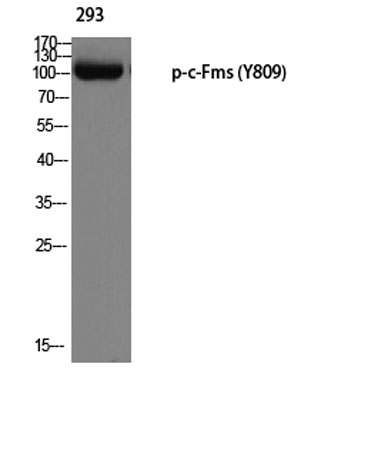
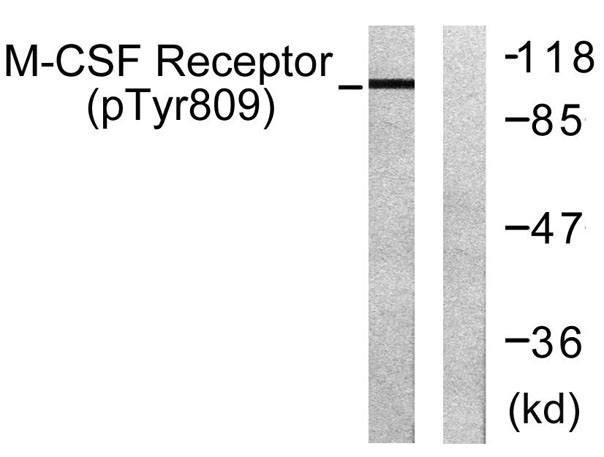
| Specificity | Phospho-c-Fms (Y809) Polyclonal Antibody detects endogenous levels of c-Fms protein only when phosphorylated at Y809. |
| Formulation | Liquid in PBS containing 50% glycerol, 0.5% BSA and 0.02% sodium azide. |
| Clonality | Polyclonal |
| Dilution | Western Blot: 1/500 - 1/2000. ELISA: 1/5000. Not yet tested in other applications. |
| Purification | The antibody was affinity-purified from rabbit antiserum by affinity-chromatography using epitope-specific immunogen. |
| Concentration | 1 mg/ml |
| Storage stability | -20°C/1 year |
| Molecular Weight (Da) | |
| Observed band (KD) | 108kD |
| Background | The protein encoded by this gene is the receptor for colony stimulating factor 1, a cytokine which controls the production, differentiation, and function of macrophages. This receptor mediates most if not all of the biological effects of this cytokine. Ligand binding activates the receptor kinase through a process of oligomerization and transphosphorylation. The encoded protein is a tyrosine kinase transmembrane receptor and member of the CSF1/PDGF receptor family of tyrosine-protein kinases. Mutations in this gene have been associated with a predisposition to myeloid malignancy. The first intron of this gene contains a transcriptionally inactive ribosomal protein L7 processed pseudogene oriented in the opposite direction. Alternative splicing results in multiple transcript variants. [provided by RefSeq, Dec 2013], |
| Function | catalytic activity:ATP + a [protein]-L-tyrosine = ADP + a [protein]-L-tyrosine phosphate.,function:Protein tyrosine-kinase transmembrane receptor for CSF1 and IL34.,similarity:Belongs to the protein kinase superfamily. Tyr protein kinase family.,similarity:Belongs to the protein kinase superfamily. Tyr protein kinase family. CSF-1/PDGF receptor subfamily.,similarity:Contains 1 protein kinase domain.,similarity:Contains 5 Ig-like C2-type (immunoglobulin-like) domains.,subunit:Interacts with INPPL1/SHIP2 and THOC5.,tissue specificity:Expressed in bone marrow and in differentiated blood mononuclear cells., |
| Subcellular location | Cell membrane; Single-pass type I membrane protein. |
| Expression | Expressed in bone marrow and in differentiated blood mononuclear cells. |

Use collapsible tabs for more detailed information that will help customers make a purchasing decision.
Ex: Shipping and return policies, size guides, and other common questions.