 Français
 English

| ELK.No | ES4877 |
| Product name | Six5 rabbit pAb |
| Reactivity | Human;Mouse |
| Applications | WB;IHC |
| Other name | SIX5; DMAHP; Homeobox protein SIX5; DM locus-associated homeodomain protein; Sine oculis homeobox homolog 5 |
| Size | 50μL |
| Unit price ($) | 148 |
| Human gene ID | 147912 |
| Human Swiss-Prot | Q8N196 |
| Source | Rabbit |
| Isotype | IgG |
| Target | Six5 |
| Fields | |
| Gene name | SIX5 |
| Protein name | Homeobox protein SIX5 |
| Human gene link | View Human Gene |
| Human Swiss link | View Human Swiss-Prot |
| Mouse gene ID | 20475 |
| Mouse gene link | View Mouse Gene |
| Mouse Swiss-Prot | P70178 |
| Mouse Swiss link | View Mouse Swiss-Prot |
| Rat gene ID | |
| Rat gene link | |
| Rat Swiss-Prot | |
| Rat Swiss link | |
| Immunogen | The antiserum was produced against synthesized peptide derived from human SIX5. AA range:201-250 |
| Specificity | Six5 Polyclonal Antibody detects endogenous levels of Six5 protein. |
| Formulation | Liquid in PBS containing 50% glycerol, 0.5% BSA and 0.02% sodium azide. |
| Clonality | Polyclonal |
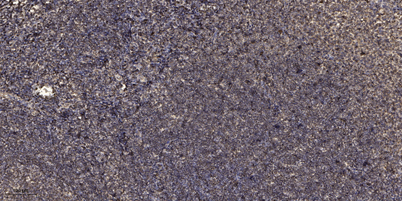
| Dilution | WB 1:500-2000;IHC-p 1:50-300 |
| Purification | The antibody was affinity-purified from rabbit antiserum by affinity-chromatography using epitope-specific immunogen. |
| Concentration | 1 mg/ml |
| Storage stability | -20°C/1 year |
| Molecular Weight (Da) | |
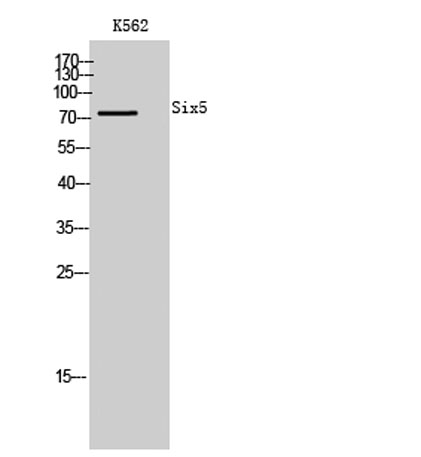
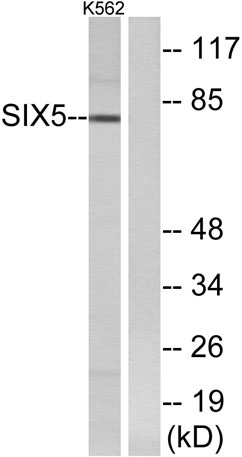
| Observed band (KD) | 75kD |
| Background | The protein encoded by this gene is a homeodomain-containing transcription factor that appears to function in the regulation of organogenesis. This gene is located downstream of the dystrophia myotonica-protein kinase gene. Mutations in this gene are a cause of branchiootorenal syndrome type 2. [provided by RefSeq, Jul 2009], |
| Function | caution:The region from 1 to 184 was deduced from the genomic sequence and ESTs.,developmental stage:At the begin of fourth week of development detected in cytoplasm of somite cells, and at the end of fourth week is accumulated in the nucleus. Between the sixth and eighth week of development detected in the nucleus of limb bud cells.,disease:Defects in SIX5 are the cause of branchiootorenal syndrome type 2 (BOR2) [MIM:610896]. BOR is an autosomal dominant disorder manifested by various combinations of preauricular pits, branchial fistulae or cysts, lacrimal duct stenosis, hearing loss, structural defects of the outer, middle, or inner ear, and renal dysplasia. Associated defects include asthenic habitus, long narrow facies, constricted palate, deep overbite, and myopia. Hearing loss may be due to mondini type cochlear defect and stapes fixation. Penetrance of BOR syndrome is high, althou |
| Subcellular location | Cytoplasm . Nucleus . |
| Expression | Expressed in adult but not in fetal eyes. Found in corneal epithelium and endothelium, lens epithelium, ciliary body epithelia, cellular layers of the retina and the sclera. |

Use collapsible tabs for more detailed information that will help customers make a purchasing decision.
Ex: Shipping and return policies, size guides, and other common questions.