 Français
 English
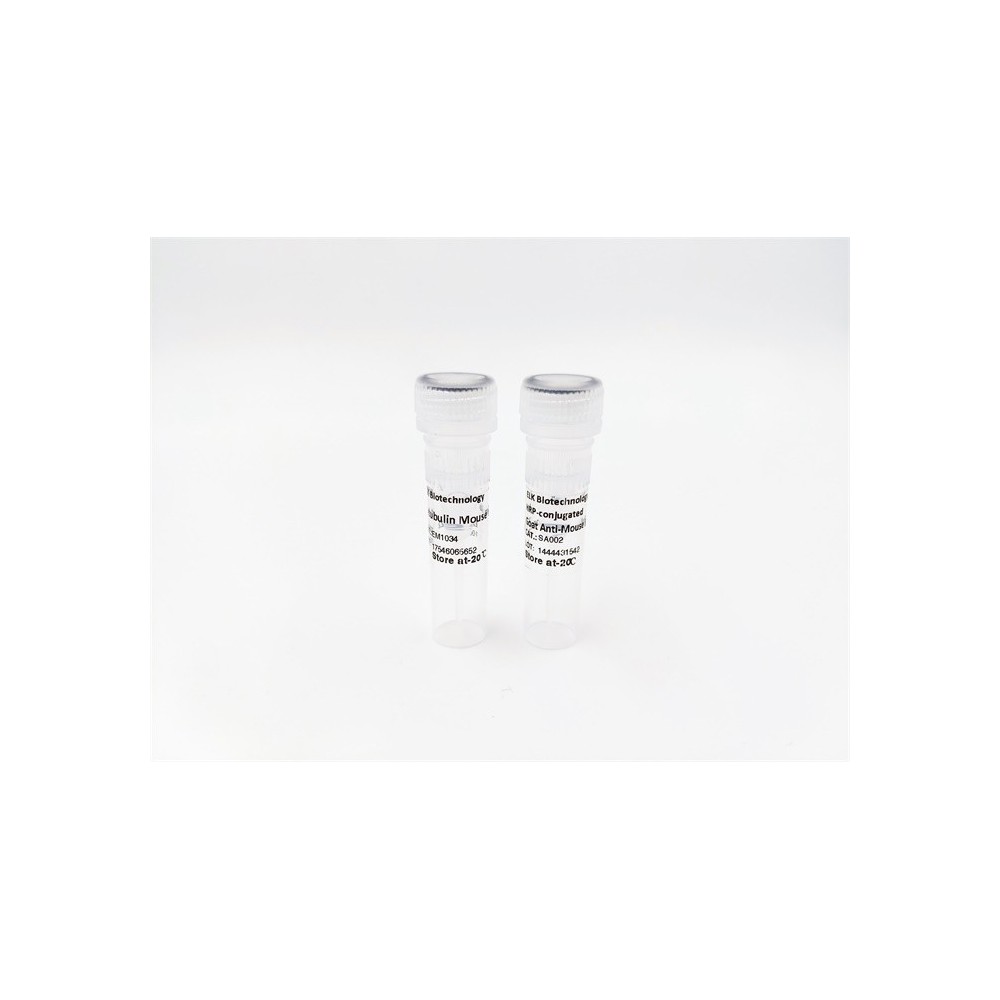

| ELK.No | ES5006 |
| Product name | Dyskerin rabbit pAb |
| Reactivity | Human;Mouse;Rat |
| Applications | WB;IHC;IF;ELISA |
| Other name | DKC1; NOLA4; H/ACA ribonucleoprotein complex subunit 4; CBF5 homolog; Dyskerin; Nopp140-associated protein of 57 kDa; Nucleolar protein NAP57; Nucleolar protein family A member 4; snoRNP protein DKC1 |
| Size | 100μL |
| Unit price ($) | 248 |
| Human gene ID | 1736 |
| Human Swiss-Prot | O60832 |
| Source | Rabbit |
| Isotype | IgG |
| Target | Dyskerin |
| Fields | >>Ribosome biogenesis in eukaryotes |
| Gene name | DKC1 |
| Protein name | H/ACA ribonucleoprotein complex subunit 4 |
| Human gene link | View Human Gene |
| Human Swiss link | View Human Swiss-Prot |
| Mouse gene ID | 245474 |
| Mouse gene link | View Mouse Gene |
| Mouse Swiss-Prot | Q9ESX5 |
| Mouse Swiss link | View Mouse Swiss-Prot |
| Rat gene ID | 170944 |
| Rat gene link | View Rat Gene |
| Rat Swiss-Prot | P40615 |
| Rat Swiss link | View Rat Swiss-Prot |
| Immunogen | The antiserum was produced against synthesized peptide derived from human Dyskerin. AA range:171-220 |
| Specificity | Dyskerin Polyclonal Antibody detects endogenous levels of Dyskerin protein. |
| Formulation | Liquid in PBS containing 50% glycerol, 0.5% BSA and 0.02% sodium azide. |
| Clonality | Polyclonal |
| Dilution | Western Blot: 1/500 - 1/2000. Immunohistochemistry: 1/100 - 1/300. Immunofluorescence: 1/200 - 1/1000. ELISA: 1/40000. Not yet tested in other applications. |
| Purification | The antibody was affinity-purified from rabbit antiserum by affinity-chromatography using epitope-specific immunogen. |
| Concentration | 1 mg/ml |
| Storage stability | -20°C/1 year |
| Molecular Weight (Da) | |
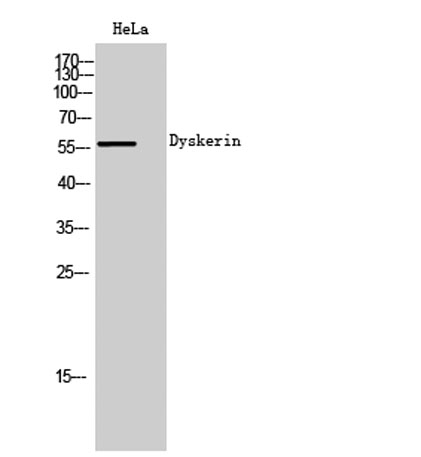
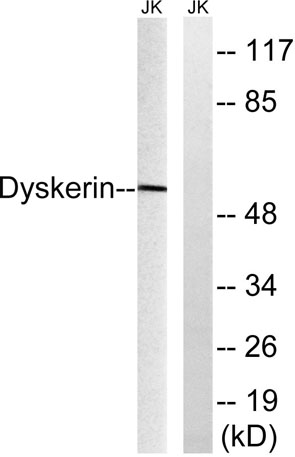
| Observed band (KD) | 57kD |
| Background | dyskerin pseudouridine synthase 1(DKC1) Homo sapiens This gene functions in two distinct complexes. It plays an active role in telomerase stabilization and maintenance, as well as recognition of snoRNAs containing H/ACA sequences which provides stability during biogenesis and assembly into H/ACA small nucleolar RNA ribonucleoproteins (snoRNPs). This gene is highly conserved and widely expressed, and may play additional roles in nucleo-cytoplasmic shuttling, DNA damage response, and cell adhesion. Mutations have been associated with X-linked dyskeratosis congenita. Alternative splicing results in multiple transcript variants. [provided by RefSeq, Jan 2014], |
| Function | catalytic activity:RNA uridine = RNA pseudouridine.,disease:Defects in DKC1 are a cause of dyskeratosis congenita X-linked recessive (XDKC) [MIM:305000]. XDKC is a rare, progressive bone marrow failure syndrome characterized by the triad of reticulated skin hyperpigmentation, nail dystrophy, and mucosal leukoplakia. Early mortality is often associated with bone marrow failure, infections, fatal pulmonary complications, or malignancy.,disease:Defects in DKC1 are the cause of Hoyeraal-Hreidarsson syndrome (HHS) [MIM:300240]. HHS is a multisystem disorder affecting males and is characterized by aplastic anemia, immunodeficiency, microcephaly, cerebellar hypoplasia, and growth retardation.,function:Required for ribosome biogenesis and telomere maintenance. Probable catalytic subunit of H/ACA small nucleolar ribonucleoprotein (H/ACA snoRNP) complex, which catalyzes pseudouridylation of rRNA. |
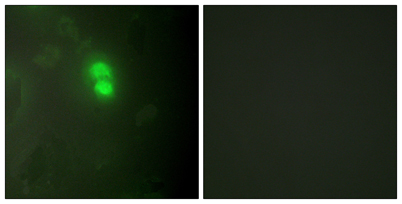
| Subcellular location | [Isoform 1]: Nucleus, nucleolus . Nucleus, Cajal body . Also localized to Cajal bodies (coiled bodies). .; [Isoform 3]: Cytoplasm . |
| Expression | Ubiquitously expressed. |

Use collapsible tabs for more detailed information that will help customers make a purchasing decision.
Ex: Shipping and return policies, size guides, and other common questions.