 Français
 English
Dok-1 (phospho Tyr398) rabbit pAb
AO-06-ES5017-50

| ELK.No | ES5017 |
| Product name | Dok-1 (phospho Tyr398) rabbit pAb |
| Reactivity | Human;Mouse;Rat |
| Applications | WB;ELISA |
| Other name | DOK1; Docking protein 1; Downstream of tyrosine kinase 1; p62(dok); pp62 |
| Size | 50μL |
| Unit price ($) | 148 |
| Human gene ID | 1796 |
| Human Swiss-Prot | Q99704 |
| Source | Rabbit |
| Isotype | IgG |
| Target | p62 Dok |
| Fields | |
| Gene name | DOK1 |
| Protein name | Docking protein 1 |
| Human gene link | View Human Gene |
| Human Swiss link | View Human Swiss-Prot |
| Mouse gene ID | 13448 |
| Mouse gene link | View Mouse Gene |
| Mouse Swiss-Prot | P97465 |
| Mouse Swiss link | View Mouse Swiss-Prot |
| Rat gene ID | 312477 |
| Rat gene link | View Rat Gene |
| Rat Swiss-Prot | Q4QQV2 |
| Rat Swiss link | View Rat Swiss-Prot |
| Immunogen | The antiserum was produced against synthesized peptide derived from human p62 Dok around the phosphorylation site of Tyr398. AA range:365-414 |
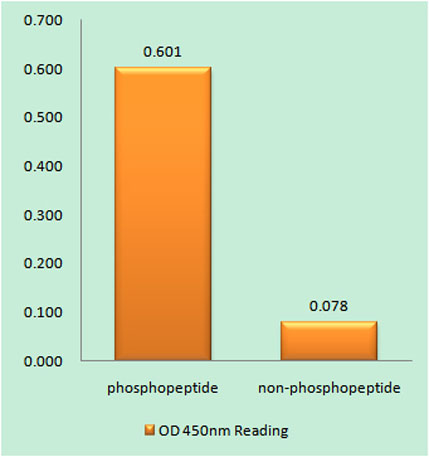
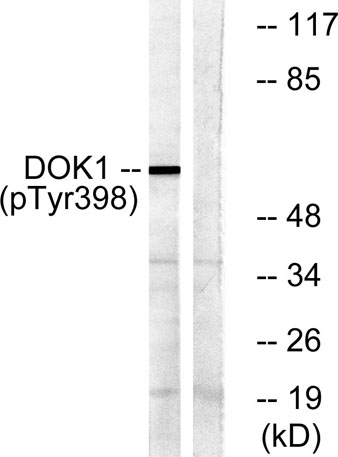
| Specificity | Phospho-Dok-1 (Y398) Polyclonal Antibody detects endogenous levels of Dok-1 protein only when phosphorylated at Y398. |
| Formulation | Liquid in PBS containing 50% glycerol, 0.5% BSA and 0.02% sodium azide. |
| Clonality | Polyclonal |
| Dilution | Western Blot: 1/500 - 1/2000. ELISA: 1/20000. Not yet tested in other applications. |
| Purification | The antibody was affinity-purified from rabbit antiserum by affinity-chromatography using epitope-specific immunogen. |
| Concentration | 1 mg/ml |
| Storage stability | -20°C/1 year |
| Molecular Weight (Da) | |
| Observed band (KD) | 62kD |
| Background | docking protein 1(DOK1) Homo sapiens The protein encoded by this gene is part of a signal transduction pathway downstream of receptor tyrosine kinases. The encoded protein is a scaffold protein that helps form a platform for the assembly of multiprotein signaling complexes. Several transcript variants encoding different isoforms have been found for this gene. [provided by RefSeq, Jan 2016], |
| Function | domain:The PTB domain mediates receptor interaction.,function:DOK proteins are enzymatically inert adaptor or scaffolding proteins. They provide a docking platform for the assembly of multimolecular signaling complexes. DOK1 appears to be a negative regulator of the insulin signaling pathway. Modulates integrin activation by competing with talin for the same binding site on ITGB3.,PTM:Constitutively tyrosine-phosphorylated.,PTM:Phosphorylated on tyrosine residues by the insulin receptor kinase. Results in the negative regulation of the insulin signaling pathway.,similarity:Belongs to the DOK family. Type A subfamily.,similarity:Contains 1 IRS-type PTB domain.,similarity:Contains 1 PH domain.,subunit:Interacts with ABL (By similarity). Interacts with RasGAP and INPP5D/SHIP1. Interacts directly with phosphorylated ITGB3.,tissue specificity:Expressed in pancreas, heart, leukocyte and spleen |
| Subcellular location | [Isoform 1]: Cytoplasm. Nucleus.; [Isoform 3]: Cytoplasm, perinuclear region. |
| Expression | Expressed in pancreas, heart, leukocyte and spleen. Expressed in both resting and activated peripheral blood T-cells. Expressed in breast cancer. |

Use collapsible tabs for more detailed information that will help customers make a purchasing decision.
Ex: Shipping and return policies, size guides, and other common questions.