 Français
 English
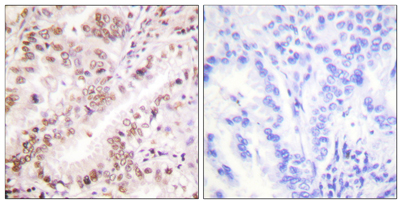
ERα (phospho Tyr537) rabbit pAb
AO-06-ES5172-50

| ELK.No | ES5172 |
| Product name | ERα (phospho Tyr537) rabbit pAb |
| Reactivity | Human;Mouse;Rat |
| Applications | WB;IHC;IF;ELISA |
| Other name | ESR1; ESR; NR3A1; Estrogen receptor; ER; ER-alpha; Estradiol receptor; Nuclear receptor subfamily 3 group A member 1 |
| Size | 50μL |
| Unit price ($) | 148 |
| Human gene ID | 2099 |
| Human Swiss-Prot | P03372 |
| Source | Rabbit |
| Isotype | IgG |
| Target | Estrogen Receptor-α |
| Fields | >>Endocrine resistance;>>Estrogen signaling pathway;>>Prolactin signaling pathway;>>Thyroid hormone signaling pathway;>>Endocrine and other factor-regulated calcium reabsorption;>>Pathways in cancer;>>Proteoglycans in cancer;>>Chemical carcinogenesis - receptor activation;>>Breast cancer |
| Gene name | ESR1 |
| Protein name | Estrogen receptor |
| Human gene link | View Human Gene |
| Human Swiss link | View Human Swiss-Prot |
| Mouse gene ID | 13982 |
| Mouse gene link | View Mouse Gene |
| Mouse Swiss-Prot | P19785 |
| Mouse Swiss link | View Mouse Swiss-Prot |
| Rat gene ID | 24890 |
| Rat gene link | View Rat Gene |
| Rat Swiss-Prot | P06211 |
| Rat Swiss link | View Rat Swiss-Prot |
| Immunogen | The antiserum was produced against synthesized peptide derived from human Estrogen Receptor-alpha around the phosphorylation site of Tyr537. AA range:501-550 |
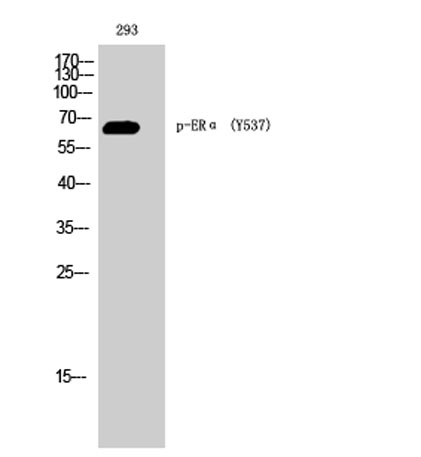
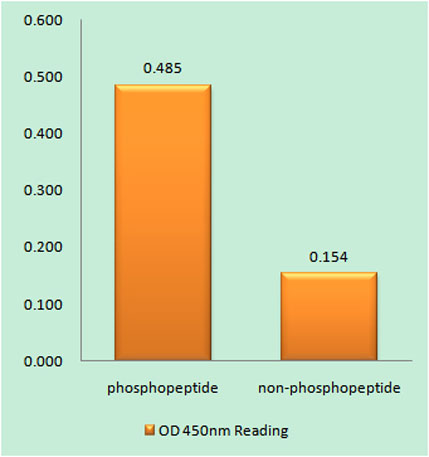
| Specificity | Phospho-ERα (Y537) Polyclonal Antibody detects endogenous levels of ERα protein only when phosphorylated at Y537. |
| Formulation | Liquid in PBS containing 50% glycerol, 0.5% BSA and 0.02% sodium azide. |
| Clonality | Polyclonal |
| Dilution | Western Blot: 1/500 - 1/2000. Immunohistochemistry: 1/100 - 1/300. ELISA: 1/10000. Not yet tested in other applications. |
| Purification | The antibody was affinity-purified from rabbit antiserum by affinity-chromatography using epitope-specific immunogen. |
| Concentration | 1 mg/ml |
| Storage stability | -20°C/1 year |
| Molecular Weight (Da) | |
| Observed band (KD) | 66kD |
| Background | This gene encodes an estrogen receptor, a ligand-activated transcription factor composed of several domains important for hormone binding, DNA binding, and activation of transcription. The protein localizes to the nucleus where it may form a homodimer or a heterodimer with estrogen receptor 2. Estrogen and its receptors are essential for sexual development and reproductive function, but also play a role in other tissues such as bone. Estrogen receptors are also involved in pathological processes including breast cancer, endometrial cancer, and osteoporosis. Alternative promoter usage and alternative splicing result in dozens of transcript variants, but the full-length nature of many of these variants has not been determined. [provided by RefSeq, Mar 2014], |
| Function | domain:Composed of three domains: a modulating N-terminal domain, a DNA-binding domain and a C-terminal steroid-binding domain.,function:Nuclear hormone receptor. The steroid hormones and their receptors are involved in the regulation of eukaryotic gene expression and affect cellular proliferation and differentiation in target tissues.,online information:Estrogen receptor entry,polymorphism:Genetic variations in ESR1 are correlated with bone mineral density (BMD). Low BMD is a risk factor for osteoporotic fracture. Osteoporosis is characterized by reduced bone mineral density, disrutption of bone microarchitecture, and the alteration of the amount and variety of non-collagenous proteins in bone. Osteoporotic bones are more at risk of fracture.,PTM:Glycosylated; contains N-acetylglucosamine, probably O-linked.,PTM:Phosphorylated by cyclin A/CDK2. Phosphorylation probably enhances transcri |
| Subcellular location | [Isoform 1]: Nucleus . Cytoplasm . Cell membrane ; Peripheral membrane protein ; Cytoplasmic side . A minor fraction is associated with the inner membrane.; [Isoform 3]: Nucleus. Cytoplasm. Cell membrane; Peripheral membrane protein; Cytoplasmic side. Cell membrane; Single-pass type I membrane protein. Associated with the inner membrane via palmitoylation (Probable). At least a subset exists as a transmembrane protein with a N-terminal extracellular domain. .; Nucleus. Golgi apparatus. Cell membrane. Colocalizes with ZDHHC7 and ZDHHC21 in the Golgi apparatus where most probably palmitoylation occurs. Associated with the plasma membrane when palmitoylated. |
| Expression | Widely expressed (PubMed:10970861). Not expressed in the pituitary gland (PubMed:10970861). ; [Isoform 3]: Widely expressed, however not expressed in the pituitary gland. |

Use collapsible tabs for more detailed information that will help customers make a purchasing decision.
Ex: Shipping and return policies, size guides, and other common questions.