 Français
 English
Cleaved-Factor XIIIa (G39) rabbit pAb
AO-06-ES5191-100

| ELK.No | ES5191 |
| Product name | Cleaved-Factor XIIIa (G39) rabbit pAb |
| Reactivity | Human;Rat;Mouse; |
| Applications | WB;ELISA |
| Other name | F13A1; F13A; Coagulation factor XIII A chain; Coagulation factor XIIIa; Protein-glutamine gamma-glutamyltransferase A chain; Transglutaminase A chain |
| Size | 100μL |
| Unit price ($) | 248 |
| Human gene ID | 2162 |
| Human Swiss-Prot | P00488 |
| Source | Rabbit |
| Isotype | IgG |
| Target | Factor XIIIa |
| Fields | >>Complement and coagulation cascades;>>Coronavirus disease - COVID-19 |
| Gene name | F13A1 |
| Protein name | Coagulation factor XIII A chain |
| Human gene link | View Human Gene |
| Human Swiss link | View Human Swiss-Prot |
| Mouse gene ID | |
| Mouse gene link | |
| Mouse Swiss-Prot | Q8BH61 |
| Mouse Swiss link | View Mouse Swiss-Prot |
| Rat gene ID | |
| Rat gene link | |
| Rat Swiss-Prot | |
| Rat Swiss link | |
| Immunogen | The antiserum was produced against synthesized peptide derived from human FA13A. AA range:20-69 |
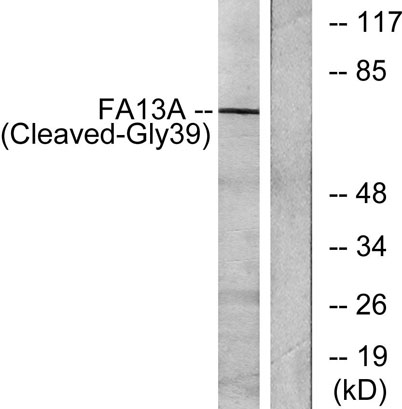
| Specificity | Cleaved-Factor XIIIa (G39) Polyclonal Antibody detects endogenous levels of fragment of activated Factor XIIIa protein resulting from cleavage adjacent to G39. |
| Formulation | Liquid in PBS containing 50% glycerol, 0.5% BSA and 0.02% sodium azide. |
| Clonality | Polyclonal |
| Dilution | Western Blot: 1/500 - 1/2000. ELISA: 1/20000. Not yet tested in other applications. |
| Purification | The antibody was affinity-purified from rabbit antiserum by affinity-chromatography using epitope-specific immunogen. |
| Concentration | 1 mg/ml |
| Storage stability | -20°C/1 year |
| Molecular Weight (Da) | |
| Observed band (KD) | 79kD |
| Background | This gene encodes the coagulation factor XIII A subunit. Coagulation factor XIII is the last zymogen to become activated in the blood coagulation cascade. Plasma factor XIII is a heterotetramer composed of 2 A subunits and 2 B subunits. The A subunits have catalytic function, and the B subunits do not have enzymatic activity and may serve as plasma carrier molecules. Platelet factor XIII is comprised only of 2 A subunits, which are identical to those of plasma origin. Upon cleavage of the activation peptide by thrombin and in the presence of calcium ion, the plasma factor XIII dissociates its B subunits and yields the same active enzyme, factor XIIIa, as platelet factor XIII. This enzyme acts as a transglutaminase to catalyze the formation of gamma-glutamyl-epsilon-lysine crosslinking between fibrin molecules, thus stabilizing the fibrin clot. It also crosslinks alpha-2-plasmin inhibitor, or |
| Function | catalytic activity:Protein glutamine + alkylamine = protein N(5)-alkylglutamine + NH(3).,cofactor:Binds 1 calcium ion per subunit.,disease:Defects in F13A1 are the cause of F13A deficiency [MIM:134570]. F13A deficiency is an autosomal recessive disorder characterized by a life-long bleeding tendency, impaired wound healing and spontaneous abortion in affected women. In addition to the common presentation such as subcutaneous and intramuscular haematomas, severe bleeding such as intracranial hemorrhages may occur.,function:Factor XIII is activated by thrombin and calcium ion to a transglutaminase that catalyzes the formation of gamma-glutamyl-epsilon-lysine cross-links between fibrin chains, thus stabilizing the fibrin clot. Also cross-link alpha-2-plasmin inhibitor, or fibronectin, to the alpha chains of fibrin.,online information:Factor XIII entry,online information:The Singapore human |
| Subcellular location | Cytoplasm. Secreted . Secreted into the blood plasma. Cytoplasmic in most tissues, but also secreted in the blood plasma. |
| Expression | Brain,Pancreas,Plasma, |

Use collapsible tabs for more detailed information that will help customers make a purchasing decision.
Ex: Shipping and return policies, size guides, and other common questions.