 Français
 English

| ELK.No | ES5272 |
| Product name | CD314 rabbit pAb |
| Reactivity | Human;Rat;Mouse; |
| Applications | WB;ELISA |
| Other name | KLRK1; D12S2489E; NKG2D; NKG2-D type II integral membrane protein; Killer cell lectin-like receptor subfamily K member 1; NK cell receptor D; NKG2-D-activating NK receptor; CD antigen CD314 |
| Size | 100μL |
| Unit price ($) | 248 |
| Human gene ID | 22914 |
| Human Swiss-Prot | P26718 |
| Source | Rabbit |
| Isotype | IgG |
| Target | CD314 |
| Fields | >>Natural killer cell mediated cytotoxicity;>>Malaria |
| Gene name | KLRK1 |
| Protein name | NKG2-D type II integral membrane protein |
| Human gene link | View Human Gene |
| Human Swiss link | View Human Swiss-Prot |
| Mouse gene ID | |
| Mouse gene link | |
| Mouse Swiss-Prot | O54709 |
| Mouse Swiss link | View Mouse Swiss-Prot |
| Rat gene ID | |
| Rat gene link | |
| Rat Swiss-Prot | |
| Rat Swiss link | |
| Immunogen | The antiserum was produced against synthesized peptide derived from human KLRK1. AA range:111-160 |
| Specificity | CD314 Polyclonal Antibody detects endogenous levels of CD314 protein. |
| Formulation | Liquid in PBS containing 50% glycerol, 0.5% BSA and 0.02% sodium azide. |
| Clonality | Polyclonal |
| Dilution | Western Blot: 1/500 - 1/2000. ELISA: 1/10000. Not yet tested in other applications. |
| Purification | The antibody was affinity-purified from rabbit antiserum by affinity-chromatography using epitope-specific immunogen. |
| Concentration | 1 mg/ml |
| Storage stability | -20°C/1 year |
| Molecular Weight (Da) | |
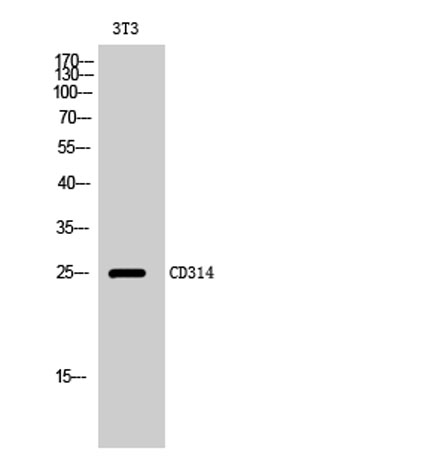
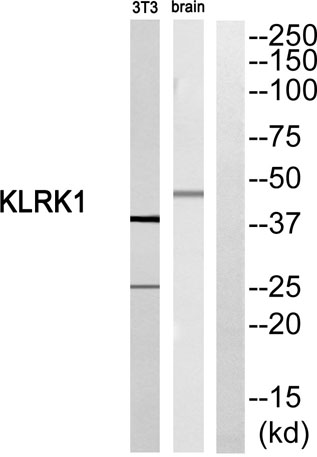
| Observed band (KD) | 25kD |
| Background | Natural killer (NK) cells are lymphocytes that can mediate lysis of certain tumor cells and virus-infected cells without previous activation. They can also regulate specific humoral and cell-mediated immunity. NK cells preferentially express several calcium-dependent (C-type) lectins, which have been implicated in the regulation of NK cell function. The NKG2 gene family is located within the NK complex, a region that contains several C-type lectin genes preferentially expressed in NK cells. This gene encodes a member of the NKG2 family. The encoded transmembrane protein is characterized by a type II membrane orientation (has an extracellular C terminus) and the presence of a C-type lectin domain. It binds to a diverse family of ligands that include MHC class I chain-related A and B proteins and UL-16 binding proteins, where ligand-receptor interactions can result in the activation of |
| Function | alternative products:A number of isoforms are produced,function:Receptor for MICA, MICB, ULBP1, ULBP2, ULBP3 (ULBP2>ULBP1>ULBP3) and ULBP4. Plays a role as a receptor for the recognition of MHC class I HLA-E molecules by NK cells and some cytotoxic T-cells. Involved in the immune surveillance exerted by T- and B-lymphocytes.,miscellaneous:Structurally distinct families of ligands for mouse and human NKG2D receptors have been characterized. They might be orthologs.,online information:NKG-2D,similarity:Contains 1 C-type lectin domain.,subunit:Homodimer. Interacts with DAP10. The interaction with DAP10 is required for NKG2D cell surface expression.,tissue specificity:Natural killer cells. Expressed on essentially all CD56+CD3- NK cells from freshly isolated PBMC. Also detected in gamma-delta cells and CD8+ alpha-beta T-cells. Expressed in interferon-producing killer dendritic cells (IKDCs). |
| Subcellular location | Cell membrane ; Single-pass type II membrane protein . Colocalized with HCST on the cell surface. |
| Expression | Expressed in natural killer (NK) cells, CD8(+) alpha-beta and gamma-delta T-cells. Expressed on essentially all CD56+CD3- NK cells from freshly isolated PBMC. Expressed in interferon-producing killer dendritic cells (IKDCs). |

Use collapsible tabs for more detailed information that will help customers make a purchasing decision.
Ex: Shipping and return policies, size guides, and other common questions.