 Français
 English

| ELK.No | ES5278 |
| Product name | TCP-1 ε rabbit pAb |
| Reactivity | Human;Mouse;Rat |
| Applications | WB;ELISA |
| Other name | CCT5; CCTE; KIAA0098; T-complex protein 1 subunit epsilon; TCP-1-epsilon; CCT-epsilon |
| Size | 50μL |
| Unit price ($) | 148 |
| Human gene ID | 22948 |
| Human Swiss-Prot | P48643 |
| Source | Rabbit |
| Isotype | IgG |
| Target | TCP-1 ε |
| Fields | |
| Gene name | CCT5 |
| Protein name | T-complex protein 1 subunit epsilon |
| Human gene link | View Human Gene |
| Human Swiss link | View Human Swiss-Prot |
| Mouse gene ID | 12465 |
| Mouse gene link | View Mouse Gene |
| Mouse Swiss-Prot | P80316 |
| Mouse Swiss link | View Mouse Swiss-Prot |
| Rat gene ID | 294864 |
| Rat gene link | View Rat Gene |
| Rat Swiss-Prot | Q68FQ0 |
| Rat Swiss link | View Rat Swiss-Prot |
| Immunogen | The antiserum was produced against synthesized peptide derived from human CCT5. AA range:241-290 |
| Specificity | TCP-1 ε Polyclonal Antibody detects endogenous levels of TCP-1 ε protein. |
| Formulation | Liquid in PBS containing 50% glycerol, 0.5% BSA and 0.02% sodium azide. |
| Clonality | Polyclonal |
| Dilution | Western Blot: 1/500 - 1/2000. ELISA: 1/10000. Not yet tested in other applications. |
| Purification | The antibody was affinity-purified from rabbit antiserum by affinity-chromatography using epitope-specific immunogen. |
| Concentration | 1 mg/ml |
| Storage stability | -20°C/1 year |
| Molecular Weight (Da) | |
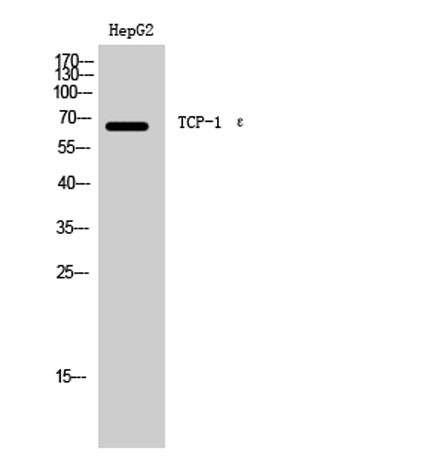
| Observed band (KD) | 67kD |
| Background | The protein encoded by this gene is a molecular chaperone that is a member of the chaperonin containing TCP1 complex (CCT), also known as the TCP1 ring complex (TRiC). This complex consists of two identical stacked rings, each containing eight different proteins. Unfolded polypeptides enter the central cavity of the complex and are folded in an ATP-dependent manner. The complex folds various proteins, including actin and tubulin. Mutations in this gene cause hereditary sensory and autonomic neuropathy with spastic paraplegia (HSNSP). Alternative splicing results in multiple transcript variants. Related pseudogenes have been identified on chromosomes 5 and 13. [provided by RefSeq, Apr 2015], |
| Function | disease:Defects in CCT5 are the cause of autosomal recessive sensory neuropathy with spastic paraplegia [MIM:256840]. The disease is characterized by spastic paraplegia and progressive distal sensory neuropathy leading to mutilating ulcerations of the upper and lower limbs.,function:Molecular chaperone; assist the folding of proteins upon ATP hydrolysis. Known to play a role, in vitro, in the folding of actin and tubulin.,similarity:Belongs to the TCP-1 chaperonin family.,subunit:Heterooligomeric complex of about 850 to 900 kDa that forms two stacked rings, 12 to 16 nm in diameter. Interacts with PACRG., |
| Subcellular location | Cytoplasm . Cytoplasm, cytoskeleton, microtubule organizing center, centrosome . |
| Expression | Bone marrow,Brain,Cajal-Retzius cell,Embryonic kidney,Fetal brain c |

Use collapsible tabs for more detailed information that will help customers make a purchasing decision.
Ex: Shipping and return policies, size guides, and other common questions.