 Français
 English

| ELK.No | ES5339 |
| Product name | hCAP-H rabbit pAb |
| Reactivity | Human;Rat;Mouse; |
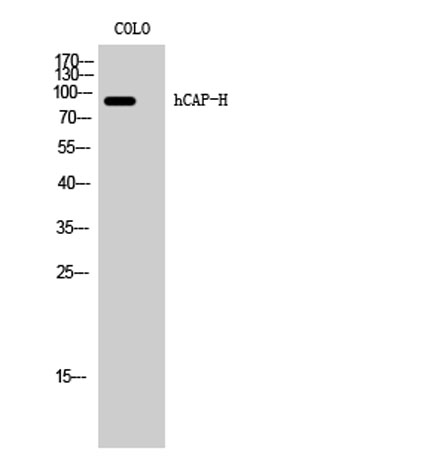
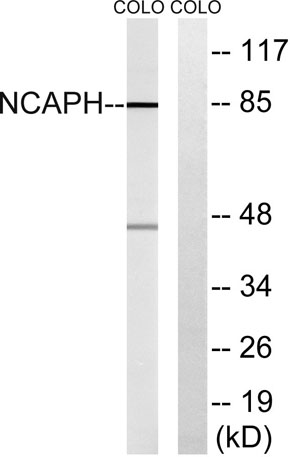
| Applications | WB;ELISA |
| Other name | NCAPH; BRRN; BRRN1; CAPH; KIAA0074; Condensin complex subunit 2; Barren homolog protein 1; Chromosome-associated protein H; hCAP-H; Non-SMC condensin I complex subunit H; XCAP-H homolog |
| Size | 50μL |
| Unit price ($) | 148 |
| Human gene ID | 23397 |
| Human Swiss-Prot | Q15003 |
| Source | Rabbit |
| Isotype | IgG |
| Target | hCAP-H |
| Fields | |
| Gene name | NCAPH |
| Protein name | Condensin complex subunit 2 |
| Human gene link | View Human Gene |
| Human Swiss link | View Human Swiss-Prot |
| Mouse gene ID | |
| Mouse gene link | |
| Mouse Swiss-Prot | Q8C156 |
| Mouse Swiss link | View Mouse Swiss-Prot |
| Rat gene ID | |
| Rat gene link | |
| Rat Swiss-Prot | |
| Rat Swiss link | |
| Immunogen | The antiserum was produced against synthesized peptide derived from human NCAPH. AA range:441-490 |
| Specificity | hCAP-H Polyclonal Antibody detects endogenous levels of hCAP-H protein. |
| Formulation | Liquid in PBS containing 50% glycerol, 0.5% BSA and 0.02% sodium azide. |
| Clonality | Polyclonal |
| Dilution | Western Blot: 1/500 - 1/2000. ELISA: 1/40000. Not yet tested in other applications. |
| Purification | The antibody was affinity-purified from rabbit antiserum by affinity-chromatography using epitope-specific immunogen. |
| Concentration | 1 mg/ml |
| Storage stability | -20°C/1 year |
| Molecular Weight (Da) | |
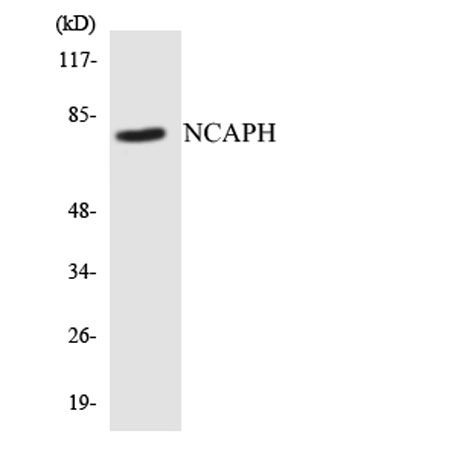
| Observed band (KD) | 83kD |
| Background | This gene encodes a member of the barr gene family and a regulatory subunit of the condensin complex. This complex is required for the conversion of interphase chromatin into condensed chromosomes. The protein encoded by this gene is associated with mitotic chromosomes, except during the early phase of chromosome condensation. During interphase, the protein has a distinct punctate nucleolar localization. Alternatively spliced transcript variants encoding different proteins have been described. [provided by RefSeq, Jul 2013], |
| Function | function:Regulatory subunit of the condensin complex, a complex required for conversion of interphase chromatin into mitotic-like condense chromosomes. The condensin complex probably introduces positive supercoils into relaxed DNA in the presence of type I topoisomerases and converts nicked DNA into positive knotted forms in the presence of type II topoisomerases.,PTM:Phosphorylated by CDC2. Its phosphorylation, as well as that of NCAPD2 and NCAPG subunits, activates the condensin complex and is required for chromosome condensation.,similarity:Belongs to the CND2 (condensin subunit 2) family.,subcellular location:In interphase cells, the majority of the condensin complex is found in the cytoplasm, while a minority of the complex is associated with chromatin. A subpopulation of the complex however remains associated with chromosome foci in interphase cells. During mitosis, most of the con |
| Subcellular location | Nucleus . Cytoplasm . Chromosome . In interphase cells, the majority of the condensin complex is found in the cytoplasm, while a minority of the complex is associated with chromatin. A subpopulation of the complex however remains associated with chromosome foci in interphase cells. During mitosis, most of the condensin complex is associated with the chromatin. At the onset of prophase, the regulatory subunits of the complex are phosphorylated by CDK1, leading to condensin's association with chromosome arms and to chromosome condensation. Dissociation from chromosomes is observed in late telophase. |
| Expression | Widely expressed at low level. Expressed in proliferating cells. |

Use collapsible tabs for more detailed information that will help customers make a purchasing decision.
Ex: Shipping and return policies, size guides, and other common questions.